Whilst surfing through my Blogger reading list earlier a thought came to me* that there were two or three books which have had a massive impact on my wargaming life. More than any others. All three were published, and acquired by me, in the 1970s, so they've been around me during the last 5 decades. Whilst others have come since and have had a big impact on my hobby time, most of these have sprung from one or more of these wellsprings. I mentioned a couple of these last year in a trawl through my own history as a wargamer.
* Two things probably brought this about. One, I made a throw-away remark to david in suffolk about the 1970s. Two, I had been thinking about Jonathan's analyses of the Great Wargames Survey 2020 which discussed the associations between age and wargaming interests.
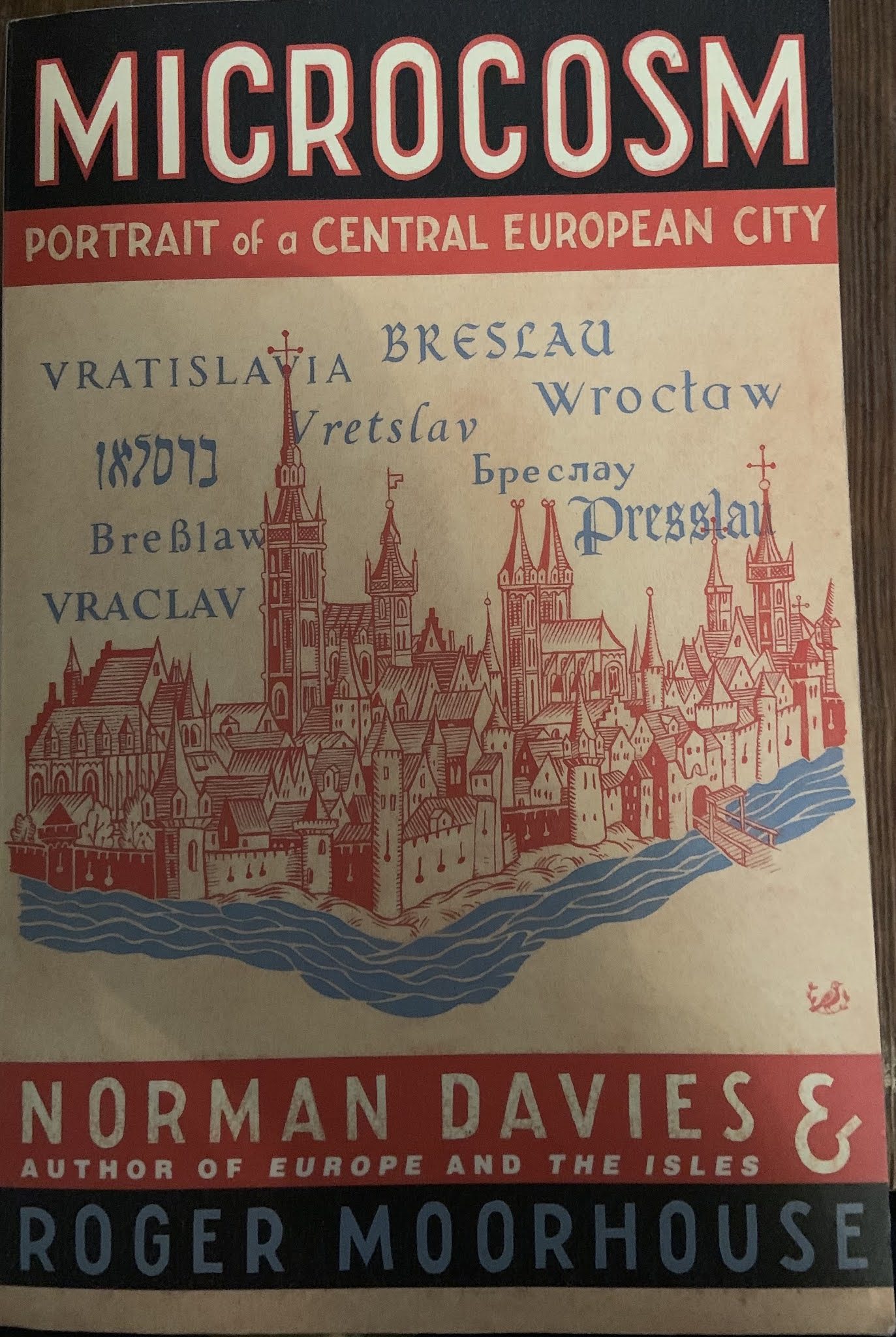
The three books in question are:
- The War Game, ed. Peter Young, London 1972
- Wargame Rules 1685-1845, The Wargames Research Group, 1977
- The Army of Frederick the Great, Christopher Duffy, Newton Abbot 1974
The Young and Duffy books were both presents from my sister and brother-in-law, known within the family for the great books they choose as presents. I think I was 13 when I got number 1, then I bought the WRG rules in early 1978. This in turn got me into the SYW and I was subsequently bought number 3.
 |
| The dust jacket alone got a young lad salivating. Incidentally this is the second copy of the book. The original I had got damaged when it was stored in a damp garage for several years. |
I want to take each book in turn and give a sense of how and why it has influenced my wargaming path, naturally starting with The War Game. Wargamers of a slightly older vintage often cite Featherstone, Grant, and Scruby as their formative wargaming influencers. Others in this truly 'Old School' era were Young & Lawford, and Wesencraft. Whilst many of the chapters were written by these luminaries, mentally I classify the War Game as 'NQOS' (Not Quite Old School). For a start it's in colour! And the terrain is diorama quality. Also, the chapters do not describe wargames or wargaming but historical battles. For Tail-end Baby Boomers like me (I snuck in under the wire) the 70s were probably our formative years. The 1980s were by contrast the least favourite of all my 6 decades. In fact I pity people for whom the 80s were their formative years (sorry Gen-Xers).
So, this book, edited by the pioneering Peter Young, was produced near the start of the best decade and I got given it somewhere in the middle. I'd not seen the real Old School stuff at that stage. I'd not seen any wargaming books or rules at all. So getting the War Game was truly one of those mind blowing moments. First of all, the photography and the models are stunning. Peter Gilder was a major influence on the look with his terrain and some of the models. The other chapter authors, plus other wargamers, also contributed models. And all were superbly photographed by Philip O Stearns, who looks to have had an interesting life. He was in the OSS during the War, and as well as photographing wargames and toy soldiers, he also photographed er-hem, models in 1/1 scale. There's more about him here including some of his contributions to something called Mayfair. No me neither 😉.
I'm not sure whether I saw the book first, or a display by the Grimsby Wargaming Club in the Army Recruitment Office Window, but both were around the same period. This was a Proper grown-up Hobby. (I think the GWC was called the Horse & Musket Society in those days).
 |
Clearly a Proper Hobby. Apparently not all wargamers have such paraphernalia lying around the table.
|
So clearly presentationally the book was superb. Then there was an impressive list of authors, many with military experience themselves. The pen portraits of the authors gave it all added respectability in my eyes. Each chapter was well structured giving historical background to each of the battles, descriptions of the leaders, a summary of the forces engaged, an account of the battle and some very useful maps.I'm going to throw in some gratuitous photos here, because the book is such a feast for the eyes. And it conveys something of the sheer mass of material that was in front of my young eyes 45 years ago. Here's something from every chapter. This showed me what a rich field of interest was opening up to me. I hope it conveys some of the excitement I felt first opening up the book and when I devoured every page. And if you haven't read this book, I hope it inspires you to get hold of a copy.
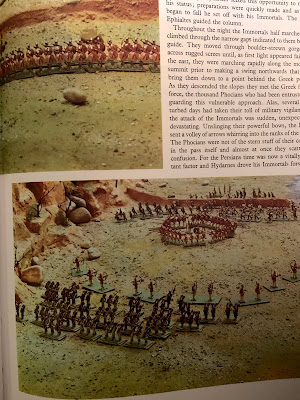 |
| From the chapter on Thermopylae. So this was the battle that inspired The 300 Spartans film! Not gamed it though. Yet. |
 |
| Agincourt initial dispositions |
 |
| Agincourt again. A lot of the English archers here are Airfix Sheriff of Nottingham and Robin Hood's Men conversions, as are some of the French dismounted men-at-arms. I ended up buying lots of these but for conversion to Ancients. |
 |
| Dispositions for Edgehill. Now I hadn't heard of this battle at the time. It took me until 3 years ago to finally get this battle on the table. Over 40 years but I got there eventually! |
 |
| Lovely opening shot from the Blenheim chapter. I had Airfix Napoleonic at the time but this set the slow match burning for the 18th century. Or was that down to songs like 'Soldier Soldier' and 'O'er the Hills' learnt at primary school? |
 |
| Now this was a complete eye-opener for me! I'd not heard of Frederick the Great, or von Browne, let alone Lobositz. I don't think I even knew that Austria and Prussia contended the SYW! That was all Britain and France in North America, India, plus a bit in Germany right? This shows the style of the pen portraits of the commanders as well as the maps. The figures are clearly Grant's Spencer Smiths - painted in his imagi-nations' armies' colours. Finally re-fought this one 35 years later. |
 |
| From the Saratoga chapter. Another battle I'd not heard of. The Battle of Freeman's Farm. 2 battles in the one chapter here, the other being Bemis Heights. Re-fought with a lad from school using book 2 rules and Airfix AWI figures. |
 |
| In the Grand Manner! Austerlitz - another new one on me (I don't recall it from the Ladybird book on Napoleon which was my one source on the Nap Wars outside the British area of involvement). Just look at that lot! |
 |
| Another mouth-watering shot from Austerlitz. It took until about 2011 to get involved in a re-fight of this when I umpired a game using Marechal de l'Empire and Old School Tony's Baccus collection. |
 |
| Pretty much all I would need to know to get Waterloo set-up. It took me a few years before I war-gamed it, and that was a refight as a SYW battle because that's what our school group did. |
 |
| Last, but not least. El Alamein. Shot of a German column. Whilst I was aware of the Desert War (how could I not be with Airfix DAK and 8th Army sets amongst the first figures I had) I wasn't familiar with El Alamein. I must have had a very cursory acquaintance with the campaign in the Western Desert! And still not made it to the table. |
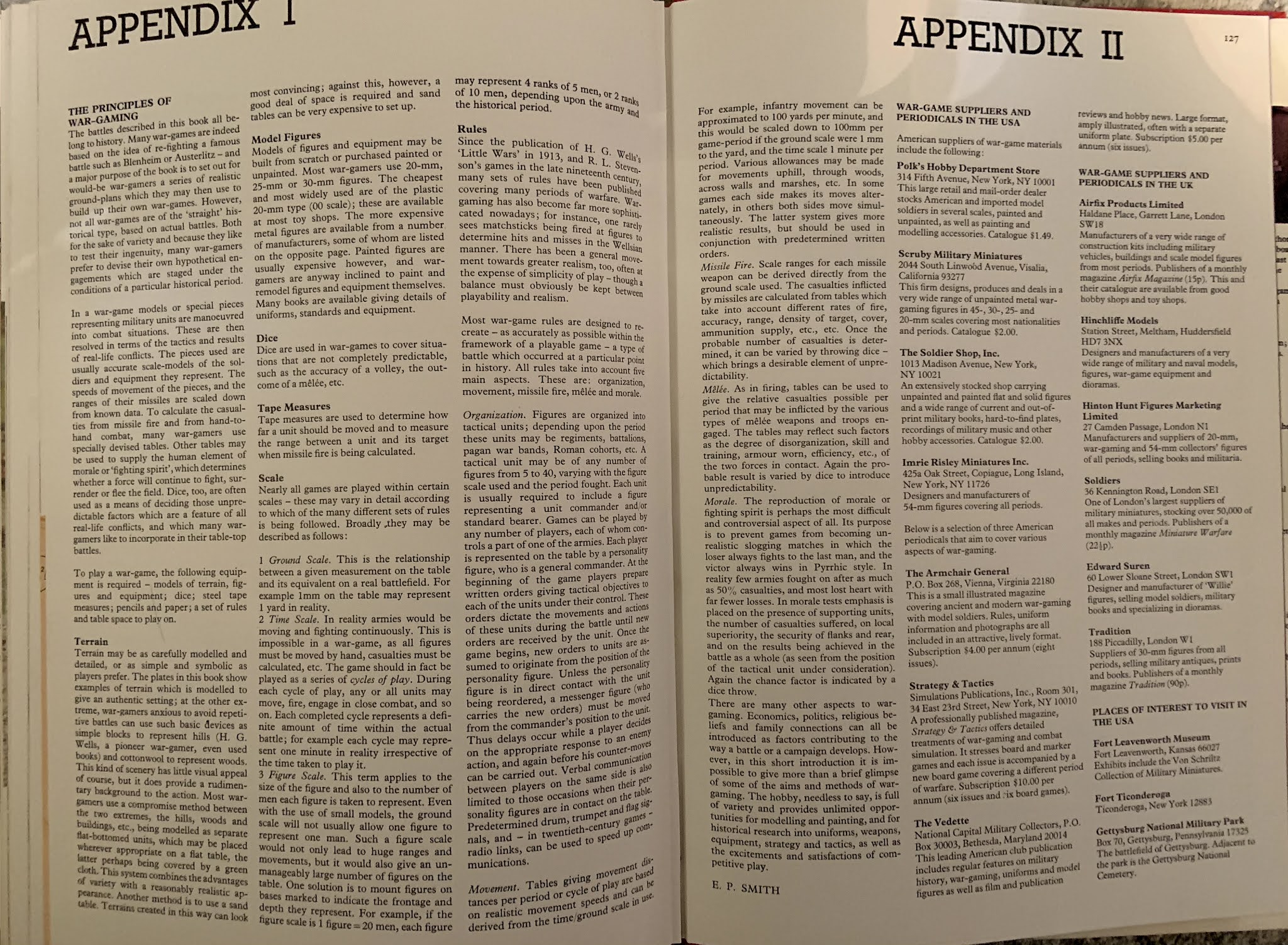
Lots of eye-candy then. And lots of historical background. Much new information. And all very well put together and excellent told. But what helped nudge me in the right direction was the appendix. This gave me the bare bones to get started with war-games rules. Most of this was a revelation. I had not seen a set of war-games rules at that point. I still hadn't after reading this book. But I could cobble together my own on the basis of what the appendix described. Before this I was struggling with 1:1 troop ratios - shooting ranges were enormous on the table!

In conclusion then, the War Game really set me on the path to 'proper' wargaming. It gave me inspiration, validation, information, and (importantly) a framework. More than that it, educated me in areas of military history that I knew nothing about and it nudged me more towards the 18th century from Napoleonics where my area of interest had been the Peninsular War. The Seven Years War in Central Europe became my abiding passion, but not straight away, though the slow match had been lit.
I almost forgot that it also encouraged me to get into Ancients. One of the lads at the school wargames club was also interested in Ancients. Through him I heard about the Wargames Research Group, and thence on to book 2 on the list.....
What would you say are the books most influenced your wargaming career?