Showing posts with label WRG 1685-1845. Show all posts

Saturday, 7 June 2025

Only mad dogs…and inspirations

Jonathan Freitag’s recent post got me thinking about sources of inspiration for me as a wargamer. One of my top sources is printed matter. I actually commented to Jon’s post that I didn’t really count magazines these days amongst my sources. Gone are the days of MW and WI in what for me was their heyday in the 80s and early 90s. But then I looked at this photo I took of a history magazine in a supermarket in an obscure Spanish town.


The article is about a book on Spanish soldiers in the British Army in WWII. The author gave a talk at the National Army Museum a few months ago (which I attended with David-in-Suffolk). The picture of the volunteers on the truck is similar to ones that got me interested in the SCW 45 years ago. But that is not a wargaming itch that I have scratched yet.

The same magazine also had an article on the Battle of the River Ter (or Torroella) in 1694. I passed on buying the magazine but I’m thinking that was a mistake, even though my Spanish is fledgling to say the least. 

As with the previous article, it’s the imagery that captures my imagination. At least at first. What about you? Is it words, pictures (still or moving) or sounds that spark your urge to wargame a conflict?

As for the mad dogs reference: the Margravina (who is most definitely not an Englishman) persuaded me to take a walk in to said town when most sensible locals were indoors behind closed shutters. The supermarket provided a welcome respite from the heat).


!Adiós!

Monday, 21 December 2020

Influential Book 2/Shameless Nostalgiafest

Things have been quiet on the wargaming front. Since the last post I've not read any wargaming related books, but blogs have been keeping me going. Reading time has mostly found me with my nose stuck in the Return of the King. I seem to have acquired a lot of books this year and I was poised ready to order new titles a couple of times recently but something held me back. It's so easy to see something I want, click and order it. It's not that I'm worried about the expense - as pastimes go it's not expensive as long as I don't go mad, and I've saved a bit with Lockdown. What I'm worried about, I suppose, is that it's too easy and that diminishing returns will set in. I wonder am I missing something. Is it just another form of consumerism, or displacement activity. Yes and yes, probably, to the last two, but mostly it's the diminishing returns thing. 'Where will it stop?', I ask myself if I simply order a book that I want, read it, enjoy it, then order another.*

* Aside. Where does this thinking come from? Is there some underlying facet of my character that makes me feel guilty about satisfying my own wants? It's not like I'm taking bread from my children's mouths. I didn't grow up in a particularly religious household. The family weren't churchy. Not irreligious. Just not churchy. We weren't lapsed Catholics, or from some brand of ascetic Protestantism. I had a few years in the Boys Brigade, admittedly an avowedly Christian organisation, but it never made me into a self-denying martyr. Growing up we were never flush, so maybe that's got something to do with it. Up until my 30s I didn't have a lot of spare cash, but when I did I loosened the constraints and enjoyed myself for a few years. That didn't cause any feelings of guilt. I just found that it didn't make me happy. Later in my 40s I returned to living on a budget and I was (and have been) happier. But I don't think that satisfying my wants will necessarily make me unhappy.

So I picked up ROTK again as I had read the Fellowship of the Ring a couple of months ago when hit by a similar urge to delay gratification. And that was a good decision in that I've been enjoying it and seen a couple of things I'd not noticed before, including a passage where it struck me that Tolkien might be talking about his own thoughts on fighting through the voice of Faramir. That might not be news to some people. I'm a fan but not one steeped in Tolkien lore.


Anyway, this is all a digression within a digression again. I meant to post something sooner about book 2 on my list. For what it's worth. Before I discovered that there was school wargames club, I played solo with my own rules derived from the notes in the Appendix to the War Game. To be honest, these were a bit laborious, but in my mind this was serious stuff and so any dullness should be accepted. Maybe greater minds could come up with ways of combining all this "realism" with fast playability - perhaps computers could do all the work if only they could be made available to mere mortals. It was the mid-70s so way before even PCs. Finding the school club was a big relief. Here were a bunch of like-minded individuals and the 'house rules' followed the same principles as those suggested in the War Game. In fact the house rules were Arthur Taylor's Rules for Wargaming. Great stuff!

** It wasn't something massively publicised, but there wasn't a massive stigma attached to it. 

Now selling for silly prices on-line

In practice however, the rules, if followed fully, still took forever. There was lots of admin. Casualty rosters (each figure = 20 men). Written orders and simultaneous movement, and therefore scope for much lawyerly activity. Writing the orders with all the daft contingencies we made took longer than the turns. I'm not saying that we didn't have enjoyable games, but it was difficult to reach a conclusion in a couple of hours after school before we were kicked out. I did miss out on an epic D-Day game one weekend, and the boys who took part really enjoyed that, so maybe it was me.

Soon after I bought the newly published WRG rules for the horse and musket period (cannot remember where from though?). It took a bit of getting my head round the new turn phase sequence, but there it was. Simplicity! No written orders. No casualty rosters. Hurrah! (with a few 'huzzahs!' thrown in for good measure). They also came with a points system so we could each choose an army and have a nominally balanced game. 

What it's all about! (Not my copy, I had the '77 edition)

The fledgling Seven Years War interest, sparked by the Lobositz chapter of the War Game, was positively encouraged by the WRG rules. The rules had army lists in an appendix. Army lists only for Marlburians (WSS), SYW and the early Anglo-French conflicts in India. No Napoleonics. I'd been wavering between SYW and Marlburians, but as Martin already had SYW Austrians, SYW Prussians it was. 

I had a trial game on my own then persuaded Martin (the lad who had the Minifigs SYW Austrian collection) to have a game at the school club. This attracted a bit of attention from some of the other lads because one, we were using metal figures (ooh shiny - and they were just that because they were mostly unpainted), and two, it was not the green book. The game was a success in more ways than one. I had the advantage of knowing the rules better, so I won; it turned out to be a very playable game (helped no doubt by the fact that we had no more than a battalion, plus a squadron of cavalry each); and it was of wider interest to the group. 

The rules were a liberation from book-keeping and we could concentrate on being little Napoleons, not Berthier's. Other lads then joined in subsequent games and the arms race commenced! SYW began to butt in on the WWII and ACW table time. My mostly unpainted Airfix Napoleonics and Ancients conversions were consigned to the cupboard. Pocket-money and cash from jobs were funnelled into the fledgling armies. Month-by-month, as state resources allowed, new units were ordered from Minifigs via Toynes model shop in Grimsby. Units under these rules were economical too, when you consider that with the 1:50 ratio you only needed a dozen or so models instead of 30-40 figures. Points values of our respective armies increased, from 150 to 200, 300 and it didn't seem long before we were battling it out with 1,000 point armies. Megalomania had set in. 1,500 points became the norm.

The SYW group grew to five. So we ended up respectively with Austrian, Prussian, Russian, French and British. We started on historical re-fights. Sometimes 2 aside, sometimes 1-v-1. Action relocated from school to my mum's dining room or Tony's bedroom. 6 by 4 feet became 8 by 4 feet and eventually 8 by 6. Anything horse and musket period was adopted as a SYW battle. From Aughrim to Waterloo. All scaled down of course, so 1 battalion on the table represented 3 or 4. The length of the games stretched out from a couple of hours to whole weekend affairs. All day Saturday, right through the evening. Then again the next day until tea time ('dinner time' for southerners). Tony's parents were very tolerant!

Often games would be paused while we got side-tracked in various discussions. Military history. Or politics. Sometimes in intervals, whilst downstairs we'd chat to Tony's parents, or one one memorable occasions, one of the guys who worked for his dad. He had an interesting anecdote of interest to teenage boys. Let's leave it there.

Over time, some of the others dropped out. Martin discovered Lambrettas and sold his collection to Tony. Anthony, discovered I don't know what, and sold out to Tony. And I think the other Chris' collection was also procured by Tony. The height of the megalomania was some time in the early 80s. By then Tony had moved out from his parents house and was living in a flat above a pub on Cleethorpes promenade (what could possibly go wrong!). A couple of his other mates were interested in wargaming. Every SYW-looking model we possessed was put on the table. A simple scenario was devised. My outnumbered army (around 20-odd battalions with slightly more than proportionate cavalry, plus guns) defended a river against Tony's 40 battalions and God knows how many cavalry. Columns from one end of the table to the other. There wasn't space for deploying into lines. The 4 of us pulled an all-nighter, claiming to ourselves that our tiredness would reflect real generals' fatigue. To be honest, we did run out of steam a bit by the end. Not helped by the refuelling method. Well, our 18th century heroes couldn't drink the water could they. I think my side lost.

That was probably the last time I had a SYW game using those rules until I ran a solo version of Soor this time last year. A few years after that all-nighter I sold my stuff off to fund my Heroics and Ros armies.

So, the WRG 1685-1845 rules have a special place in my wargaming life. I had a LOT of fun with them. They helped steer me in the direction of the SYW (and all the subsequent satisfaction I've gained from that interest). The bibliography included a couple of books by a chap called Duffy. WRG 1685-1845 were almost ever-present in my longest spell as a social wargamer. And those games helped cement a friendship. You can't say better than that really for a ruleset.


Saturday, 12 December 2020

Influential books

Whilst surfing through my Blogger reading list earlier a thought came to me* that there were two or three books which have had a massive impact on my wargaming life. More than any others. All three were published, and acquired by me, in the 1970s, so they've been around me during the last 5 decades. Whilst others have come since and have had a big impact on my hobby time, most of these have sprung from one or more of these wellsprings. I mentioned a couple of these last year in a trawl through my own history as a wargamer.

* Two things probably brought this about. One, I made a throw-away remark to david in suffolk  about the 1970s. Two, I had been thinking about Jonathan's analyses of the Great Wargames Survey 2020 which discussed the associations between age and wargaming interests.

The three books in question are:

  1. The War Game, ed. Peter Young, London 1972
  2. Wargame Rules 1685-1845, The Wargames Research Group, 1977
  3. The Army of Frederick the Great, Christopher Duffy, Newton Abbot 1974

The Young and Duffy books were both presents from my sister and brother-in-law, known within the family for the great books they choose as presents. I think I was 13 when I got number 1, then I bought the WRG rules in early 1978. This in turn got me into the SYW and I was subsequently bought number 3.

The dust jacket alone got a young lad salivating. Incidentally this is the second copy of the book. The original I had got damaged when it was stored in a damp garage for several years.

I want to take each book in turn and give a sense of how and why it has influenced my wargaming path, naturally starting with The War Game. Wargamers of a slightly older vintage often cite Featherstone, Grant,  and Scruby as their formative wargaming influencers. Others in this truly 'Old School' era were Young & Lawford, and Wesencraft. Whilst many of the chapters were written by these luminaries, mentally I classify the War Game as 'NQOS' (Not Quite Old School). For a start it's in colour! And the terrain is diorama quality. Also, the chapters do not describe wargames or wargaming but historical battles. For Tail-end Baby Boomers like me (I snuck in under the wire) the 70s were probably our formative years. The 1980s were by contrast the least favourite of all my 6 decades. In fact I pity people for whom the 80s were their formative years (sorry Gen-Xers).

So, this book, edited by the pioneering Peter Young, was produced near the start of the best decade and I got given it somewhere in the middle. I'd not seen the real Old School stuff at that stage. I'd not seen any wargaming books or rules at all. So getting the War Game was truly one of those mind blowing moments. First of all, the photography and the models are stunning. Peter Gilder was a major influence on the look with his terrain and some of the models. The other chapter authors, plus other wargamers, also contributed models. And all were superbly photographed by Philip O Stearns, who looks to have had an interesting life. He was in the OSS during the War, and as well as photographing wargames and toy soldiers, he also photographed  er-hem, models in 1/1 scale. There's more about him here including some of his contributions to something called Mayfair. No me neither 😉. 

I'm not sure whether I saw the book first, or a display by the Grimsby Wargaming Club in the Army Recruitment Office Window, but both were around the same period. This was a Proper grown-up Hobby. (I think the GWC was called the Horse & Musket Society in those days).  

Clearly a Proper Hobby. Apparently not all wargamers have such paraphernalia lying around the table.

So clearly presentationally the book was superb. Then there was an impressive list of authors, many with military experience themselves. The pen portraits of the authors gave it all added respectability in my eyes. Each chapter was well structured giving historical background to each of the battles, descriptions of the leaders, a summary of the forces engaged, an account of the battle and some very useful maps.

I'm going to throw in some gratuitous photos here, because the book is such a feast for the eyes. And it conveys something of the sheer mass of material that was in front of my young eyes 45 years ago. Here's something from every chapter. This showed me what a rich field of interest was opening up to me. I hope it conveys some of the excitement I felt first opening up the book and when I devoured every page. And if you haven't read this book, I hope it inspires you to get hold of a copy. 

From the chapter on Thermopylae. So this was the battle that inspired The 300 Spartans film! Not gamed it though. Yet.

Agincourt initial dispositions

Agincourt again. A lot of the English archers here are Airfix Sheriff of Nottingham and Robin Hood's Men conversions, as are some of the French dismounted men-at-arms. I ended up buying lots of these but for conversion to Ancients.

Dispositions for Edgehill. Now I hadn't heard of this battle at the time. It took me until 3 years ago to finally get this battle on the table. Over 40 years but I got there eventually!

Lovely opening shot from the Blenheim chapter. I had Airfix Napoleonic at the time but this set the slow match burning for the 18th century. Or was that down to songs like 'Soldier Soldier' and 'O'er the Hills' learnt at primary school?

Now this was a complete eye-opener for me! I'd not heard of Frederick the Great, or von Browne, let alone  Lobositz. I don't think I even knew that Austria and Prussia contended the SYW! That was all Britain and France in North America, India, plus a bit in Germany right? This shows the style of the pen portraits of the commanders as well as the maps. The figures are clearly Grant's Spencer Smiths - painted in his imagi-nations' armies' colours. Finally re-fought this one 35 years later.


From the Saratoga chapter. Another battle I'd not heard of. The Battle of Freeman's Farm. 2 battles in the one chapter here, the other being Bemis Heights. Re-fought with a lad from school using book 2 rules and Airfix AWI figures.

In the Grand Manner! Austerlitz - another new one on me (I don't recall it from the Ladybird book on Napoleon which was my one source on the Nap Wars outside the British area of involvement). Just look at that lot!

Another mouth-watering shot from Austerlitz. It took until about 2011 to get involved in a re-fight of this when I umpired a game using Marechal de l'Empire and Old School Tony's Baccus collection.

Pretty much all I would need to know to get Waterloo set-up. It took me a few years before I war-gamed it, and that was a refight as a SYW battle because that's what our school group did.

Gettysburg. Day One. Another new one on me. Again it took me a long time to get to this. And again with Old School Tony, using Altar of Freedom. A great battle to attempt. Lots of options.
Last, but not least. El Alamein. Shot of a German column. Whilst I was aware of the Desert War (how could I not be with Airfix DAK and 8th Army sets amongst the first figures I had) I wasn't familiar with El Alamein. I must have had a very cursory acquaintance with the campaign in the Western Desert! And still not made it to the table.

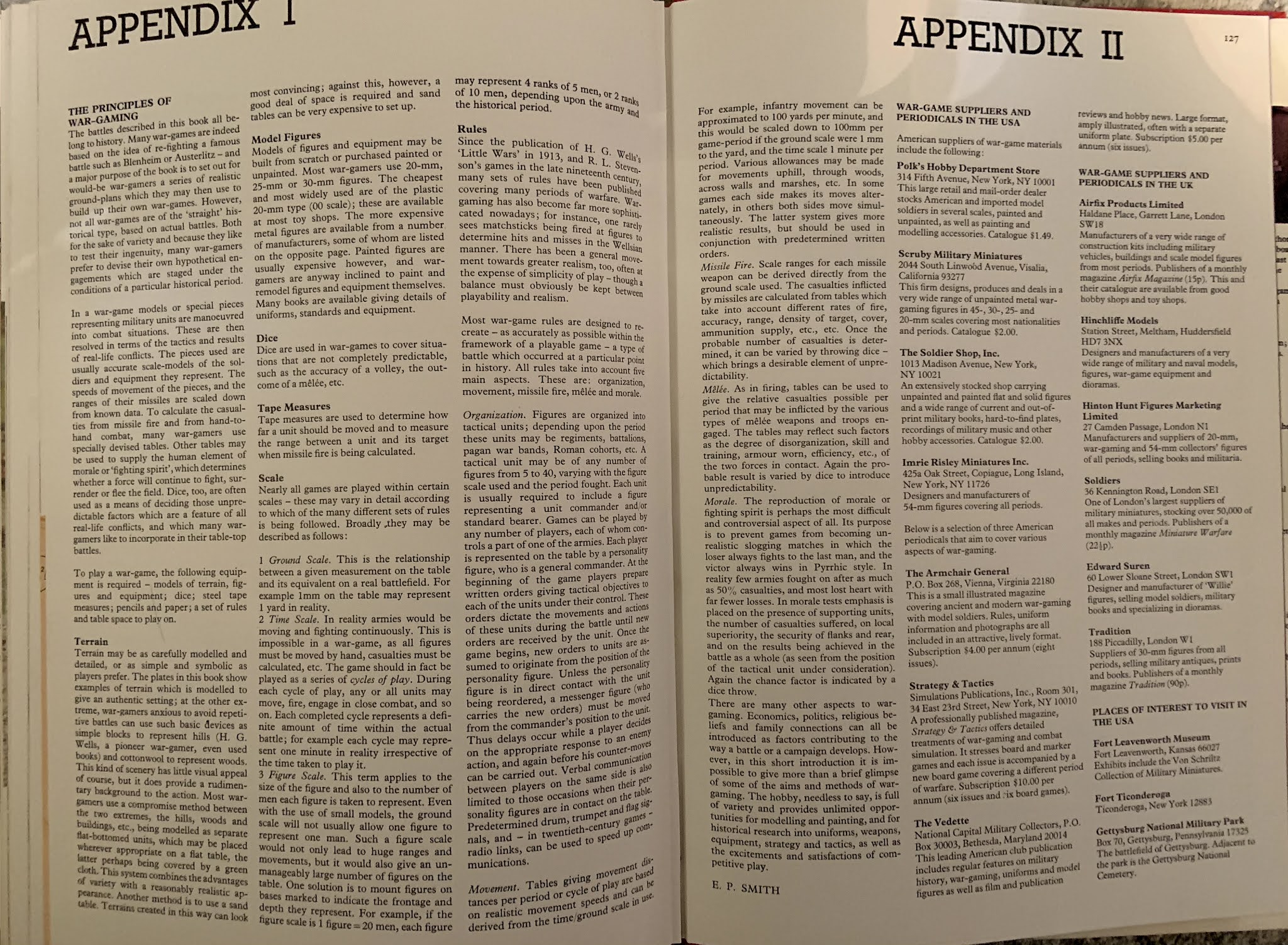
Lots of eye-candy then. And lots of historical background. Much new information. And all very well put together and excellent told. But what helped nudge me in the right direction was the appendix. This gave me the bare bones to get started with war-games rules. Most of this was a revelation. I had not seen a set of war-games rules at that point. I still hadn't after reading this book. But I could cobble together my own on the basis of what the appendix described. Before this I was struggling with 1:1 troop ratios - shooting ranges were enormous on the table!


In conclusion then, the War Game really set me on the path to 'proper' wargaming. It gave me inspiration, validation, information, and (importantly) a framework. More than that it, educated me in areas of military history that I knew nothing about and it nudged me more towards the 18th century from Napoleonics where my area of interest had been the Peninsular War. The Seven Years War in Central Europe became my abiding passion, but not straight away, though the slow match had been lit.

I almost forgot that it also encouraged me to get into Ancients. One of the lads at the school wargames club was also interested in Ancients. Through him I heard about the Wargames Research Group, and thence on to book 2 on the list.....

What would you say are the books most influenced your wargaming career?


Thursday, 26 December 2019

Soor Re-fought

News has been received from Bohemia of a great victory by the King! His Majesty has astounded the world again by a stunning victory over the Queen of Hungary's army led by her husband's brother, Prinz Karl von Lotharingen. Divine Providence has repeatedly shown that the King was right to press his lawful claim on the Silesian provinces. Yet again His Majesty was forced against his dearest wishes to take the field against his gathering foes and overturn the machinations of Vienna and Dresden. Early this Summer he crushed their wicked invasion of the Kingdom at Hohenfriedberg in the Royal Province of Lower Silesia. Then to make sure the Queen of Hungary learnt the lesson and to prevent further incursions, he was forced against his peace-loving nature, to march across the border hills. By right of arms he is now master of a large portion of Bohemia. It only remains to complete the instruction of the King of Poland for the treachery in allowing his Saxon subjects to abandon the old alliance and take sides with the Queen. If portions of the Electorate of Saxony need to be detached in compensation, then so be it. 

The King has let it be known that he is weary of bearing the burden of the struggle, and wishes that the King of France returns his attention from his rivalry with the English to restoring the peace of the Empire against its would-be oppressors.

Such are the words of an imaginery Berlin 'spin doctor' (probably copied almost verbatim from the King's own instructions).

I played the game on Christmas Eve. Delayed from the Monday as I spent half the day exhausted in bed and the other half out walking. I finished setting up the table around 12 noon and completed the game by 3PM.

Scale
I took the orders of battle from the previous post on Soor and divided everything by the usual WRG troop scale, then by 3 to fit the space (and figures) available. Instead of being about 3 miles long the battlefield was about a mile (6 foot 6).

Each WRG element was represented by a base of my SYW 6mm troops on bases 60mm wide. Conveniently this is the recommended base width for an element (4 infantry/3 cavalry) in WRG. Artillery elements (1 gun figure representing 2 guns) in WRG are 40mm wide but my bases are only 30mm wide. As this represents 30 paces I thought this was a reasonable frontage for two guns anyway.

Infantry were combined in units (battalions) of 3 or 4 elements (bases) so there were 72-96 figures per battalion so 1 figure represented about 7 or 8 men.  Cavalry units were mostly 4 elements (bases) to the unit with some 2, 3 and 5 elements strong and the Austrian elite units combined were a single base unit. At about 10 figures per base each figure represented approximately 12 men.

In total there were 122 cavalry and infantry elements plus 17 artillery elements. As I didn't have enough bases of cuirassiers for both sides I had to use some Russians as stand ins. Similarly for the Austrians, or more correctly the Austro-Saxons, I had to use a number of Russian infantry bases and the Saxons were represented by Bavarians.

Orders of Battle

Soor Refight Orders of Battle

PRUSSIAN

AUSTRIAN
Infantry
Elements
Units

Elements
Units
Elite
11
3 Battalions

4
1 battalion
Veteran
18
5 Battalions


Trained


49
13 battalions
Cavalry


Elite cuirassiers
3
1 regiment

1
1 combined  unit
Veteran cuirassiers
12
4 regiments


Trained cuirassiers


13
4 regiments
Trained dragoons
4
2 regiments

7
2 regiments
Irregular soldier cavalry (hussars)


2
1 units - off attacking Prussian camp
Artillery


Heavy guns
2
1 battery

7
3 batteries
Light guns
3
battalion pieces

5
battalion pieces


Map, Scenario & Objectives

The game was played from the point when the Prussians were formed up and were launching their attack. I took the positions from the map given in Duffy's Frederick the Great: a Military Life ('the Duffy map').  I measured out a scaled version of my table size (for this case 6.5 x 3 feet) onto a copy of the Duffy map. Then appended what each of the different formations consisted of for ease of setting up the table.

I started the game with some of the Austrians off table on the right wing. Entry was diced for after one or two turns (a 4,5 or 6 being required) provided that the point of entry was available to them. Any friendly or enemy troops in the way would prevent entry whilst the blockage lasted.

Furthermore, the right wing Austrian formations could not initiate any moves until getting a 4, 5 or 6 or until directly attacked. This meant that even when off table units were able to dice for entry they could not come on if the on table troops hadn't moved forward. This and the use of off-table troops was an attempt to model the rather supine nature of the Austrians tactics, as well as levelling up the odds. Without it the Austrians would have been able to roll-up the Prussian left quite quickly.

The Prussians Primary Objective was to seize and hold the Graner Koppe. The Secondary Objective was to seize and hold Burkersdorf. The Austrians' aim was to prevent this.

The Game

So without further ado, here is the re-fight told in pictures with captions.
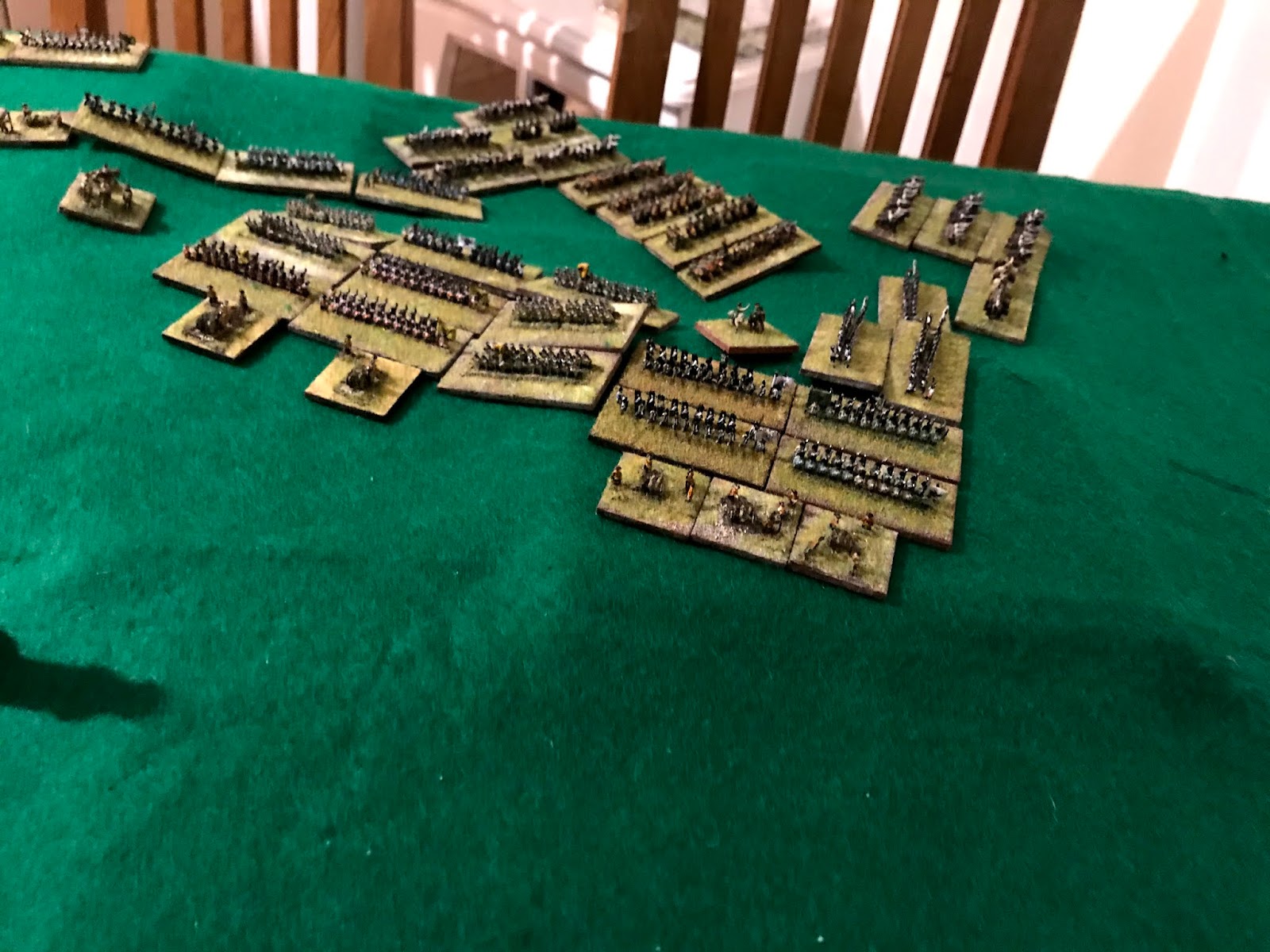
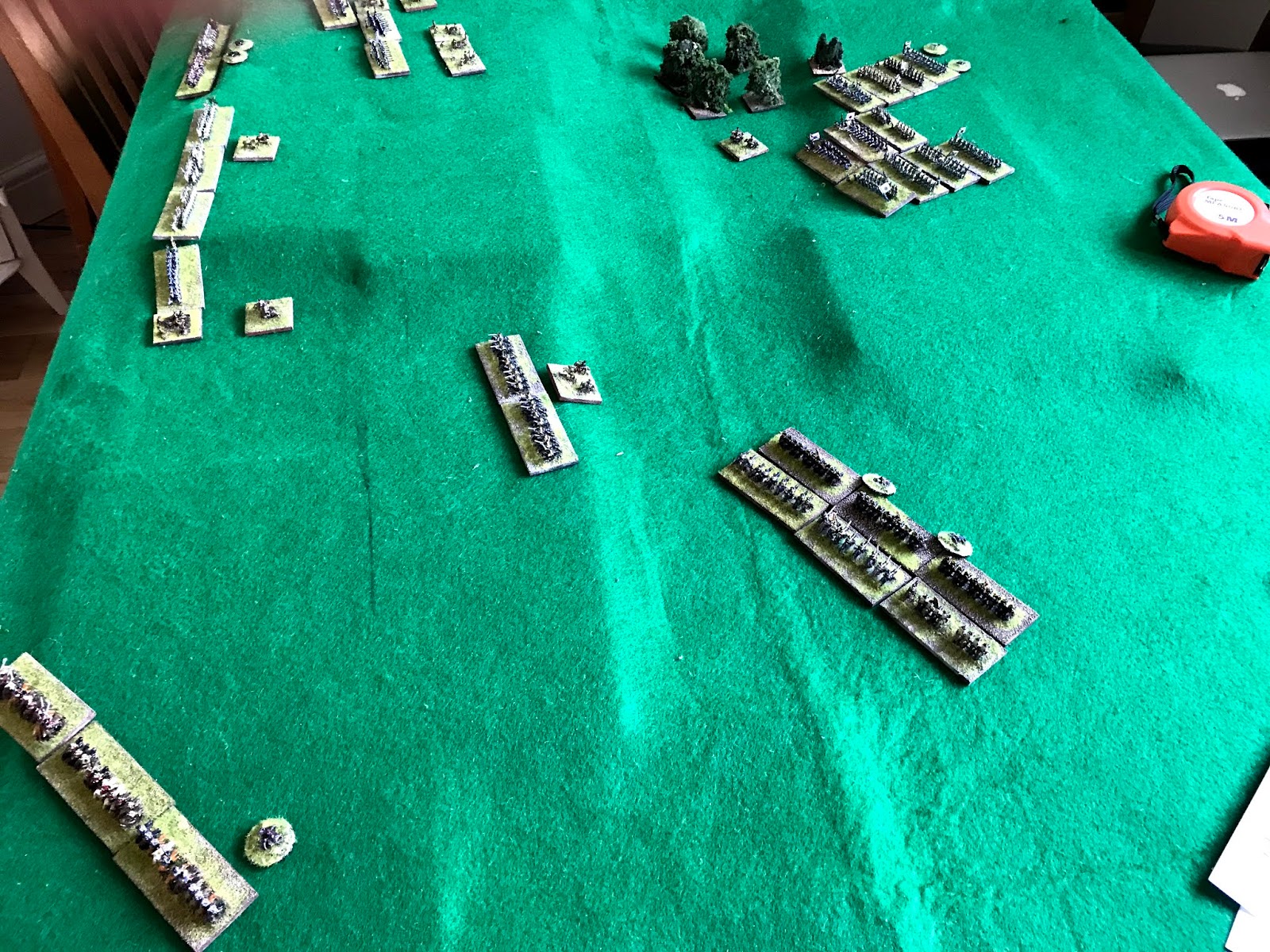
View of the whole array looking in a northerly direction. Austrians to the west, Prussians to the east. The village of Burkersdorf in the head of the valley.  The large Austrian concentration at the top is on the Graner Koppe.

Closer view of the Prussians. The cavalry wing at the far end set up within charge range of the Austrian horse on the hill - in the historical battle, the Austrians received the charge at the halt so this was reasonable.

Close up of the Graner Koppe. A tough nut to crack? Elite companies of infantry (grenadiers) behind the 3 gun model battery. The elite infantry here were over-represented but I allowed for the elite Saxon units historically elsewhere.

The southern end of the field. At this point the Prussians have the advantage with on-table cavalry. Off-table, behind the two long rows of Austrians lie further horse and foot.

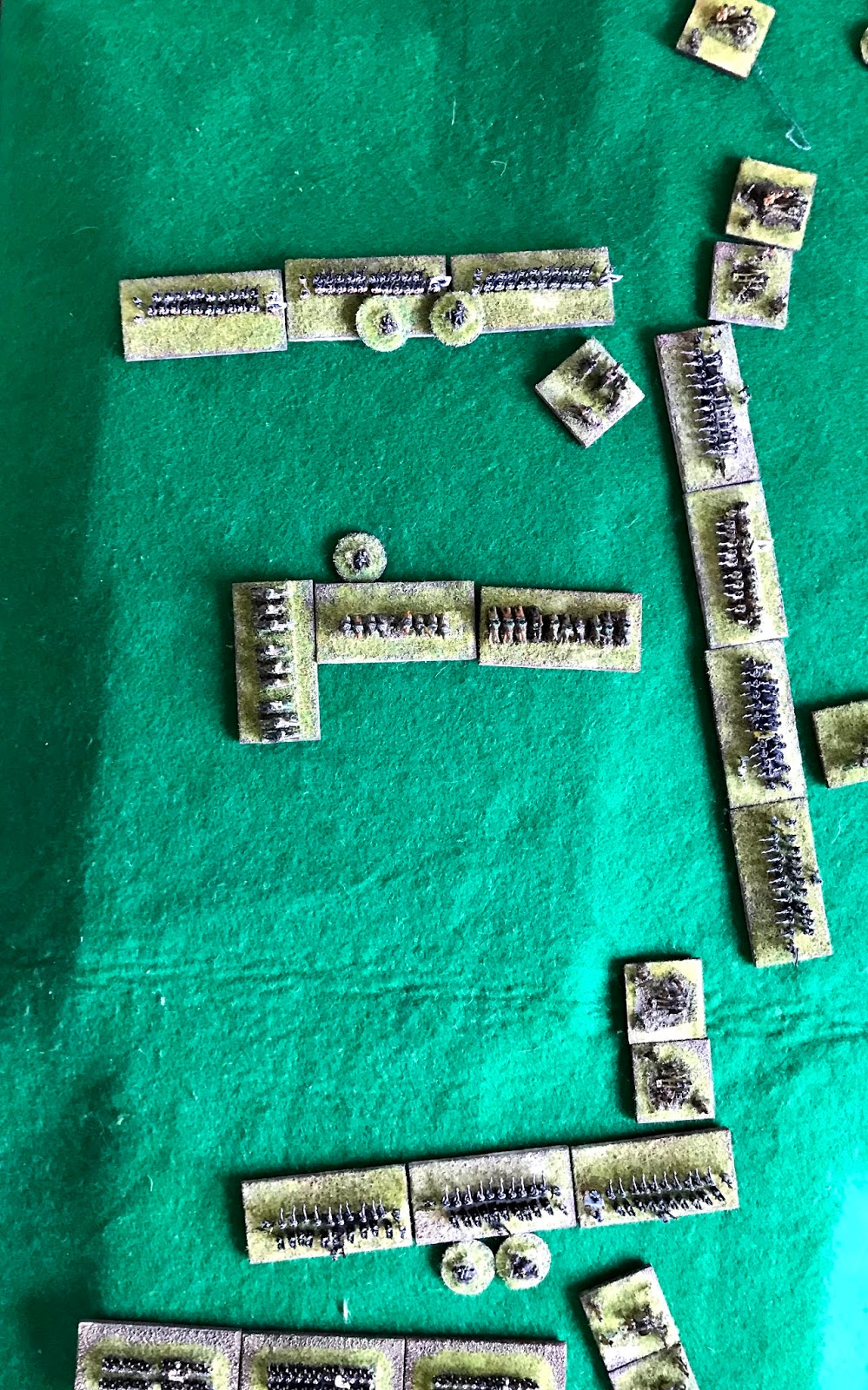
Close up of the Prussian left wing cavalry. The bases in the near ground are Irregular Miniatures cavalry painted as Russian cuirasiers.

The formidable lines of infantry on the Austrian right flank.

The assault on the Graner Koppe goes in at the far end. The Prussian left wing infantry change direction and take shelter behind the wood from the Austrian battery in the centre. The Prussians left wing cuirassiers charge the Austrian horse and foot but lose an element in the process. The foot are routed off table but the cavalry battle doesn't go their way. One advantage in attacking this way is that the enemy if routed soon disappear off the table. They can dice to return after 3 turns but the chance isn't high. If by contrast you are routed you have room to rally on table unless you are pursued to destruction.

Close up of the Graner Koppe action. The Austrian gunners fled immediately and the veteran Prussian cuirassiers crash into the Austrian grenadiers who initially proved a tough nut to crack. The elite (Gens d'Armes and Garde du Corps) Prussian cuirassiers don't have it easy either against their opposite numbers.

The fighting on this key hill was confused and hung in the balance for some time. The round bases are to mark hits since I couldn't remove figures. 4 hits to remove a foot element and 3 to remove a cavalry element. With one hit an element would fight as if it was untouched - 2 or more and it couldn't fire/inflict hand-to-hand hits.

The Prussian centre has occupied Burkersdorf and the Austrians begin to inch forward in response. Still no re-inforcements from the off-table troops.

The left wing Prussian infantry decide to attack left of the wood once it is clear that the attack on the right is going well. There was to be an element of  D'Erlons Corps at Ligny-Quatre Bras about this though. One unit ended up heading back towards Burkersdorf but never quite made it. In the foreground the defeated Prussian cuirassiers are being pursued (foreground centre) and an Austrian reinforcement of 3 dragoon elements enters bottom left.

As the dragoons attack the remaining two elements of Prussian cuirassiers another cavalry reinforcement enters on the left of the picture. It's starting to look grim for the Prussians on this wing.

Meanwhile, the Graner Koppe is nearly cleared. That's Prussian horse and infantry at the top of the hill. More bluecoats commence a firefight with the Austrian columns and the infantry in the village pour fire into the advancing Austrians who cannot hit back until they get to close range. Centre left is a Prussian cuirassier unit rallying after pursuit and the Saxons have formed a new flank to face them.

Same stage as above but you can see half way up on the left the remaining two elemenqts of a Prussian cavalry unit have penetrated the centre of the Austrian position causing the second line to also refuse a flank. That small Prussian unit proves a nuuissance as until it is cleared off it stops more re-inforcements arriving. On the right of the picture the Prussian cavalry have rallied back on the infantry which is also bending back to stop the Austrian cavalry rolling them up.

Three units of Austrian and Saxon foot form a cauldron (Kessel!) around that wayward unit of Prussian cavalry who launch a charge in a desparate bid to escape......and succeed!


From the Graner Koppe the bluecoats line engages the Austrians in a fierce firefight gaining the upper hand because of their superior discipline (veteran versus elite). Following this Prussians in Burkersdorf are forced to retire by the Austrian artillery.

With what can only be described as luck, in a renewed cavalry battle in the south, the Prussians prevail against superior numbers. In the north the Prussian cavalry have renewed their attack having cleared away all opposing horse, they begin to clear every remaining (and returning) Austrian infantry and artillery unit from the area around the Graner Koppe. Mainly because the clock was ticking down and I had to prepare for guests so decided it was time for the coup de grace. Now the whole Austrian position looks like it's squeezed from 3 sides.

The final assualts on the hill go in.

The end. One final Austrian infantry unit on the lower slopes of the Graner Koppe are about to be scattered to the winds by a cavalry flank attack. The column of 4 elements bottom right never did fire a shot - the Garde remain intact! The same cannot be said of the Prussian cavalry who retain but a fraction of their number having borne the brunt of the victory.


Thoughts and Reflections
So pretty much a historical outcome albeit in one in which the Prussian cavalry bore more of the fighting on the hill. Also I had to hamstring the Austrians with a coule of 'scenario tweaks' in order to make a game of it. Apart from that, I played the rules unamended.

As I mentioned on Christmas Eve, the rules came back to me pretty well despite not having played them for I reckon 33 years!  The absolute latest I could have played them was 1987 when I purchased my first H&R and Irregular 6mils with the proceeds from selling my Minifigs 25mm collection. But I think it was a good while before that. I think that is testament as much to the amount of times we played them at a young impressionable age, as to the clarity of the rules themselves. I had a quick skim through the rules before I played to refresh myself on the sequence and I had to check details a few times whilst I played, but pretty much I played by memory and the use of the quick reference sheet.

Would I change anything in the rules? Yes. I think cavalry is too effective against formed infantry. Command and control: it's a bit too easy to do what you want and too easy to telepathically co-ordinate disparate bdoies of men (e.g. the Kessel formed around the Prussian cavalry). Also without a massive table and teams of players they are really suited to 'divisional' or perhaps small corps-sized actions which were pretty thin on the ground in my preferred theatre of the SYW. But did I enjoy my game? Yes definitely. I was left wanting to have another go! Good fun.

As for the table, later that evening it was pressed into use for its original intended purpose when we had my son and elder daughter (both at their mother's whilst home from uni) plus their respective 'significant others' for dinner. So with the tytöt, Rouva Nundanket and myself we had 8 sat around the former battlefield. A good time was had by all and I was struck by the fact my elder two are both such drama 'luvvies', neither being shy to take turns at charades. What made it extra special for me was getting the two older offspring in the room together for such a long period for the second time this year. The previous occasion was when my other half finally made an honest man of me - I suppose that's one thing I have Nigel Falange to thank for ;-)