
Showing posts with label Development. Show all posts
Showing posts with label Development. Show all posts
Wednesday, 1 June 2022
Helion sale
Worth a look at the current sale. Mainly ‘esoteric’ books from my perspective, but it does include this one which I liked.


Friday, 8 April 2022
Daily reality of war
Now then. This song has got helpful side-by-side translations. It sounds like a straight militaristic song, with a jaunty tune, revelling in the imagined glories of war. But when you read the words you can see it’s about the grim reality. There are enough sarcastic, and bitter lines in there to make me believe it was written by someone who knew from first hand what he was talking about. It fits well within the cultural reference points of Unknown Soldier (Tuntematon Sotilas).
What really gets me is the line about the horses being so hungry they try to eat the stable walls.
https://youtu.be/-W9m1bLbKjg
This sort of thing is in the back of my mind when I think of the Continuation War, and forms the backstory to my (rare) games in the period.
Saturday, 12 December 2020
Influential books
Whilst surfing through my Blogger reading list earlier a thought came to me* that there were two or three books which have had a massive impact on my wargaming life. More than any others. All three were published, and acquired by me, in the 1970s, so they've been around me during the last 5 decades. Whilst others have come since and have had a big impact on my hobby time, most of these have sprung from one or more of these wellsprings. I mentioned a couple of these last year in a trawl through my own history as a wargamer.
* Two things probably brought this about. One, I made a throw-away remark to david in suffolk about the 1970s. Two, I had been thinking about Jonathan's analyses of the Great Wargames Survey 2020 which discussed the associations between age and wargaming interests.
The three books in question are:
- The War Game, ed. Peter Young, London 1972
- Wargame Rules 1685-1845, The Wargames Research Group, 1977
- The Army of Frederick the Great, Christopher Duffy, Newton Abbot 1974
The Young and Duffy books were both presents from my sister and brother-in-law, known within the family for the great books they choose as presents. I think I was 13 when I got number 1, then I bought the WRG rules in early 1978. This in turn got me into the SYW and I was subsequently bought number 3.
 |
| The dust jacket alone got a young lad salivating. Incidentally this is the second copy of the book. The original I had got damaged when it was stored in a damp garage for several years. |
I want to take each book in turn and give a sense of how and why it has influenced my wargaming path, naturally starting with The War Game. Wargamers of a slightly older vintage often cite Featherstone, Grant, and Scruby as their formative wargaming influencers. Others in this truly 'Old School' era were Young & Lawford, and Wesencraft. Whilst many of the chapters were written by these luminaries, mentally I classify the War Game as 'NQOS' (Not Quite Old School). For a start it's in colour! And the terrain is diorama quality. Also, the chapters do not describe wargames or wargaming but historical battles. For Tail-end Baby Boomers like me (I snuck in under the wire) the 70s were probably our formative years. The 1980s were by contrast the least favourite of all my 6 decades. In fact I pity people for whom the 80s were their formative years (sorry Gen-Xers).
So, this book, edited by the pioneering Peter Young, was produced near the start of the best decade and I got given it somewhere in the middle. I'd not seen the real Old School stuff at that stage. I'd not seen any wargaming books or rules at all. So getting the War Game was truly one of those mind blowing moments. First of all, the photography and the models are stunning. Peter Gilder was a major influence on the look with his terrain and some of the models. The other chapter authors, plus other wargamers, also contributed models. And all were superbly photographed by Philip O Stearns, who looks to have had an interesting life. He was in the OSS during the War, and as well as photographing wargames and toy soldiers, he also photographed er-hem, models in 1/1 scale. There's more about him here including some of his contributions to something called Mayfair. No me neither 😉.
I'm not sure whether I saw the book first, or a display by the Grimsby Wargaming Club in the Army Recruitment Office Window, but both were around the same period. This was a Proper grown-up Hobby. (I think the GWC was called the Horse & Musket Society in those days).
 |
| Clearly a Proper Hobby. Apparently not all wargamers have such paraphernalia lying around the table. |
 |
| From the chapter on Thermopylae. So this was the battle that inspired The 300 Spartans film! Not gamed it though. Yet. |
 |
| Agincourt initial dispositions |
 |
| Agincourt again. A lot of the English archers here are Airfix Sheriff of Nottingham and Robin Hood's Men conversions, as are some of the French dismounted men-at-arms. I ended up buying lots of these but for conversion to Ancients. |
 |
| Dispositions for Edgehill. Now I hadn't heard of this battle at the time. It took me until 3 years ago to finally get this battle on the table. Over 40 years but I got there eventually! |
 |
| Lovely opening shot from the Blenheim chapter. I had Airfix Napoleonic at the time but this set the slow match burning for the 18th century. Or was that down to songs like 'Soldier Soldier' and 'O'er the Hills' learnt at primary school? |
 |
| Now this was a complete eye-opener for me! I'd not heard of Frederick the Great, or von Browne, let alone Lobositz. I don't think I even knew that Austria and Prussia contended the SYW! That was all Britain and France in North America, India, plus a bit in Germany right? This shows the style of the pen portraits of the commanders as well as the maps. The figures are clearly Grant's Spencer Smiths - painted in his imagi-nations' armies' colours. Finally re-fought this one 35 years later. |
 |
| From the Saratoga chapter. Another battle I'd not heard of. The Battle of Freeman's Farm. 2 battles in the one chapter here, the other being Bemis Heights. Re-fought with a lad from school using book 2 rules and Airfix AWI figures. |
 |
| In the Grand Manner! Austerlitz - another new one on me (I don't recall it from the Ladybird book on Napoleon which was my one source on the Nap Wars outside the British area of involvement). Just look at that lot! |
 |
| Another mouth-watering shot from Austerlitz. It took until about 2011 to get involved in a re-fight of this when I umpired a game using Marechal de l'Empire and Old School Tony's Baccus collection. |
 |
| Pretty much all I would need to know to get Waterloo set-up. It took me a few years before I war-gamed it, and that was a refight as a SYW battle because that's what our school group did. |
 |
| Gettysburg. Day One. Another new one on me. Again it took me a long time to get to this. And again with Old School Tony, using Altar of Freedom. A great battle to attempt. Lots of options. |
 |
| Last, but not least. El Alamein. Shot of a German column. Whilst I was aware of the Desert War (how could I not be with Airfix DAK and 8th Army sets amongst the first figures I had) I wasn't familiar with El Alamein. I must have had a very cursory acquaintance with the campaign in the Western Desert! And still not made it to the table. |
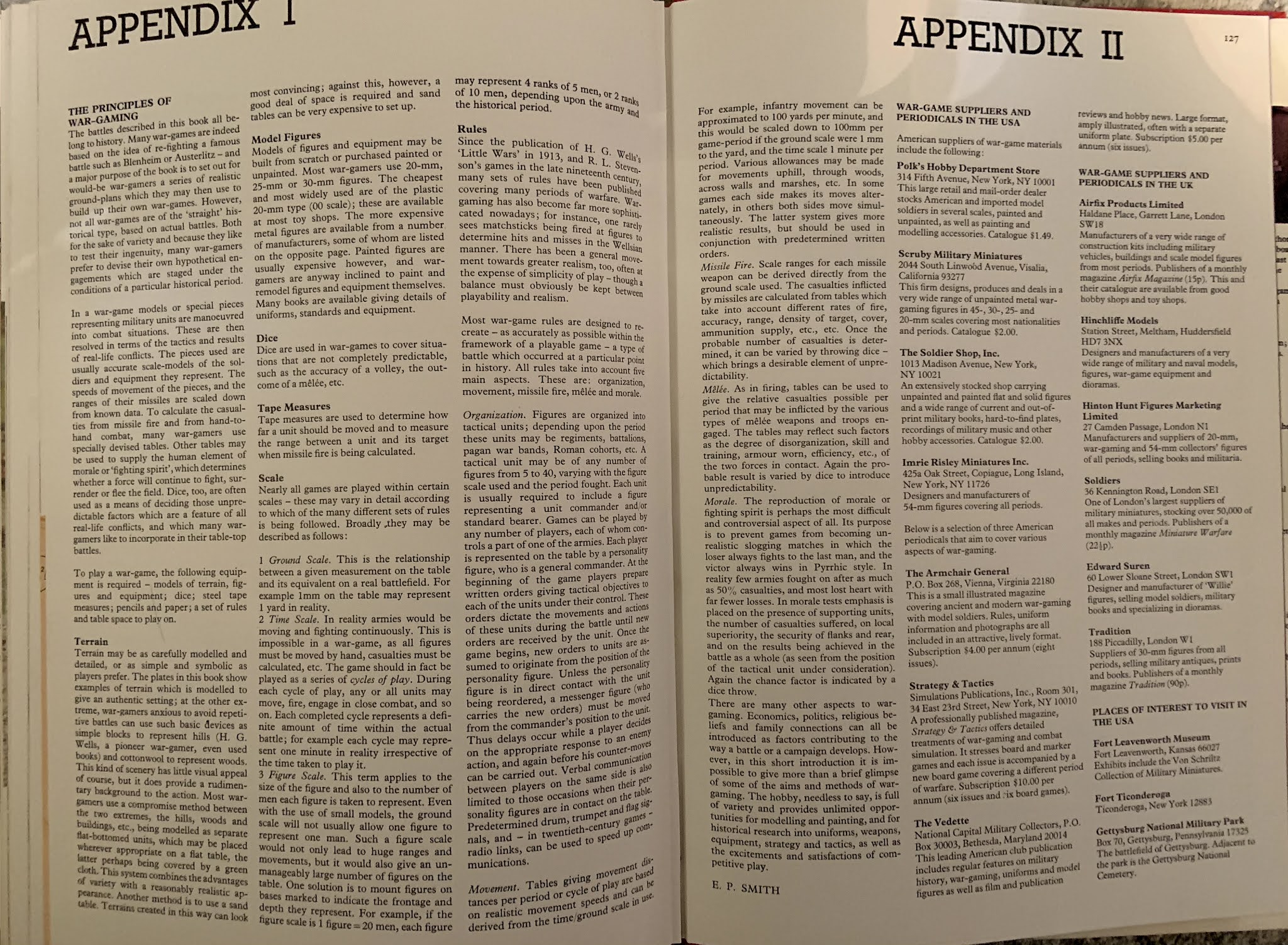
Lots of eye-candy then. And lots of historical background. Much new information. And all very well put together and excellent told. But what helped nudge me in the right direction was the appendix. This gave me the bare bones to get started with war-games rules. Most of this was a revelation. I had not seen a set of war-games rules at that point. I still hadn't after reading this book. But I could cobble together my own on the basis of what the appendix described. Before this I was struggling with 1:1 troop ratios - shooting ranges were enormous on the table!
In conclusion then, the War Game really set me on the path to 'proper' wargaming. It gave me inspiration, validation, information, and (importantly) a framework. More than that it, educated me in areas of military history that I knew nothing about and it nudged me more towards the 18th century from Napoleonics where my area of interest had been the Peninsular War. The Seven Years War in Central Europe became my abiding passion, but not straight away, though the slow match had been lit.
I almost forgot that it also encouraged me to get into Ancients. One of the lads at the school wargames club was also interested in Ancients. Through him I heard about the Wargames Research Group, and thence on to book 2 on the list.....
What would you say are the books most influenced your wargaming career?
Tuesday, 31 March 2020
Collections
A recent post by Bob Cordery about his hat collection got me reminiscing about the collection of hats I had as a small boy. Not unusually for a boy in those days (1960s) I played at ‘War’, Cowboys and Indians, knights and Robin Hood, and this led naturally to wanting to dress up in the appropriate costumes. ‘War’ by the way, generally meant the Second World War, although we weren’t aware of any anachronisms in our kit and accoutrements - FN Rifles? Sure bring it. Winchester Repeaters? Ace.
Digression: in primary school at break times, if we wanted to play war/cowies & indies we would start with a call to arms. The initial cadre would stand side by side, arms over each other’s shoulders, then proceed to march across the playground chanting “who wants to play at War? No girls allowed!” Volunteers would join the line in turn and the line would continue marching and chanting. I have to this day no idea how we would decide when the recruitment stage had finished and we could proceed to the game. Looking back it appears as if it was just something we intuitively agreed upon. Taking sides was the next phase, and this was largely decided by self-selection, and this naturally led to many on the ‘goodies’ side and a pitiful number of 'baddies'. The odds were evened up by allowing the undermanned baddies extra lives. Occasionally a more assertive boy would insist on some poor sap having to go on the baddies side. As an occasional exception to the “no girls allowed” rule, girls could be allowed to play as the Indians. After all, they had long hair, had no idea about military discipline and could not make good gun noises so were better suited to imaginery bows and arrows. Later variants on the games would include Romans v Greeks, Saxons v Vikings and Normans v Saxons, all after watching BBC TV for schools history programmes in class. I remember being virtually the sole Greek volunteer. I wonder if our pre-game recruitment method was just something we did at our school or was it more widespread?
Outfits in my case came courtesy of my mum’s dad, a deep sea trawlerman who was always generous, especially after a good trip. And there were plenty of good trips in those days. The crews of trawlers were classed as ‘casual’ workers (a ludicrously inappropriate description for a job of such long hours and danger) were paid a relatively small fixed amount but had a share in the catch which frequently turned them into ‘3-day millionaires’. Three days because they were often only home for that amount of time before returning to sea.
Half crowns (12.5 pence in modern money) were common currency after Granda's trips, and this funded a growing collection of Timpo cowboys and Indians, and later Airfix toy soldiers. Christmas and birthdays meant a succession of outfits, bikes and scooters. There was a range of outfits using the brand Billy Best and at different times grandad bought me cowboy, soldier (modern) and spaceman outfits. Other, home made, outfits included Robin (my big brother was Batman naturally) and Robin Hood and his Merry Men (complete with home made bows and arrows). So far so good. All fairly normal (we'll gloss over the costumes my sisters made for Batman and Robin).
Now I’m very hazy on the timing here. I’m not sure what came in what order, but at around the same time I took to wearing hats of whatever type took my fancy on other occasions. I don’t mean things like balaclavas or sun hats that had a practical application, but my play hats. I have an old picture of me with two of my sisters on the prom at Scarborough, holding a tiny monkey with me in a US navy style hat. Re-reading that back now it sounds more camp than it was. I was not sporting a Jean-Paul Gaultier stripey top. My mother’s youngest brother was then a rating in the Royal Navy and he gave me his hat from HM Bloody Big S. He would drop off other hats that he acquired on his travels from time to time - my favoured titfer being a bush hat acquired from somewhere out in the Far East. The HM Bloody Big S hat never left the house as it was too splendid for mere play and more importantly, too big to stay on my bonce.
The same uncle used to come back with an array of exotic loose change after his trips, so foreign coins became another collection. This really was a ‘collection’ as opposed to something I had rather a lot of. It served no practical purpose. It was just for looking at and organising. I certainly wasn’t going to play shops with it - girls games, yeugh! I think my favourites were some small Danish coins with holes in the middle and a Kenyan shilling. The Danish coins could well have turned up in Grimsby rather than on some naval posting, as the town was a port of call and eventually home to a lot of fishermen and other merchants sailors from Denmark in the 20th century. Quite appropriate given the place's origins.
So hats, toy soldiers and foreign coins. Added to that was what became a vast (over 100) collection of badges. I have no idea how this started. The sort of badges I had were a random assemblage of company marketing tat (Eskimo Frozen Foods anyone?) and hippy type slogans. One of my main sources being my eldest sister (by then mid-to-late teens). These badges were typically tin or some cheap metal, round, about an inch in diameter and with a safety-pin type, erm, pin on the back. Rather like this: https://www.ebay.ie/itm/Vtg-Badge-Eskimo-Frozen-Foods-Fish-Advert-Advertising-1960s-Promotion/223793975200?hash=item341b290fa0:g:DfoAAOSw7iZd88cF It seems on reflection that my sister was always encouraging me to adopt hobbies of one sort of the other (see other posts about her influence on me with regard to football, wargaming and real ale).
OK, badges were still fairly ordinary as a collection. Indeed, noting the e-Bay Ireland link above some people are still collecting them. But bottle tops?* The sort that you have to lever off with a bottle opener, not screw caps. This collection grew and grew, although there were many duplicates. Quality or uniqueness was not of overriding importance to me. I remember as a small boy my siblings trying to tell me that I already had a Pepsi bottle top but I simply would not part with the surplus examples. So the collection was a hoard really. An evolutionary psychologist would have had a field day.
* I thought I was weird but a quick look on the aforementioned auction site suggests it's alive and kicking as 'a thing'. And who am I to call others weird? I play with toy soldiers.
Ultimately the collection of collections reduced over time to just one. The toy soldiers. That grew and grew. Before shrinking in number when I transferred from plastic to metal, and then growing again in number when I switched to a smaller size of toy.
Digression: in primary school at break times, if we wanted to play war/cowies & indies we would start with a call to arms. The initial cadre would stand side by side, arms over each other’s shoulders, then proceed to march across the playground chanting “who wants to play at War? No girls allowed!” Volunteers would join the line in turn and the line would continue marching and chanting. I have to this day no idea how we would decide when the recruitment stage had finished and we could proceed to the game. Looking back it appears as if it was just something we intuitively agreed upon. Taking sides was the next phase, and this was largely decided by self-selection, and this naturally led to many on the ‘goodies’ side and a pitiful number of 'baddies'. The odds were evened up by allowing the undermanned baddies extra lives. Occasionally a more assertive boy would insist on some poor sap having to go on the baddies side. As an occasional exception to the “no girls allowed” rule, girls could be allowed to play as the Indians. After all, they had long hair, had no idea about military discipline and could not make good gun noises so were better suited to imaginery bows and arrows. Later variants on the games would include Romans v Greeks, Saxons v Vikings and Normans v Saxons, all after watching BBC TV for schools history programmes in class. I remember being virtually the sole Greek volunteer. I wonder if our pre-game recruitment method was just something we did at our school or was it more widespread?
Outfits in my case came courtesy of my mum’s dad, a deep sea trawlerman who was always generous, especially after a good trip. And there were plenty of good trips in those days. The crews of trawlers were classed as ‘casual’ workers (a ludicrously inappropriate description for a job of such long hours and danger) were paid a relatively small fixed amount but had a share in the catch which frequently turned them into ‘3-day millionaires’. Three days because they were often only home for that amount of time before returning to sea.
Half crowns (12.5 pence in modern money) were common currency after Granda's trips, and this funded a growing collection of Timpo cowboys and Indians, and later Airfix toy soldiers. Christmas and birthdays meant a succession of outfits, bikes and scooters. There was a range of outfits using the brand Billy Best and at different times grandad bought me cowboy, soldier (modern) and spaceman outfits. Other, home made, outfits included Robin (my big brother was Batman naturally) and Robin Hood and his Merry Men (complete with home made bows and arrows). So far so good. All fairly normal (we'll gloss over the costumes my sisters made for Batman and Robin).
Now I’m very hazy on the timing here. I’m not sure what came in what order, but at around the same time I took to wearing hats of whatever type took my fancy on other occasions. I don’t mean things like balaclavas or sun hats that had a practical application, but my play hats. I have an old picture of me with two of my sisters on the prom at Scarborough, holding a tiny monkey with me in a US navy style hat. Re-reading that back now it sounds more camp than it was. I was not sporting a Jean-Paul Gaultier stripey top. My mother’s youngest brother was then a rating in the Royal Navy and he gave me his hat from HM Bloody Big S. He would drop off other hats that he acquired on his travels from time to time - my favoured titfer being a bush hat acquired from somewhere out in the Far East. The HM Bloody Big S hat never left the house as it was too splendid for mere play and more importantly, too big to stay on my bonce.
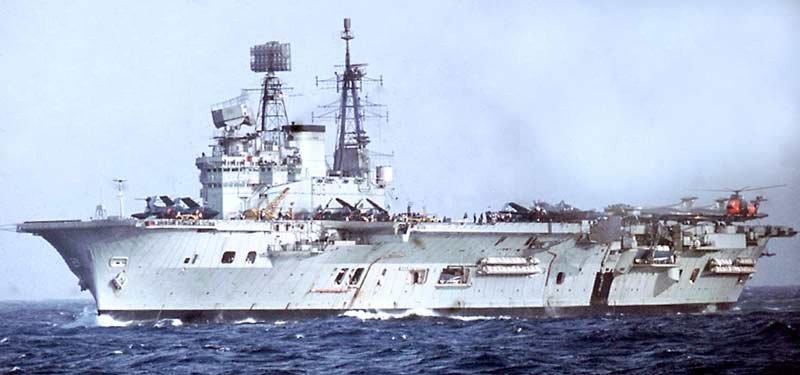 |
| Photograph by Isaac Newton of a Bloody Big Ship from Wikipedia. |
The same uncle used to come back with an array of exotic loose change after his trips, so foreign coins became another collection. This really was a ‘collection’ as opposed to something I had rather a lot of. It served no practical purpose. It was just for looking at and organising. I certainly wasn’t going to play shops with it - girls games, yeugh! I think my favourites were some small Danish coins with holes in the middle and a Kenyan shilling. The Danish coins could well have turned up in Grimsby rather than on some naval posting, as the town was a port of call and eventually home to a lot of fishermen and other merchants sailors from Denmark in the 20th century. Quite appropriate given the place's origins.
So hats, toy soldiers and foreign coins. Added to that was what became a vast (over 100) collection of badges. I have no idea how this started. The sort of badges I had were a random assemblage of company marketing tat (Eskimo Frozen Foods anyone?) and hippy type slogans. One of my main sources being my eldest sister (by then mid-to-late teens). These badges were typically tin or some cheap metal, round, about an inch in diameter and with a safety-pin type, erm, pin on the back. Rather like this: https://www.ebay.ie/itm/Vtg-Badge-Eskimo-Frozen-Foods-Fish-Advert-Advertising-1960s-Promotion/223793975200?hash=item341b290fa0:g:DfoAAOSw7iZd88cF It seems on reflection that my sister was always encouraging me to adopt hobbies of one sort of the other (see other posts about her influence on me with regard to football, wargaming and real ale).
OK, badges were still fairly ordinary as a collection. Indeed, noting the e-Bay Ireland link above some people are still collecting them. But bottle tops?* The sort that you have to lever off with a bottle opener, not screw caps. This collection grew and grew, although there were many duplicates. Quality or uniqueness was not of overriding importance to me. I remember as a small boy my siblings trying to tell me that I already had a Pepsi bottle top but I simply would not part with the surplus examples. So the collection was a hoard really. An evolutionary psychologist would have had a field day.
* I thought I was weird but a quick look on the aforementioned auction site suggests it's alive and kicking as 'a thing'. And who am I to call others weird? I play with toy soldiers.
Ultimately the collection of collections reduced over time to just one. The toy soldiers. That grew and grew. Before shrinking in number when I transferred from plastic to metal, and then growing again in number when I switched to a smaller size of toy.
Tuesday, 9 July 2019
The Continued Recollections of a Wargamer or Nostalgia Ain’t What it Used to Be
I mentioned last time round probably to no one but my reader and myself, how I’d built up a SYW Prussian army in Minifigs 25mm (as small group of school mates variously built up French, Austrian and Russian forces. Minifigs at that time (late 70s) were not the greatest of models. Apart from being on the chunky side. They were not just an extra 5mm taller than Airfix but twice as wide and ‘deep’. Other failings were inaccuracies, anachronisms and idiosyncrasies in the figures. The Prussian heavy cavalry hats were arguably a bit too late for the SYW, but passable. ‘Hungarian Fusileers’ had uniforms and hats that were about 2 decades too late (I don’t know the correct name but they look a bit like short Belgic shakos without the peak; and I cannot find any pictures of said articles). Prussian cuirassiers and Austrian dragoons were modelled holding their carbines, when most authorities at the time emphasised action with the sword in anything but outpost duty. I’m sure ‘button counters’ can find many other faults. However, they were readily available and served us well at the time - remember there was none of this t’internet business in those days and penniless 15 year olds were not apt to ‘waste’ money on catalogues (printed/typed price lists) when they could pop into a shop in town.
At some point in the 80s I bought a publication called A Book of Sandhurst Wargames by Paddy Griffith.


It consisted of 3 boardgames and an RPG (Roll-Playing Game not Rocket-Propelled Grenade. Obviously). I haven’t re-read it for many years and I seem to have lost the maps and counters. I must re-read it because in the back of my head I feel it was somehow influential on me, but I can’t remember exactly how. Oh and I bought this when it was (re-)published in the mid-80s by Bill Leeson:
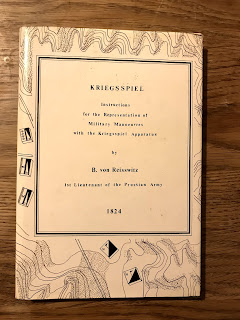
It only held an interest for me in the part it played in the history of our hobby. I found it of little practical interest beyond its use as a source of data like movement rates.
As time moved on (mid-80s), I’d left the delights of South Humberside’s premier coastal resort and became 'spacially challenged' for a few years while I attempted to join the booming property market in the capital’s outer suburbs. I sold the Minifigs and re-invested the proceeds in H&R and Irregular 6mm SYW ranges. By then Miniature Wargames had been going a few years and Wargames Illustrated had joined the 80s glossy mag market. I devoured them both avidly, and Practical Wargamer too when it came along. I’d had the Morschauser article in the back of my mind and other articles in MW introduced me to the idea of ‘Strength Points’ (SPs) with single base units. SPs were, at the risk of stating the bleeding obvious, a way of combining size of unit with unit quality (training, morale, experience etc). They could be used as die roll modifiers in modelling combat. An idea I think borrowed from board wargames.
Never being a great originator of new ideas, but a shameless adapter, I latched onto the idea as the basis for a new set of rules I wanted to write. There didn’t seem to be any real grand tactical rules around for the Seven Years War - everything I saw and read about commercial sets involved some sort of figure or sub-unit base removal, and usually formation changes, despite claims that they were for war in the grand manner. I wanted to get to the point where I could at least game something the size of Lobositz (30ish thousand a side) which meant a ground scale in the region of 100 paces to the inch (25mm). So I got writing and eventually went along to SELWG one evening with my toys and found a willing victim to try it out on. That taught me a valuable lesson in play testing. The rules basically totted up the combined SP of any units in contact in a combat, adjusted based on tactical factors, and added a dice throw. What I hadn’t thought of was the decidedly un-Frederician tactic of building up a mass by having deep formations adding SPs to the combat. I felt like the Ancien Regime commanders must have felt like when their battalions in the effete sounding ordre mince faced the hordes of Revolutionary France in l’ordre profond.
The rules got adjusted accordingly, but I somehow never managed to fit in return visits to SELWG. It was a faff and a half to get to after work, and then get home. That’s my excuse and I’m sticking to it. Real Life also intruded in other ways - I was still ambitious in those days and I had a wife at least as ambitious. Long work days, including some weekends, and domestic responsibilities took precedence, even before having kids. I managed a few solo games in the partially converted loft of the house we moved into in the mid-90s (it seemed expensive then but I could cry when I think what I had to pay for a run down house in a less desirable street nearby, a few years ago). The rules were gradually honed. I borrowed the idea of using playing cards to generate an element of randomness in the order in which units were activated. A small sized set of cards from a Christmas cracker came in very handy.
Units were foot battalions, 3 cavalry squadrons or a company of heavy artillery (battalion guns being considered ‘factored’ in to the infantry SP). Frontages were 50mm (200 paces). Bases could be any shape and I was able to create various dioramas or tableaux with units. Combat was engaged in when opposing units of cavalry or infantry came within 200 paces of each other. At this range cavalry were assumed to be committed to charging and infantry engaged in a fire fight and advance with the bayonet. Artillery, obviously, engaged in ranged combat and could degrade enemy units’ SP before they got to combat range.
Provision was made for hidden movement - never really tested or testable in the solo environment. The idea was to use blocks to represent columns of troops, as range decreased these could be rotated to show troop type (cavalry/infantry), then later specific categories (e.g. cuirassier/dragoons/hussars) then actual strength (models replaced the blocks).
Next came Command and Control. There had been discussion of the issue in a number of magazine articles in the 80s/90s and the idea of Initiative Ratings for generals came up. I think I got the idea from Koenig Krieg. In fact I’m pretty certain. A now lost version of my rules had basically the same table of Initiative Ratings as used in KK for named historical figures. The way I used these were to get units to perform a certain action, be it initiate movement, assault the enemy or change direction, a simple dice test had to be passed whereby the dice throw had to be below the Initiative Rating (IR) of the force’s commander. In fact there had to be 3 levels of general in an unbroken chain of command from brigade to commander in chief or penalties were incurred. ‘Unbroken’ meaning that units had to be within a command radius of their brigade commander, he in turn had to be within a command radius of his column commander, who in turn had to be within range of his C-in-C. If the chain was only partially complete, the combined IR was therefore lower and the test was harder to pass. Simple and effective in principle, but it required a bit of tweaking of IRs and/or type of die used to get the balance right. [The following text in blue is a new addition to explain a little more about my thinking.] The idea was that the player was nominally the C-in-C, so formations lower down couldn't be expected to act as the player wished without there being the ability to communicate (command radius being the proxy) with subordinates. It wasn't impossible for formations to act on their own initiative but it was a lot harder, unless the subordinate had the coup d'oeuil of a Seydlitz.
The thinking that underlay this was that disciplined military formations (particularly) in the linear period would follow instructions (if they understood them) and would continue to follow them until something made them stop following them. Those 'things' could be combat with an enemy that stopped them, the attainment of an objective (what next?), new orders (successfully delivered and understood), or different circumstances noticed by the local commander who saw the need to do something different AND he was willing to use his initiative. In less centralised armies than the Prussians, say, aristocratic rivalry might cause nominal subordinates to show less willingness to follow the original script.
Then Real Life took over. Big time. 2 small children and divorce straddled the old and new millennia. Time, space and budgets were massively impacted, to say nothing of the emotional fallout. The new Frau* Nundanket came along, followed a few short years afterwards by the new Misses Nundanket, so even less space and even less disposable income. Around about this time I re-established regular contact with Old School Tony
* or I should say Rouva Nundanket.
Tony had discovered Baccus and Polemos in his self-enforced exile from the Mother Country. He started building up forces of French and (if I recall correctly) Russian Napoleonics based for General de Division and Marechal de l’Empire (‘GDD’ and ‘MDE’). I tried a game on a trip home and was hooked! This was the basis for my next few years wargaming. Helped in no small measure by his purchase of a house-warming present of a British Peninsular War starter army, ready painted and based, for my impending move back up North. A move that never came off (too good to be true - same income as I was on in London but with the ability to go to bed every night in the DN35 postcode area!). We played the Talavera and Austerlitz scenarios from the Polemos scenario book and later Zorndorf using my home-brewed rules described above. The SYW game went OK but the rules lacked something. The obvious answer was there on Tony's bookshelf. There being no Polemos SYW ruleset at that time (around 2010) I set about adapting MDE to the mid-eighteenth century. And my cardboard bases were somewhat lacking too next to his beautifully finished MDF bases. A mass re-basing followed, including a tweak to the ground scale, and a refresh on the paintjob of my H&Rs (some of which were over 20 years old by then). In my new found enthusiasm, I also painted and based to a decent standard a fair amount of Baccus Spanish and Portuguese, and a couple of corps worth of late Napoleonic Prussians (for my son who I'dsuckered nurtured into being a historical wargamer). As well as the Polemos-style grand tactical rule-rehash, in my continued obsession with things Frederician, I dabbled in rules for everything from campaign, to siege, operational, to battalion-level** actions.
** as in a battalion's part in line of battle rather than a skirmish.
Nearly there now. Just a major re-hash, ditching of the Polemos MDE framework for my SYW rules to follow before I get to the ECW and the last few years!
At some point in the 80s I bought a publication called A Book of Sandhurst Wargames by Paddy Griffith.

Front cover

Contents page

Back cover showing maps and game pieces
It consisted of 3 boardgames and an RPG (Roll-Playing Game not Rocket-Propelled Grenade. Obviously). I haven’t re-read it for many years and I seem to have lost the maps and counters. I must re-read it because in the back of my head I feel it was somehow influential on me, but I can’t remember exactly how. Oh and I bought this when it was (re-)published in the mid-80s by Bill Leeson:

It only held an interest for me in the part it played in the history of our hobby. I found it of little practical interest beyond its use as a source of data like movement rates.
As time moved on (mid-80s), I’d left the delights of South Humberside’s premier coastal resort and became 'spacially challenged' for a few years while I attempted to join the booming property market in the capital’s outer suburbs. I sold the Minifigs and re-invested the proceeds in H&R and Irregular 6mm SYW ranges. By then Miniature Wargames had been going a few years and Wargames Illustrated had joined the 80s glossy mag market. I devoured them both avidly, and Practical Wargamer too when it came along. I’d had the Morschauser article in the back of my mind and other articles in MW introduced me to the idea of ‘Strength Points’ (SPs) with single base units. SPs were, at the risk of stating the bleeding obvious, a way of combining size of unit with unit quality (training, morale, experience etc). They could be used as die roll modifiers in modelling combat. An idea I think borrowed from board wargames.
Never being a great originator of new ideas, but a shameless adapter, I latched onto the idea as the basis for a new set of rules I wanted to write. There didn’t seem to be any real grand tactical rules around for the Seven Years War - everything I saw and read about commercial sets involved some sort of figure or sub-unit base removal, and usually formation changes, despite claims that they were for war in the grand manner. I wanted to get to the point where I could at least game something the size of Lobositz (30ish thousand a side) which meant a ground scale in the region of 100 paces to the inch (25mm). So I got writing and eventually went along to SELWG one evening with my toys and found a willing victim to try it out on. That taught me a valuable lesson in play testing. The rules basically totted up the combined SP of any units in contact in a combat, adjusted based on tactical factors, and added a dice throw. What I hadn’t thought of was the decidedly un-Frederician tactic of building up a mass by having deep formations adding SPs to the combat. I felt like the Ancien Regime commanders must have felt like when their battalions in the effete sounding ordre mince faced the hordes of Revolutionary France in l’ordre profond.
The rules got adjusted accordingly, but I somehow never managed to fit in return visits to SELWG. It was a faff and a half to get to after work, and then get home. That’s my excuse and I’m sticking to it. Real Life also intruded in other ways - I was still ambitious in those days and I had a wife at least as ambitious. Long work days, including some weekends, and domestic responsibilities took precedence, even before having kids. I managed a few solo games in the partially converted loft of the house we moved into in the mid-90s (it seemed expensive then but I could cry when I think what I had to pay for a run down house in a less desirable street nearby, a few years ago). The rules were gradually honed. I borrowed the idea of using playing cards to generate an element of randomness in the order in which units were activated. A small sized set of cards from a Christmas cracker came in very handy.
Units were foot battalions, 3 cavalry squadrons or a company of heavy artillery (battalion guns being considered ‘factored’ in to the infantry SP). Frontages were 50mm (200 paces). Bases could be any shape and I was able to create various dioramas or tableaux with units. Combat was engaged in when opposing units of cavalry or infantry came within 200 paces of each other. At this range cavalry were assumed to be committed to charging and infantry engaged in a fire fight and advance with the bayonet. Artillery, obviously, engaged in ranged combat and could degrade enemy units’ SP before they got to combat range.
Provision was made for hidden movement - never really tested or testable in the solo environment. The idea was to use blocks to represent columns of troops, as range decreased these could be rotated to show troop type (cavalry/infantry), then later specific categories (e.g. cuirassier/dragoons/hussars) then actual strength (models replaced the blocks).
Next came Command and Control. There had been discussion of the issue in a number of magazine articles in the 80s/90s and the idea of Initiative Ratings for generals came up. I think I got the idea from Koenig Krieg. In fact I’m pretty certain. A now lost version of my rules had basically the same table of Initiative Ratings as used in KK for named historical figures. The way I used these were to get units to perform a certain action, be it initiate movement, assault the enemy or change direction, a simple dice test had to be passed whereby the dice throw had to be below the Initiative Rating (IR) of the force’s commander. In fact there had to be 3 levels of general in an unbroken chain of command from brigade to commander in chief or penalties were incurred. ‘Unbroken’ meaning that units had to be within a command radius of their brigade commander, he in turn had to be within a command radius of his column commander, who in turn had to be within range of his C-in-C. If the chain was only partially complete, the combined IR was therefore lower and the test was harder to pass. Simple and effective in principle, but it required a bit of tweaking of IRs and/or type of die used to get the balance right. [The following text in blue is a new addition to explain a little more about my thinking.] The idea was that the player was nominally the C-in-C, so formations lower down couldn't be expected to act as the player wished without there being the ability to communicate (command radius being the proxy) with subordinates. It wasn't impossible for formations to act on their own initiative but it was a lot harder, unless the subordinate had the coup d'oeuil of a Seydlitz.
The thinking that underlay this was that disciplined military formations (particularly) in the linear period would follow instructions (if they understood them) and would continue to follow them until something made them stop following them. Those 'things' could be combat with an enemy that stopped them, the attainment of an objective (what next?), new orders (successfully delivered and understood), or different circumstances noticed by the local commander who saw the need to do something different AND he was willing to use his initiative. In less centralised armies than the Prussians, say, aristocratic rivalry might cause nominal subordinates to show less willingness to follow the original script.
Then Real Life took over. Big time. 2 small children and divorce straddled the old and new millennia. Time, space and budgets were massively impacted, to say nothing of the emotional fallout. The new Frau* Nundanket came along, followed a few short years afterwards by the new Misses Nundanket, so even less space and even less disposable income. Around about this time I re-established regular contact with Old School Tony
* or I should say Rouva Nundanket.
Tony had discovered Baccus and Polemos in his self-enforced exile from the Mother Country. He started building up forces of French and (if I recall correctly) Russian Napoleonics based for General de Division and Marechal de l’Empire (‘GDD’ and ‘MDE’). I tried a game on a trip home and was hooked! This was the basis for my next few years wargaming. Helped in no small measure by his purchase of a house-warming present of a British Peninsular War starter army, ready painted and based, for my impending move back up North. A move that never came off (too good to be true - same income as I was on in London but with the ability to go to bed every night in the DN35 postcode area!). We played the Talavera and Austerlitz scenarios from the Polemos scenario book and later Zorndorf using my home-brewed rules described above. The SYW game went OK but the rules lacked something. The obvious answer was there on Tony's bookshelf. There being no Polemos SYW ruleset at that time (around 2010) I set about adapting MDE to the mid-eighteenth century. And my cardboard bases were somewhat lacking too next to his beautifully finished MDF bases. A mass re-basing followed, including a tweak to the ground scale, and a refresh on the paintjob of my H&Rs (some of which were over 20 years old by then). In my new found enthusiasm, I also painted and based to a decent standard a fair amount of Baccus Spanish and Portuguese, and a couple of corps worth of late Napoleonic Prussians (for my son who I'd
** as in a battalion's part in line of battle rather than a skirmish.
Nearly there now. Just a major re-hash, ditching of the Polemos MDE framework for my SYW rules to follow before I get to the ECW and the last few years!
Tuesday, 2 July 2019
Early Social Gaming and the Minifigs ‘Incredible Hulk’ period
More self-indulgence.
I’ve just remembered whilst reviewing the draft of this post (yes really, I do check them!) that one Christmas my brother got Waddingtons Battle of the Little Big Horn. I seem to remember it a tough and challenging game for the Cavalry to win. As it should be. Maybe that’s where some of the initial rules ideas came from that I referred to in the last post.
I can’t remember the order in which more ‘authoritative’ rules crept into my games. At this point I thought I was still an oddbod wishing to play with toy soldiers, albeit in a ‘serious’ way. Gradually facts like ‘Edward Woodward is a wargamer’ came to light. Some years after the Battle of Little Big Horn arrived in the house, I got the Airfix Waterloo Wargame for Christmas. https://boardgamegeek.com/boardgame/31537/waterloo-wargame
The playing surface was a ‘vinyl’ map of the Waterloo battlefield about 2 feet by 3 from memory. Units were variable strength (1cm frontage = 1000 troops) on plinth-like hard plastic stands on which were mounted Airfix Waterloo horse/foot/gun figures (again in hard plastic). The rules were simple but I had good fun with it. It introduced me to the idea of games where casualties were not removed from units until the whole unit was removed.
Not long after my eldest sister* bought me The War Game, edited by Brigadier Peter Young.
This was it! This was validation. And my first exposure to wargaming eye-candy. Brilliantly written accounts of 10 battles, illustrated with fantastic photos of model soldiers in carefully sculpted terrain. Some battles I knew of or had heard about, others were totally new. Thermopylae, ah yes, so that was the battle seen in the 300 Spartans. Agincourt I knew about. Edgehill, I’d heard of the English Civil War, Roundheads and Cavaliers, even Marston Moor, but not this specific battle. Blenheim, yes, that’d been in a book on decisive battles I’d read from the junior school library. Lobositz - the SYW was known to me in the context of Wolf and Quebec, and some vague notions of redcoats fighting the French on the Continent (Minden?) - again a totally new battle (and whole theatre of war) unknown to me. That set off a future debate whether to ‘do’ the War of the Spanish Succession or the SYW. Lobositz is a battle that has become legendary amongst some warmers thanks to Charles Grant (senior and junior). And there were 5 more battles, 3 of which were new to me. And crucially, there were ideas for rules in an appendix. It made wargaming look something serious and complex, and something to be mastered to my young mind. Fantastic!
* The same sister took me to my first ever football match at Blundell Park (a Lawrie McMenemy-inspired 4-3 victory over Doncaster Rovers), then got me this iconic book, and later with her husband introduced me to real ale. She has probably been the most responsible for cementing my three longest-standing pastimes. I owe her a lot!
The appendix to the War Game introduced me to the idea that figures could represent more than one real soldier. And that ground scales could consequently be shrunk so that at last my 6’x4’ board could become a (small) battlefield. Companies reduced from 100+ figures to 6 at full strength.
Then I discovered, around 1976-7, that there was a wargames club at school and that I knew one of the lads in it. What’s more he was one of the cool rebels, not a geek. So I joined and ended up having a few years of very enjoyable gaming. There was a rulebook in use at the club, a thin book with a green cover which had rules for ACW, WWII and a few other periods. What’s more it chimed with the ideas I’d got from the War Game. 1 man = 20. You kept a unit ledger in which you wrote down casualties in men, only removing another figure when the next multiple of 20 was reached. Orders were handwritten and had to travel to units from the commander at courier speed. There was even one lad into the then new scale of micro-armour. One of the boys had WRG ancients rules and having set out to convert (and paint!) Airfix Romans into classical Greeks) we got together to fight a Greco-Persian War battle in his partly converted loft. My phalanxes (including my red-cloaked ‘Spartans’) didn’t get close to his line, being shot up by archers on the way in. Most disconcerting! It didn’t seem to work out that way in the history books I grumbled to myself, and I didn’t return to ancients.
In 1978 I bought WRG 1685-1845 rules. Some people are not keen on these rules now but they were like a liberation (from written orders and keeping tally). The original retro ‘old school’ rules in a way - back to rolling a dice and ‘bang you’re dead’. The army lists in the back particularly pushed Marlburians and SYW - something I’d wanted to do for a long time (proper soldiers in tricornes and mitres). I was torn between the two. I’d need an opponent. Fortuitously, the same lad who I’d had the ancients game with already had a collection of Minifigs SYW Austrians. I have never figured out why he’d bought these - he clearly wasn’t the sort of person who only buys the ‘best’ army (to our level of knowledge then, that clearly would have been Frederick the Great’s Prussians). So that made the decision for me, I would get SYW Prussians (I’d be that kid who chose the ‘best army’). For me the best thing about the Prussians was that I’d be able to build up a points based army cheaper! Being generally elite and veteran, I’d need fewer models to get to 100, 200 or 500 points. Thus started a 40 year interest.
We had a game at the school club and it took off from there. I think we had 150 point ‘armies’ (probably a battalion and a squadron of cavalry, plus commander). The game attracted a lot of attention at the club, and from 2 interested boys we grew to 5 SYW regulars. Games grew from 100 point armies to 1500 point armies! Great games were had and I can still picture the other lads and the funny things that used to come out of our mouths (intentional and non-intentional).
Inspired by the Charles Grant classic, the Wargame, we plotted an Imagination campaign. Five rival states were created (conveniently based on Britain, France, Prussia, Russia and Austria), backstories developed, and 4th year English lessons (Year 10 in modern parlance) saw a flurry of secret diplomatic correspondence (a lot of it scurrilous, concerning the ‘drug-addicted Tsar of All the Russias’). Sadly the campaign never got off the ground and over the next few years, 5 whittled down to 2 over the years.
Building up my army was a case of the excitement of deferred gratification. Pocket-money and cash from odd jobs was saved up for weeks ready for visits to Toynes in Grimsby. Orders were placed via the shop for Minifigs (Ancients and Napoleonics seemed to be the popular periods so little or no stock of SYW was held). More weeks of waiting was ‘endured’ before being able to get your hands on shiny shiny metal. It did give you time to get units painted! Also by time they arrived you had saved for the next order.
At some point in the late 70s in a magazine (Military Modelling or Airfix?) I read an article about single stand units by what was then already a vintage set of American rules. I guess it was Morschauser, but I can’t honestly remember for sure now. I experimented with an ungridded version of the game (solo) but left it at that. I’ve never returned to gridded miniatures gaming, but who knows.
I’ve just remembered whilst reviewing the draft of this post (yes really, I do check them!) that one Christmas my brother got Waddingtons Battle of the Little Big Horn. I seem to remember it a tough and challenging game for the Cavalry to win. As it should be. Maybe that’s where some of the initial rules ideas came from that I referred to in the last post.
I can’t remember the order in which more ‘authoritative’ rules crept into my games. At this point I thought I was still an oddbod wishing to play with toy soldiers, albeit in a ‘serious’ way. Gradually facts like ‘Edward Woodward is a wargamer’ came to light. Some years after the Battle of Little Big Horn arrived in the house, I got the Airfix Waterloo Wargame for Christmas. https://boardgamegeek.com/boardgame/31537/waterloo-wargame
The playing surface was a ‘vinyl’ map of the Waterloo battlefield about 2 feet by 3 from memory. Units were variable strength (1cm frontage = 1000 troops) on plinth-like hard plastic stands on which were mounted Airfix Waterloo horse/foot/gun figures (again in hard plastic). The rules were simple but I had good fun with it. It introduced me to the idea of games where casualties were not removed from units until the whole unit was removed.
Not long after my eldest sister* bought me The War Game, edited by Brigadier Peter Young.
This was it! This was validation. And my first exposure to wargaming eye-candy. Brilliantly written accounts of 10 battles, illustrated with fantastic photos of model soldiers in carefully sculpted terrain. Some battles I knew of or had heard about, others were totally new. Thermopylae, ah yes, so that was the battle seen in the 300 Spartans. Agincourt I knew about. Edgehill, I’d heard of the English Civil War, Roundheads and Cavaliers, even Marston Moor, but not this specific battle. Blenheim, yes, that’d been in a book on decisive battles I’d read from the junior school library. Lobositz - the SYW was known to me in the context of Wolf and Quebec, and some vague notions of redcoats fighting the French on the Continent (Minden?) - again a totally new battle (and whole theatre of war) unknown to me. That set off a future debate whether to ‘do’ the War of the Spanish Succession or the SYW. Lobositz is a battle that has become legendary amongst some warmers thanks to Charles Grant (senior and junior). And there were 5 more battles, 3 of which were new to me. And crucially, there were ideas for rules in an appendix. It made wargaming look something serious and complex, and something to be mastered to my young mind. Fantastic!
* The same sister took me to my first ever football match at Blundell Park (a Lawrie McMenemy-inspired 4-3 victory over Doncaster Rovers), then got me this iconic book, and later with her husband introduced me to real ale. She has probably been the most responsible for cementing my three longest-standing pastimes. I owe her a lot!
The appendix to the War Game introduced me to the idea that figures could represent more than one real soldier. And that ground scales could consequently be shrunk so that at last my 6’x4’ board could become a (small) battlefield. Companies reduced from 100+ figures to 6 at full strength.
Then I discovered, around 1976-7, that there was a wargames club at school and that I knew one of the lads in it. What’s more he was one of the cool rebels, not a geek. So I joined and ended up having a few years of very enjoyable gaming. There was a rulebook in use at the club, a thin book with a green cover which had rules for ACW, WWII and a few other periods. What’s more it chimed with the ideas I’d got from the War Game. 1 man = 20. You kept a unit ledger in which you wrote down casualties in men, only removing another figure when the next multiple of 20 was reached. Orders were handwritten and had to travel to units from the commander at courier speed. There was even one lad into the then new scale of micro-armour. One of the boys had WRG ancients rules and having set out to convert (and paint!) Airfix Romans into classical Greeks) we got together to fight a Greco-Persian War battle in his partly converted loft. My phalanxes (including my red-cloaked ‘Spartans’) didn’t get close to his line, being shot up by archers on the way in. Most disconcerting! It didn’t seem to work out that way in the history books I grumbled to myself, and I didn’t return to ancients.
In 1978 I bought WRG 1685-1845 rules. Some people are not keen on these rules now but they were like a liberation (from written orders and keeping tally). The original retro ‘old school’ rules in a way - back to rolling a dice and ‘bang you’re dead’. The army lists in the back particularly pushed Marlburians and SYW - something I’d wanted to do for a long time (proper soldiers in tricornes and mitres). I was torn between the two. I’d need an opponent. Fortuitously, the same lad who I’d had the ancients game with already had a collection of Minifigs SYW Austrians. I have never figured out why he’d bought these - he clearly wasn’t the sort of person who only buys the ‘best’ army (to our level of knowledge then, that clearly would have been Frederick the Great’s Prussians). So that made the decision for me, I would get SYW Prussians (I’d be that kid who chose the ‘best army’). For me the best thing about the Prussians was that I’d be able to build up a points based army cheaper! Being generally elite and veteran, I’d need fewer models to get to 100, 200 or 500 points. Thus started a 40 year interest.
We had a game at the school club and it took off from there. I think we had 150 point ‘armies’ (probably a battalion and a squadron of cavalry, plus commander). The game attracted a lot of attention at the club, and from 2 interested boys we grew to 5 SYW regulars. Games grew from 100 point armies to 1500 point armies! Great games were had and I can still picture the other lads and the funny things that used to come out of our mouths (intentional and non-intentional).
Inspired by the Charles Grant classic, the Wargame, we plotted an Imagination campaign. Five rival states were created (conveniently based on Britain, France, Prussia, Russia and Austria), backstories developed, and 4th year English lessons (Year 10 in modern parlance) saw a flurry of secret diplomatic correspondence (a lot of it scurrilous, concerning the ‘drug-addicted Tsar of All the Russias’). Sadly the campaign never got off the ground and over the next few years, 5 whittled down to 2 over the years.
Building up my army was a case of the excitement of deferred gratification. Pocket-money and cash from odd jobs was saved up for weeks ready for visits to Toynes in Grimsby. Orders were placed via the shop for Minifigs (Ancients and Napoleonics seemed to be the popular periods so little or no stock of SYW was held). More weeks of waiting was ‘endured’ before being able to get your hands on shiny shiny metal. It did give you time to get units painted! Also by time they arrived you had saved for the next order.
At some point in the late 70s in a magazine (Military Modelling or Airfix?) I read an article about single stand units by what was then already a vintage set of American rules. I guess it was Morschauser, but I can’t honestly remember for sure now. I experimented with an ungridded version of the game (solo) but left it at that. I’ve never returned to gridded miniatures gaming, but who knows.
Monday, 1 July 2019
Early Doors
No, not a Jim Morrison inspired musical post. Or a quote from 'Big Ron' Atkinson. This is a self-indulgent post. A remiscence into childhood. I might make it more grandiose by describing it as a stage in the evolution of my thinking about wargames, which would be partly true.
Like most wargamers of my generation (end of the Baby Boom) I started playing with plastic toy soldiers, first Timpo cowboys and indians, Britains (1/32nd scale) then with Airfix 1/72/76th(?). All the usual early methods* were used in games on the living room floor or dining table - toy canon firing matches, marbles, flicking coins, Subbuteo-style. Then my first ‘proper’ wargames would be when my older brother had discovered somewhere you could use dice to determine ‘hits’ and have limits on movement. There were even different ranges and different weapons had different effects (did we learn that from warfilms or had my brother read it somewhere?). Most games involved WWII, then WWI, French Foreign Legion, US Cavalry and Plains Indians. In the background there had been colourful pictures of soldiers in a compendium of fairy stories and nursery rhymes (The Tinder Box?). I’m sure this fixed the idea in my mind that proper soldiers had colourful uniforms (indeed the Guards in London wore red coats) and wore strange hats that I subsequently learned to call mitres, shakos and tricorns**.
* Later this would include a more unsusal method. My brother, by then a smoker, to the startlement of my staid friend interrupted a Pacific War game to simulate a flamethrower with his cigarette lighter and torched a Japanese sniper out of a tree. I was a bit less surprised, having on previous occasions witnessed salvoes of lit matches being fired from Britain's naval cannon. There was no saving throw for poor Sergeant Kawasaki. Thanks Mark!
** Even later I learned they were ‘cocked hats’
I think we found Airfix Waterloo figures around the same time dad took us to see Waterloo. That was it! Proper soldiers. Lined up in ranks. In colourful uniforms. And the British still won. I’d learned that their guns were single shot and slow to load and they fired in ranks, so rules were introduced that it was one dice per 6 men. I even think soldiers ran away when 1/2 of them were killed! More reading. These 'muskets' actually fired a lot further than I thought - normally under 100 yards but up to 200yards! That was 2 yards at scale, more than the length of the (6x4’) model railway board! Infantry regiments were 1000 men. I was going to need more soldiers. I was clearly never going to ‘play’ Waterloo or even some of the smaller battles I’d read about in the library book about the Penninsular War. It was only ever going to be about part of a battle or some of the actions of the Light Division units (another new term!). That was fine, I’d discovered the Carey books of Ronald Welch - Captain of Foot was explicitly about the ‘petit guerre’ of the Light Division (was it the 52nd Foot that Carey served in?).
Nevertheless, heavily choreographed, solo war-games were set-up on the chipboard my brother had bought years before for his Hornby train set. A thousand unpainted Airfix Napoleonics, with some AWI British grenadiers and Confederate infantry (as Spanish?) were thrown in for good measure. Columns of French infantry, each 100 strong, would pour forward and initially sweep all before them before being held in a last ditch stand by the Brits. French cuirassiers would appear and the plucky British would form square and decimate the French with their controlled volleys before the massed British hussars would sweep over the ridge and rout the French from the field. An old portable record player would be carted into the room and pressed into service, with the climax from the 1812 Overture providing a stirring backdrop!
More like this later. I promise no more toys will be hurt in the future.
Like most wargamers of my generation (end of the Baby Boom) I started playing with plastic toy soldiers, first Timpo cowboys and indians, Britains (1/32nd scale) then with Airfix 1/72/76th(?). All the usual early methods* were used in games on the living room floor or dining table - toy canon firing matches, marbles, flicking coins, Subbuteo-style. Then my first ‘proper’ wargames would be when my older brother had discovered somewhere you could use dice to determine ‘hits’ and have limits on movement. There were even different ranges and different weapons had different effects (did we learn that from warfilms or had my brother read it somewhere?). Most games involved WWII, then WWI, French Foreign Legion, US Cavalry and Plains Indians. In the background there had been colourful pictures of soldiers in a compendium of fairy stories and nursery rhymes (The Tinder Box?). I’m sure this fixed the idea in my mind that proper soldiers had colourful uniforms (indeed the Guards in London wore red coats) and wore strange hats that I subsequently learned to call mitres, shakos and tricorns**.
* Later this would include a more unsusal method. My brother, by then a smoker, to the startlement of my staid friend interrupted a Pacific War game to simulate a flamethrower with his cigarette lighter and torched a Japanese sniper out of a tree. I was a bit less surprised, having on previous occasions witnessed salvoes of lit matches being fired from Britain's naval cannon. There was no saving throw for poor Sergeant Kawasaki. Thanks Mark!
** Even later I learned they were ‘cocked hats’
I think we found Airfix Waterloo figures around the same time dad took us to see Waterloo. That was it! Proper soldiers. Lined up in ranks. In colourful uniforms. And the British still won. I’d learned that their guns were single shot and slow to load and they fired in ranks, so rules were introduced that it was one dice per 6 men. I even think soldiers ran away when 1/2 of them were killed! More reading. These 'muskets' actually fired a lot further than I thought - normally under 100 yards but up to 200yards! That was 2 yards at scale, more than the length of the (6x4’) model railway board! Infantry regiments were 1000 men. I was going to need more soldiers. I was clearly never going to ‘play’ Waterloo or even some of the smaller battles I’d read about in the library book about the Penninsular War. It was only ever going to be about part of a battle or some of the actions of the Light Division units (another new term!). That was fine, I’d discovered the Carey books of Ronald Welch - Captain of Foot was explicitly about the ‘petit guerre’ of the Light Division (was it the 52nd Foot that Carey served in?).
Nevertheless, heavily choreographed, solo war-games were set-up on the chipboard my brother had bought years before for his Hornby train set. A thousand unpainted Airfix Napoleonics, with some AWI British grenadiers and Confederate infantry (as Spanish?) were thrown in for good measure. Columns of French infantry, each 100 strong, would pour forward and initially sweep all before them before being held in a last ditch stand by the Brits. French cuirassiers would appear and the plucky British would form square and decimate the French with their controlled volleys before the massed British hussars would sweep over the ridge and rout the French from the field. An old portable record player would be carted into the room and pressed into service, with the climax from the 1812 Overture providing a stirring backdrop!
More like this later. I promise no more toys will be hurt in the future.
Subscribe to:
Posts (Atom)