Showing posts with label WSS. Show all posts

Monday, 3 August 2026

Reading Resources Replenished

Greetings from a very dry south eastern England. We're now officially on a hose-pipe ban, but I'm grateful it could be much worse like France and Spain.

In an idle moment recently I had a look at the Paul Meekins website. A few clicks and I'd found that I'd ordered a stack of books. Too easy to do. I even deleted some from the 'basket' before I paid, just to show a bit of 'self-discipline'.

They arrived Friday, promptly and very well packaged. Here they are.

Well padded with bubble wrap and the box was all taped up - took some undoing and a lot of feeling off so I could put the box in the recycling. 

First edition. I already have this. In both first and second editions. But my original from the 1970s had got mouldy when stored in a damp garage, and it was well worn with reading and had dabs of Humbrol paint in the excellent appendix showing every regiment's uniform colours.

Another second copy. I think I lost my original one. This could tempt me into another 18th century sub-period if I'm not careful.

I'm already 1/4 of the way through this. A second volume on this battle, although it goes into a lot more detail on the preceding campaign-  "it does exactly what it says on the tin". I've read two of Mr Cooke's previous ECW works on Yorkshire sieges and Yorkshire battles. Good stuff.
Already devoured this one. Lots and lots of inspiration here! I love these Stuart Press booklets.

Another booklet sized publication. I shall look forward to reading this.

I'm pretty close to actually getting a game on the table. I have a few options in mind. I just need to boil down the numbers into something workable. The weather has inspired me to try something in a different setting. Until then, adios.

Friday, 22 August 2025

Prime & Load Podcast Vote

 https://primeandload.buzzsprout.com/2453485/episodes/17699697-top-commanders-bracket-round-3

This series, an FA Cup of 18th C commanders if you like, has already reached round 3. Maximilian von Browne  is the Grimsby Town of the competition, reaching the Quarter Finals. But I suspect, like the Mariners in 2023, MaxiB has reached the end of the road. Still, his supporters will have had a nice journey and a fine day out and a good singsong in Brighton Freed from Desire

The project is a bit of fun but it does provoke some interesting debate amongst the presenters and food for thought.

I may have possibly got my metaphorical wires crossed somewhere along the line, but I might have got away with it.

Thursday, 26 September 2024

AARs on a vlog!

Something or other made me search for Twilight of the Soldier Kings on YouTube. I was intending to look up the rule writer's videos, but found a new vlog that I hadn't come across before. Now this chap has done the Battle of Prague, 1757, and very good it looks too.

https://www.youtube.com/watch?v=K5aXey2xA3w&t=29s

There are also Napoleonic and WSS games on there. All in glorious 6mm Sound n Vision.

Sunday, 25 August 2024

A Battalion in line..........and column

In the last post I said I was interested to see what a battalion in line looked like. Well tonight, after watching Bastarden I set out the recently acquired troops in a three rank line.

18 bases each with 30 musketeers (or grenadiers in the case of the bases at the two ends), plus an officer and NCO per two bases, a mounted chef der battailon, 5 company ensigns in the centre, plus corps of drummers (4 in the centre and 2 at each end). I didn't put out enough NCOs and officers - should be roughly double - or drummers. 

A Prussian battalion at full strength in 1756 should have 560 privates, 18 officers, 36 NCOs and 20 musicians. I had 480 privates, s 1/7 down. However, the bases were a bit too wide for 30 men, so the overall frontage (108cm or 42 inches) was about right. There were only about 1/2 the number of grenadiers there should be for a Prussian battalion. On campaign the grenadiers would be detached to form composite grenadier battalions.

The 18 bases would work though as 18 British platoons of the WSS. Ignoring the two grenadier bases, this would also work as 8 Prussian pelotons.

You can't see much can you! To get the whole line in I had to zoom out. For context the table is 8ft by 4 ft. Sorry, I forgot to angle the overhead lights on to the line.


The mounted officer is invisible!

As I said, it's dark and you can't make out much, but at least you get a sense of how wide these formations where. And that is just one battalion. Imagine a brigade of 4-6 of these in line, let alone an army.

Battalion in column of platoons. The intervals allow enough space for the platoons to wheel into line.


In the afternoon we took a trip to Ikea to get the Youngest-of-the-Youngest the stuff she needed for uni. She's going into self-catering accommodation in halls. Whilst there, I splashed out on a new storage container as I'm running a bit low on Ferrero-Rocher boxes, and they stopped selling them in the shape of boxes I use. Should the need arise, these boxes are stackable.

The internal dimensions of most of the compartments are in multiples of 3cm, so good for my bases. The box, at c 5 cm, is very deep for 6mm figures, so I might decant some 10mm figures into it (not that they need higher boxes than I have). But at least that will keep things uniform.

I enjoyed the film by the way. I got annoyed at a couple of silly translations/bad scripting. The hero, Mikkelsen's character, was supposed to have been a captain promoted from the ranks with 25 years service. Now the film was set in Denmark roughly around the time of the SYW, and the hero had served in Mecklenburg. But the translation was given as he had "served in the German army". WTF!! In the offending section I heard them say "Mecklenburg" in so why they translated it as "German" God only knows. And later on they referred in a couple of scenes to people "serving in THE army" - to a bunch of German settlers. WHICH army? Oh, and the German settlers looked a bit well fed. Having said that, these were minor irritants and I would recommend the film (if you don't mind misery!).

Oh, nearly forgot. The title in English may have lost something in translation too. "Bastarden" became "The Promised Land".

Tuesday, 3 May 2022

Eugene of Savoy

I recently finished reading Mr Falkner’s military life of  Prince Eugene of Savoy. I got this on the back of his excellent book on Fontenoy. The Fontenoy book assuaged my fear that it would be the usual Anglo-centric work, and I found that the new book also gave a broader perspective.

This is not really my core period, or even one that I wargame, but they still wore tricorns/floppy hats so what’s not to like.

The book definitely filled in some big gaps on my knowledge of the Prince. I’d been aware that he’d had two periods when he had successful pops at the Ottomans, and that he’d ‘done something in Italy’, but beyond his role as Marlborough’s wingman, that was the extent of my knowledge.

Falkner avoids a hagiographic presentation of Eugene, and gives a balanced view of the man. It’s nice to have a bit of nuance.

Not the most detailed of works, but this is a good introduction, and it’s probably a must read if you are into the WSS at all.

Saturday, 12 December 2020

Influential books

Whilst surfing through my Blogger reading list earlier a thought came to me* that there were two or three books which have had a massive impact on my wargaming life. More than any others. All three were published, and acquired by me, in the 1970s, so they've been around me during the last 5 decades. Whilst others have come since and have had a big impact on my hobby time, most of these have sprung from one or more of these wellsprings. I mentioned a couple of these last year in a trawl through my own history as a wargamer.

* Two things probably brought this about. One, I made a throw-away remark to david in suffolk  about the 1970s. Two, I had been thinking about Jonathan's analyses of the Great Wargames Survey 2020 which discussed the associations between age and wargaming interests.

The three books in question are:

  1. The War Game, ed. Peter Young, London 1972
  2. Wargame Rules 1685-1845, The Wargames Research Group, 1977
  3. The Army of Frederick the Great, Christopher Duffy, Newton Abbot 1974

The Young and Duffy books were both presents from my sister and brother-in-law, known within the family for the great books they choose as presents. I think I was 13 when I got number 1, then I bought the WRG rules in early 1978. This in turn got me into the SYW and I was subsequently bought number 3.

The dust jacket alone got a young lad salivating. Incidentally this is the second copy of the book. The original I had got damaged when it was stored in a damp garage for several years.

I want to take each book in turn and give a sense of how and why it has influenced my wargaming path, naturally starting with The War Game. Wargamers of a slightly older vintage often cite Featherstone, Grant,  and Scruby as their formative wargaming influencers. Others in this truly 'Old School' era were Young & Lawford, and Wesencraft. Whilst many of the chapters were written by these luminaries, mentally I classify the War Game as 'NQOS' (Not Quite Old School). For a start it's in colour! And the terrain is diorama quality. Also, the chapters do not describe wargames or wargaming but historical battles. For Tail-end Baby Boomers like me (I snuck in under the wire) the 70s were probably our formative years. The 1980s were by contrast the least favourite of all my 6 decades. In fact I pity people for whom the 80s were their formative years (sorry Gen-Xers).

So, this book, edited by the pioneering Peter Young, was produced near the start of the best decade and I got given it somewhere in the middle. I'd not seen the real Old School stuff at that stage. I'd not seen any wargaming books or rules at all. So getting the War Game was truly one of those mind blowing moments. First of all, the photography and the models are stunning. Peter Gilder was a major influence on the look with his terrain and some of the models. The other chapter authors, plus other wargamers, also contributed models. And all were superbly photographed by Philip O Stearns, who looks to have had an interesting life. He was in the OSS during the War, and as well as photographing wargames and toy soldiers, he also photographed  er-hem, models in 1/1 scale. There's more about him here including some of his contributions to something called Mayfair. No me neither 😉. 

I'm not sure whether I saw the book first, or a display by the Grimsby Wargaming Club in the Army Recruitment Office Window, but both were around the same period. This was a Proper grown-up Hobby. (I think the GWC was called the Horse & Musket Society in those days).  

Clearly a Proper Hobby. Apparently not all wargamers have such paraphernalia lying around the table.

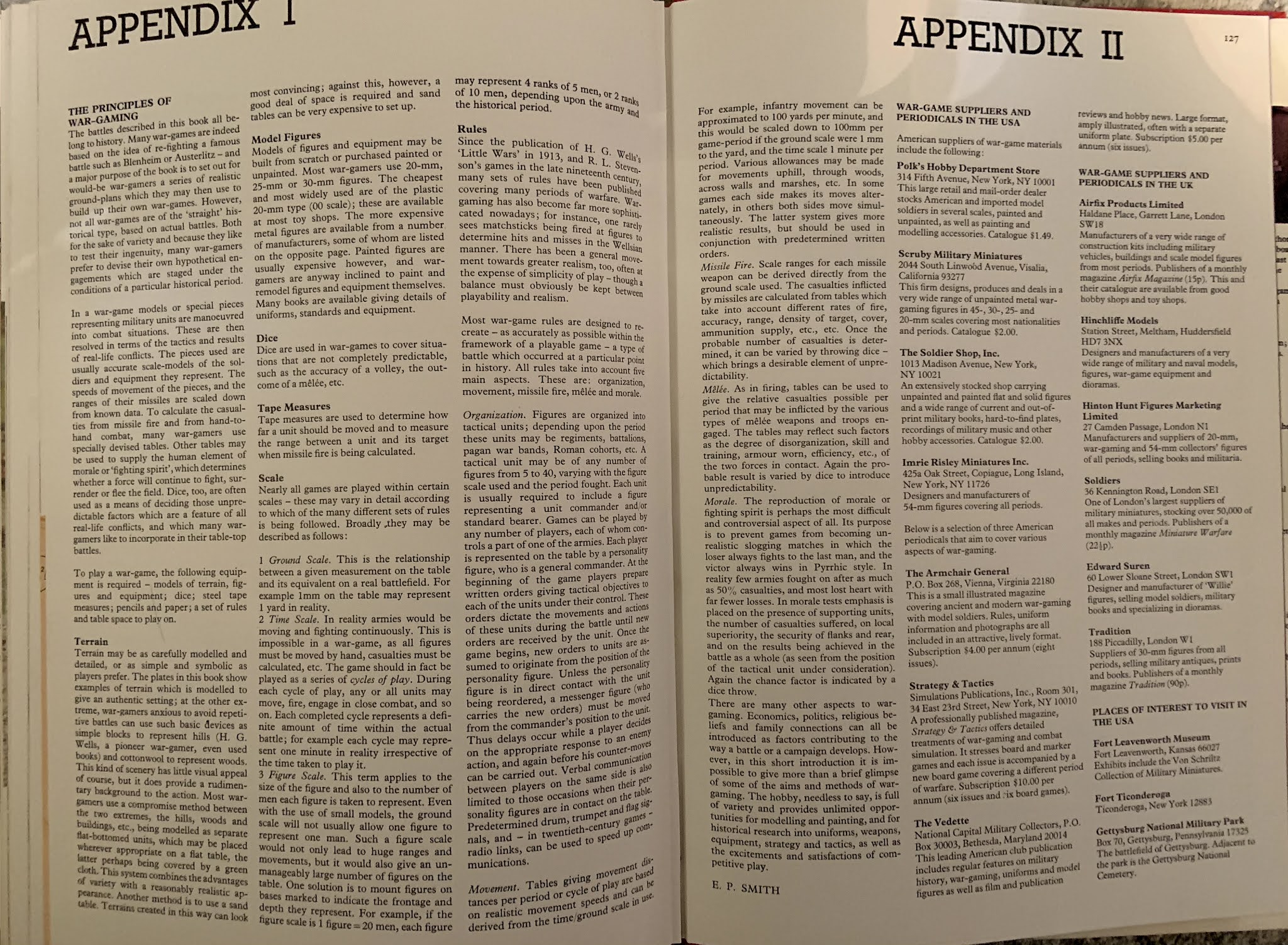
So clearly presentationally the book was superb. Then there was an impressive list of authors, many with military experience themselves. The pen portraits of the authors gave it all added respectability in my eyes. Each chapter was well structured giving historical background to each of the battles, descriptions of the leaders, a summary of the forces engaged, an account of the battle and some very useful maps.

I'm going to throw in some gratuitous photos here, because the book is such a feast for the eyes. And it conveys something of the sheer mass of material that was in front of my young eyes 45 years ago. Here's something from every chapter. This showed me what a rich field of interest was opening up to me. I hope it conveys some of the excitement I felt first opening up the book and when I devoured every page. And if you haven't read this book, I hope it inspires you to get hold of a copy. 
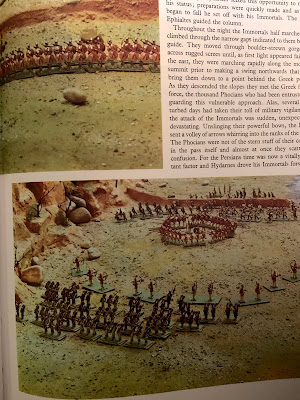
From the chapter on Thermopylae. So this was the battle that inspired The 300 Spartans film! Not gamed it though. Yet.

Agincourt initial dispositions

Agincourt again. A lot of the English archers here are Airfix Sheriff of Nottingham and Robin Hood's Men conversions, as are some of the French dismounted men-at-arms. I ended up buying lots of these but for conversion to Ancients.

Dispositions for Edgehill. Now I hadn't heard of this battle at the time. It took me until 3 years ago to finally get this battle on the table. Over 40 years but I got there eventually!

Lovely opening shot from the Blenheim chapter. I had Airfix Napoleonic at the time but this set the slow match burning for the 18th century. Or was that down to songs like 'Soldier Soldier' and 'O'er the Hills' learnt at primary school?

Now this was a complete eye-opener for me! I'd not heard of Frederick the Great, or von Browne, let alone  Lobositz. I don't think I even knew that Austria and Prussia contended the SYW! That was all Britain and France in North America, India, plus a bit in Germany right? This shows the style of the pen portraits of the commanders as well as the maps. The figures are clearly Grant's Spencer Smiths - painted in his imagi-nations' armies' colours. Finally re-fought this one 35 years later.


From the Saratoga chapter. Another battle I'd not heard of. The Battle of Freeman's Farm. 2 battles in the one chapter here, the other being Bemis Heights. Re-fought with a lad from school using book 2 rules and Airfix AWI figures.

In the Grand Manner! Austerlitz - another new one on me (I don't recall it from the Ladybird book on Napoleon which was my one source on the Nap Wars outside the British area of involvement). Just look at that lot!

Another mouth-watering shot from Austerlitz. It took until about 2011 to get involved in a re-fight of this when I umpired a game using Marechal de l'Empire and Old School Tony's Baccus collection.

Pretty much all I would need to know to get Waterloo set-up. It took me a few years before I war-gamed it, and that was a refight as a SYW battle because that's what our school group did.

Gettysburg. Day One. Another new one on me. Again it took me a long time to get to this. And again with Old School Tony, using Altar of Freedom. A great battle to attempt. Lots of options.

Last, but not least. El Alamein. Shot of a German column. Whilst I was aware of the Desert War (how could I not be with Airfix DAK and 8th Army sets amongst the first figures I had) I wasn't familiar with El Alamein. I must have had a very cursory acquaintance with the campaign in the Western Desert! And still not made it to the table.

Lots of eye-candy then. And lots of historical background. Much new information. And all very well put together and excellent told. But what helped nudge me in the right direction was the appendix. This gave me the bare bones to get started with war-games rules. Most of this was a revelation. I had not seen a set of war-games rules at that point. I still hadn't after reading this book. But I could cobble together my own on the basis of what the appendix described. Before this I was struggling with 1:1 troop ratios - shooting ranges were enormous on the table!


In conclusion then, the War Game really set me on the path to 'proper' wargaming. It gave me inspiration, validation, information, and (importantly) a framework. More than that it, educated me in areas of military history that I knew nothing about and it nudged me more towards the 18th century from Napoleonics where my area of interest had been the Peninsular War. The Seven Years War in Central Europe became my abiding passion, but not straight away, though the slow match had been lit.

I almost forgot that it also encouraged me to get into Ancients. One of the lads at the school wargames club was also interested in Ancients. Through him I heard about the Wargames Research Group, and thence on to book 2 on the list.....

What would you say are the books most influenced your wargaming career?


Tuesday, 1 September 2020

Prinz Eugen Playtest - the Combat of Zinna - Report

I played through the Combat of Zinna using Max Foy's Prinz Eugen hex-based rules for the War of the Spanish Succession. As Zinna was a SYW game I made a few tweaks to account for the slightly different troop types and capabilities.

(1) I treated skirmishers as normal infantry for firing but gave them a starting status of 2. Also I made it no harder to hit them with firing since I thought that this would make them too powerful. My rationale was that lots of lead flying around would make them more wary of popping up to reload and shoot. There's probably a better way to represent skirmishers, but it worked OK. 

(2) I gave non-Prussian light cavalry a starting status of 2 as opposed to the normal 3 (I'm sticking with the WRG that Prussian hussars were battle cavalry in the SYW). I would have given Prussian lights a minus if they came up against heavies in the first round of combat.

(3) I treated dragoons as heavy cavalry for the SYW. No bonus given for cuirassiers over dragoons, though this was a decision driven by the wish to make a game of it, rather than an effort to reflect historical quality.

(4) I gave heavy guns (12 pounders in this case) a longer range, increasing it from 4 to 6 hexes (1200 paces) representing the incremental improvements in gun technology and professionalism in the intervening 50 years.

(5) I allowed brigade orders to apply for firing as well as moving.

I didn't make any use of formation changing, stacking or spanning. This was mainly to keep it simpler for myself on a first play through.

The game lasted under two hours, and that included checking the main rules every now and again. Partly this was because the action was a small one. Partly it was because it was easy to remember the sequence and factors in tables. Including 3 generals, the Prussians had 15 units and the Imperialists 22 (including 3 generals). To even things up a bit I made the Prussian general Wunsch good (extra command chip) and the Imperialist St André poor (minus 1 command chip). This meant both sides got a basic stack of 6 command chips per turn. * VP target for the Prussians was 7 and the Imperialists target was 5 based on 1/3 of the total units. The rules were pretty clear, although I did discover I'd made a couple of mistakes later on (one more serious than the other, and that was due to my inattention). So kudos Monsieur Foy!

Do the rules give a reasonable representation of linear warfare? Yes. Can you pick them up and learn them quickly? Yes. They would probably play well for armies of up to say 30 units a side (including generals as units). This would mean a relatively small or medium sized action in terms of historic battles. For larger actions you could consider the units as regiments of infantry (large cavalry regiments) or even as whole brigades. In that case I would probably do away with ranged combat for infantry as the ground scale would be smaller, and subsume infantry firing into close combat with suitable tweaks.

The game itself was a close run thing in the sense that either side could have won it in what turned out to be the final turn. First blood went to the attacking Prussians who had some lucky shooting forcing the left wing Imperial cavalry to retreat and wiping out one infantry battalion.


Set-up. Prussians to the right, Imperialists to the left. I used Prussian musketeers for the mostly blue clad Imperial foot, and fusileers and grenadiers for the Prussians (since that is what their units were on this occasion). In the end I forgot to make any distinction in quality. Wunsch has a unit of hussars sneaking behind the village.

The Imperial left (top) has taken a battering and their right wing slowly reaches the stream and begins to cross. Square bases in front of the Imperialists are their battalion guns. Foot units are two bases of 24 figures, so almost 'Charge' sized units. Cavalry are 2 bases of 10. Instead of command chips I am using 'ADC' figures and casualty figures instead of hit markers.

Having gone into an early lead of 4 units to 1, the Prussians begin to suffer the withering fire of the Kaiserlicks, most of whom have battalion guns. You can see the ragged nature of some 'unformed' units and the casualty markers. Lots of Prussian units are on the verge of collapsing.


Top left, the Prussians have bent back the Imperialists left flank but the foot unit with 2 casualty markers fled from contact rather than let the Prussian hussars cut them up. This was a vital point in retrospect as the Austrians had lost 6 units (including one general). In the centre a unit of Imperial cavalry have penetrated the Prussian line, swept away a nit of skirmishers and are about to run amok. They choose to attack the third Prussian battalion whilst their infantry comrades shoot at the nearest two. The combined effect of this turn is that the Imperialists sweep to victory, err... 6-6 (see above *). The last unit to fall was accompanied by Wunsch himself (a 1 was rolled on 'risk to general') so 2 VPs in one combat.

The previously mentioned Imperial cavalry (circled) next to a gap where two Prussian infantry units had been. You can see the 3 other Prussian line infantry are teetering on the brink too (2 losses each - 3 means elimination). Other than that, all the Prussians have left are the hussars and two units of skirmishers (top left) and a battery (top right) and a battered dragoon unit (off camera). Maybe slightly more aggressive use of the hussars might have bagged the Prussians that extra VP needed.


So shades of Kolin here. The Prussians didn't have quite enough units to take the day, whilst possible victory was turned into defeat by the late attack by enemy cavalry riding down the exhausted bluecoats.