Showing posts with label Music. Show all posts

Friday, 29 March 2024

Vanha harmaa pillitesti

Your Old Uncle Nundanket brings you the gift of some mellow, if melancholic, music this Easter. It’s been a long time since I treated you so, and you deserve it. 

You may recognise the tune, if not the specific words. The singer, the late Topi Sorsakoski*, had, in my opinion, a super voice and imbued the song with such meaning that you don’t have to understand the words.

https://youtu.be/0IrTUI1owLg?si=oRv2eci3TpphcT6e

* not his real name, I believe. The surname translates as Duck Rapids.

Lyrics below so you can sing along. And practice rrrolling your Rrrs.

Kitara soi: the guitar plays. Other keywords: 

surua: sorrow. 

Suru vain: only sadness 

Sointi sen nyt minulle tumma on: its sound to me is dark now

Think you get the picture.


Friday, 8 April 2022

Daily reality of war

Now then. This song has got helpful side-by-side translations. It sounds like a straight militaristic song, with a jaunty tune, revelling in the imagined glories of war. But when you read the words you can see it’s about the grim reality. There are enough sarcastic, and bitter lines in there to make me believe it was written by someone who knew from first hand what he was talking about. It fits well within the cultural reference points of Unknown Soldier (Tuntematon Sotilas).

What really gets me is the line about the horses being so hungry they try to eat the stable walls.

https://youtu.be/-W9m1bLbKjg

This sort of thing is in the back of my mind when I think of the Continuation War, and forms the backstory to my (rare) games in the period.

Sunday, 13 March 2022

Polka time

I know how certain Wales based readers of this blog like nothing better than a polka. Here’s one in a slightly slower tempo for JBM (for it is he) with lyrics to sing along to if the Current Mrs JBM does not fancy dancing around the table. 

I think this is the song that set me off on this whole obscure Nordic music pursuit. A dozen or so years ago our Finnish language tutor took delight in making the adult class learn songs to sing in front of the assembled parents of the children at the local Saturday morning Finnish school, at Christmas, Easter and ‘midsummer’. Nothing as complicated, or as with it, as this one I should add. For a bit of homework I was looking on YouTube for whatever dirge teach had us learn and came across the following in the sidebar.

https://youtu.be/cz-1cBfOCc4

Wednesday, 16 February 2022

Interlude

Säkkijärven polkka

I’ve loved this tune for a few years now. This is a slightly slower version than normal, so easier for me to sing along to, but my tongue still gets twisted 🧐.

I also like this film because it has that ‘feel’ I want to capture in my Continuation War games.

Eteenpäin pojat! 

Tuesday, 27 April 2021

Sellanen ol Viipuri - A theme of Continuation

So today Postie delivered a book that I ordered from Helion in on of their frequent sales (50% off). The book is Bair Irincheev's Vyborg 1944: The Last Soviet-Finnish Campaign on the Eastern Front. When this first came out I baulked at the £30 cover price, bearing in mind the patchy quality of Helion's publications.  At half that I jumped in. I had a quick skim through the book and started reading it this evening.


A couple of immediate observations. There are some excellent photographs, including a number of shots taken by Soviet aerial reconnaissance planes and by bomber crews. The maps are strange. For a start none of them show the city of the book's title. Maybe they make more sense when I get to the relevant part of the text. Secondly, they use unit icons that are quite different to what we're used to in the west, but crucially, there's no key. Finally, none of them have scales. Maybe it's a Soviet thing and the staff couldn't be trusted with all the information. Most odd. Or sloppy. So far the text seems fine and does not suffer from the same translation issues that I mentioned with regard to the Saxon army book. More anon.


Detailed Soviet dispositions, but how big is this area?


Vyborg is the largest city in Karelia and sits on the northern side of the Gulf of Finland, about 10 miles inside the Russian border. Its fate has been that of the classic border city. Once part of the Swedish Baltic empire, Vyborg then passed into the Russian sphere during the Great Northern War. After Sweden lost Finland to the Russians in the war of 1808-09, Vyborg was included within the semi-autonomous Grand Duchy of Finland. From independence in 1917 to the end of the Winter War in 1940 Vyborg was part of the Finnish republic, then it came under Soviet control. For just over a year, as it was recaptured by the Finns in 1941 in the Continuation War. Finally in 1944 Vyborg was re-captured but the Soviets and eventually it ended up in the Russian Federation.

Viipuri by the way is the Finnish name for Vyborg, Vyborg being the old Swedish name. Viipuri is not a transliteration, but is I suppose is the closest to how it notionally sounds to Finnish ears (there being no 'B' or 'G' in the Finnish phonetic system). We did have some confusion in the Schloß several years ago over 'backs', 'bags' and 'packs'. Sellanen ol Viipuri is the usual title given to an old song which I came across on t'internet. I think rendered in formal language it would be 'sellainen on Viipuri' ('such is Vyborg').

The song was written as Ilta Viipurissa* (Sellanen on Viipuri) in 1929 by Eino Kettunen. More specifically Kettunen wrote the lyrics. As I've discovered before with these standards (e.g. Joseph Joseph and Those Were the Days), the tunes are often older. The music was composed by Moravian born Rudolph Josef František Benatzky as Abends in dem kleinen Städtchen. This seems to have been an instrumental judging by the 1924 version on YouTube. No doubt some musicologist or folklorist from Mitteleuropa will (or perhaps already has) claimed even older antecedents for the tune. 

* 'Evening in Vyborg'.  Kettunen also wrote the lyrics to another Finnish classic which became a meme a decade and a half ago when an electronic version got linked to a Japanese cartoon. Again, the tune is older. Much older I believe. (Ievan Polkka in case you're wondering).


There are many versions of Sellanen Ol Viipuri on YouTube, but my favourite is still this one. I may have mentioned it before, but I'm a sucker for cheese. 😁

https://www.youtube.com/watch?v=Gc_pVBAVzlk

Here are the lyrics so you can sing along. Enjoy!

Siihen aikaan näillä mailla

Oltiin vielä paljon vailla

Eikä kukaan kummempaa kaivannut kai

Tanssittu ei pitkin yötä

Illoin riitti puhdetyötä

Kapaloissaan kehitys köllöttää sai

Toista oli Viipurissa

Karjalaisten kaupungissa

Siellä vanhat vaihtuivatkin uusiin säveliin


Tanssia sai siellä aina

Arkena ja sunnuntaina

Helppo oli tiensä löytää

Kohti oikeata pöytää

Jos vain joku kielsi 'ei ei ei'

Toinen sanoi heti 'hem till mej'

Sellanen ol' Viipuri

Sellanen ol' Viipuri

Karjalaisten kaupunki


Silloin painaneet ei huolet

Ystävät kun kantoi puolet

Surra saivat hevoset, laulut kun soi

Pyöreen tornin hämärässä

Pöydässä niin hilpeässä

Ilo oli irrallaan niin kuin vain voi

Kaikki viihtyi Viipurissa

Karjalaisten kaupungissa

Siellä vanhat vaihtuivatkin uusiin säveliin


Tanssia sai siellä aina

Arkena ja sunnuntaina

Kieli vieras taikka tuttu

Laulu oli helppo juttu

Jos vain joku kielsi 'ei ei ei'

Toinen sanoi heti 'hem till mej'

Sellanen ol' Viipuri

Sellanen ol' Viipuri

Karjalaisten kaupunki


Tieshää Nuutipoja passas

Että syvämes ja vassas

Viipurlaise rakkaus assuuki vain

Torkkelista sai mie muiston

Alla koivu kaunii puiston

Rinkelii ko siult mie kerrankii sain

Muistat sie myös jottai muuta

Taisiha mie saaha suuta

Monrepoos myö kuuta ko nii kahe kasseltii


Laa-laa-la-la-la-la-laa-laa

Laa-laa-la-la-lal-la-laa-laa

Laa-laa-la-la-la-la-laa-laa

Laa-laa-la-la-lal-la-laa-laa

Hmm...

Hmm...

Sellanen ol' Viipuri

Sellanen ol' Viipuri

Karjalaisten kaupunki


Friday, 15 January 2021

Why we won't win Eurovision again - or I'll have extra cheese with that

I put up a post the other day with a dead link. Tradgardmastare Alan pointed out that it didn't work and in my ham-fisted attempt to correct it I deleted the post.  Apologies Alan. So as not to deny you of my exposition on this most important of current issues, I'll re-post the link and offer up a couple more in the same vein.

What I was trying to say before is that there is a fundamental cultural gulf between Britain and the Continent which might be explained by our resistance to the delights of Schlagermusik*. When it is enjoyed, it is regarded as something of a guilty pleasure for us in this Sceptered Isle.

* supposedly it has nothing to do with lager, although come to think of it, the nations that like ale are relatively immune to it. Given my inability to ever find real ale in Cork, that might explain a few things.

The link I attempted to post before is below. My 'discovery' of the lady's oeuvre has been one of my 'Guilty Pleasures' of recent months (though I'm not cool enough to feel any guilt about enjoying this). I don't think you need a word of the language to appreciate it, but by the end you will have picked up enough Finnish to sing 'laiii lai lai lai lai lai laiiii lai'.

https://www.youtube.com/watch?v=Gc_pVBAVzlk&list=RDTUVcCTpkyZg&index=7

FYI Karjala means Karelia and through my extensive research, I have discovered that it is virtually compulsory to sing about it in the Finnish version of the genre. It pops up in the above song (Viipuri is the city of Viborg) and countless others. Like this one. And if you don't like extra cheese on your cheese toastie, it's best to avoid it. Me, I love it.

https://www.youtube.com/watch?v=vZD8s-9wEQE

And then there's this video which fascinates me, despite not being able to find any reference to Karelia. I think it must be because the roof appears to have an alarming leak above the singer's left shoulder.

https://www.youtube.com/watch?v=5pwSwcLptow

Incidentally, I was led to Ms Tuupnanen's videos through my love of the song Josef Josef referred to last March.

Enjoy!


Wednesday, 23 December 2020

Stop dancing!

 ....while I’m at it, the Annie Lennox video shared by Tradgardmastare on his blog reminded me of another clip on YouTube. This one most definitely isn’t a seasonal song, warning instead of the power the Devil exerts through dance.

I was put in mind of this because of some of the imagery in the Lennox video. I thought it looked a bit like shadow puppetry and an image on this other video.

https://youtu.be/FI3iX8WtzaM

If you’re interested in the lyrics, a chap called David Nelson helpfully posted them in the comments in both Swedish and English. Bra!

I posted a link to another song by the same singer, Elina, back in May last year. At least I can claim that one was relevant to this blog’s title. 😁

The Holly and the Ivy

Inspired by some of Tradgardmastare’s recent posts, particularly the one with Annie Lennox, I looked up some of my own favourite tracks featuring Christmas carols.

For many years I played Kate Rusby’s 2008 album Sweet Bells to death every December. It features carols in the ‘Sheffield’ tradition - mostly standard words but to different tunes, sung in the pubs of the area around the Steel City. I think the album eventually got under my kids’ skin too and one of the 14-year olds told me the other day that she’d recently introduced her best friend to it. Yes, I’m one of those annoying proselytisers when I find songs that I like.

Ms Rusby normally does a tour in the run up to Christmas. Three years ago I managed to get organised in time to buy tickets for the six of us for her London gig. On my birthday. I was a very happy boy that night.

I wouldn’t say the following is my favourite track - that is too difficult to call. But I offer it here because it makes me think of ‘Olde England’. This version also made me understand that carols really are dancing tunes.

https://youtu.be/ETe6jOt6BnI

Hope you enjoy it!

Tuesday, 29 September 2020

Reasons to be cheerful

I was going to go with this post title even before I saw Tradgardmastare’s punning title. You’ll see why by the end of the post.

My walks (and related posts) have reduced in length and frequency since August. One, the days are getting shorter so there’s less daylight after work. Two, the frequency of late work calls has gone up, with a general increase in busy-ness. Three, exercise of a more vigorous nature has taken over (although this trend went back to early August).

The opportunity to take some time off work arose and after my bike and swim, and a few chores, my wife and I went for a walk in Richmond Park. Ladderstile gate to Pembroke Lodge and back to be precise.

Things are looking and sounding more Autumnal. We haven’t got really bright leaf colours yet, but the fern has started to die back and conkers are strewn over the ground. As for Autumnal sounds, well I heard my first proper stag bellow of the rutting season at the weekend, when I was peddling through Bushy Park. I then saw the big brute charge another male that was standing some way off. As with a lot of charges, it didn’t actually lead to actual contact as the defender (LMD*) opted to evade. Today we heard some serious bellowing in Richmond Park, so be careful out there.

* I believe that would be the correct WRG Ancients term for it: Light Medium Deer.

After a coffee at the Pembroke Lodge cafeteria we strolled by an area of the gardens known in the family as ‘the Squirrels’ from the times when we used to walk there with my eldest when he was very small. Sadly the area concerned is fenced off (look but don’t touch) now, so no more opportunities for small boys to chase squirrels and pigeons around the base if trees.

Here are a few pics taken along the way.


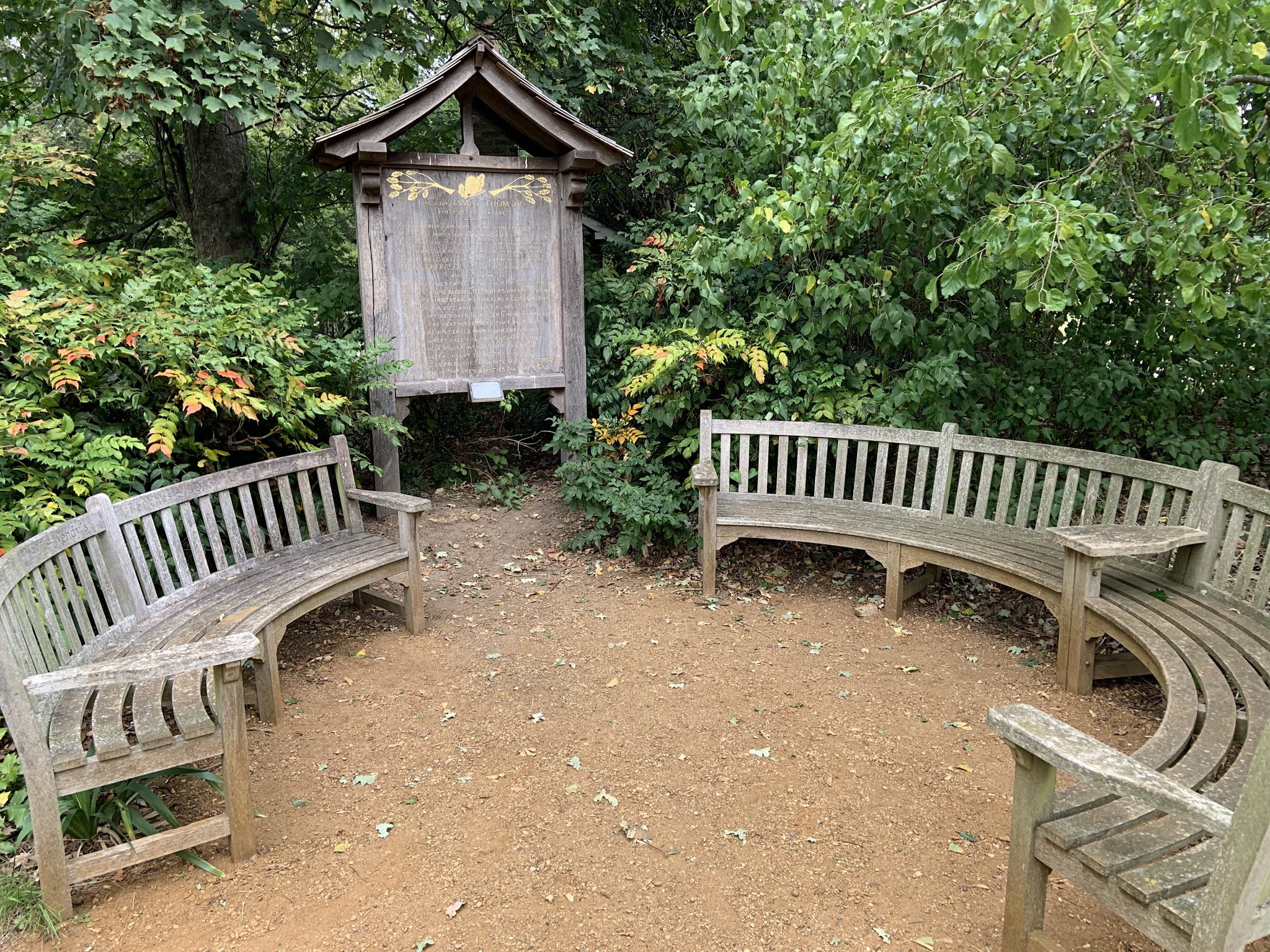
Bench at Poets' Corner. I hope you can make out the words engraved.


The whole ensemble. The words are carved in the benches to the right. The plaque in the background has some (to my mind) awful poetry. Though don't take my word for it as I don't know a foot from a metre.

Ah! But this is what we've come for.


Some explanation. I didn't try to listen today. Years ago, when the bench was first installed, I liked to take my head phones to plug in. 


As ever, the main reason to be cheerful was with me on the walk. Educating me on the Latin names for various plants, and being very calmly companionable.

Sunday, 31 May 2020

I couldn't resist it

That man Epictetus has flagged up the recent spate of Cummings-mania on YouTube. Here's a particularly good one.

I would drive 500 miles

It's only a matter of time before someone covers this:

Go Go Dick and Dom

I should have added, no prizes for guessing who the Dick is.

Tuesday, 7 April 2020

More progress and some planning

So off the back of thoughts about a FaceTime enabled game, I got out my 10mm Soviets and a few Finns. So after prepping and priming them on Sunday I painted them this morning. I'm having the day off work for the second Tuesday in a row. This time as a bit of recovery time from Operation de Gall yesterday. This was the second removal of a head of state in the last couple of months. The last, saw Donald Lump (aka Ray Cyst) ejected from office. For that one I was fully awake (a weird sensation feeling your skin being tugged but not feeling any pain), but yesterday was under GA and I was still in a golden mood and a bit woozy in the evening.

I am basing them in groups of 3 riflemen or a support weapon team on 30x30mm bases, with each base representing a section a la Tigers at Minsk. When based I have a rifle company plus a machine gun platoon of Finns (shades of Unknown Soldier/Tuntematon Sotilas), and a small rifle battalion of Soviets including support weapons (50mm and 80mm mortars, MMGs, LMGs), plus command including Commissars.

Soviets painted and awaiting bases.

Finns ditto. The chubby lads on the right are Magister Militum. Russians but painted as Finns who often used captured equipment, and specially helmets. Front left are Pendraken I think. Behind are Pithead Miniatures. 

Two scenarios sprung to mind, both inspired by the film:

  1. An assault by Finns on prepared machine gun positions from 1941
  2. A fighting withdrawal to a river line by the Finns in 1944

I will play the Soviets, semi-AI stylee working to strict orders/plans, and my son can take the Finns which will require more active engagement.

I have a couple of thoughts on the rules. One is Tigers at Minsk, which might take a bit more getting used to, or a ‘back of a fag packet’ set I drafted myself a while ago.
Our heroes will have to cross this innocuous stretch of forest clearing and the water beyond.


It all now depends on whether the bases I ordered from Pendraken  arrive in time.under present circumstances I doubt it. [incidentally I rewarded myself for my recent work on the backlog by ordering up some more horse, foot and assorted siege types from Pendraken, and some castle pieces from Leven].  If the bases don’t come quickly I’ll go for a scenario based on the Battle of Seacroft Moor from the ECW. This was a fighting withdrawal over the Yorkshire landscape from Tadcaster (home of Samuel Smiths fine ales) to Seacroft a village now in the Leeds suburbs.

This will entail some telescoping of terrain as it was a distance of some 9 miles.  Both sides had an asymmetrical 1000 each, with a foot heavy Parliament force being run down by a Horse dominated Royalist posse. In my normal troop scale this would only be 4/5 bases of foot and 3 horse for the Parlies so there’s not much scope to scale this down in order to stretch the terrain.  As I haven’t got a 15 metre* battle mat the game will need partial map movement and then quickly set out tabletop terrain for close combat.

* which is what 9 miles would work out as using my normal rules. In any case we have rain forecast for the weekend so the garden option is out of the question even if I did have a sufficiently large cloth.

So is it to be Njet Molotoff or No Popery?

Sunday, 15 March 2020

Josef Josef

I have mentioned before my penchant for obscure music in Nordic languages. This originally started as a lazy way of learning Finnish. We all know how singing makes things more memorable and one of the earliest things I learned in Finnish, after essential phrases like "you have beautiful blue eyes", was the song Incey Wincey Spider, or Hämä Hämähäki as that arachnid is known in the land of the Kalevala.

A while ago the algorithm on YouTube threw up a band named Komiat ('the Handsome Ones'). Young guys playing old school dance music (as in dancing with partners, not disco). I liked them and came across this track which I'd never heard before in any language. Some of you chaps will no doubt know the song well as Joseph Joseph as sung by the Andrews Sisters during the War and dismiss me as an ignorant young whippersnapper.  I very much like this band and this version. It's an absolutely banging choon and the singer has a very good voice.

https://www.youtube.com/watch?v=R6FmgT3V06E

Here's the lyric if you want to sing along - go on, I know you want to.

Singalonga Max (Foy)

It was only today whilst idling on my sofa that I discovered the older versions through comments below the videos. First this wartime version in Finnish by the Harmony Sisters and then the Andrews Sisters version. It was then but a short hop (again led by the comments*) to the even older Yiddish version. Apparently it was originally written in 1923 in Yiddish (Music, Nelly Casman; Lyric, Samuel Steinberg) and later translated into English by Saul Chaplin.

The Finnish lyric isn't a straight translation of the English. For all I know it might have been directly translated from the Yiddish, but I don't know what the Yiddish version says. Instead of the song being a woman lamenting her lover not popping the question, the Finnish refers to a man who clearly has a woman in every town. Maybe that was just a bit too much for Anglo-American ears in the 30s and 40s, so we end up with a man who just cannot commit rather than a real tom cat.

Finnish Version
English Translation of the Finnish
English Version
Oi Josef, Josef, muistatko kun kuljit maan halki etelästä pohjoiseen?

Sä kaikki neidot syliisi suljit kuiskaten: "Näämme kohta uudelleen."
Oh, Josef, Josef, do you remember when you travelled through the land from south to north?
You held every woman in your arms and whispered: "We will [meet] soon again."
Oh Joseph Joseph, won’t you make your mind up, it’s time I knew just how I stand with you.

My heart’s no clock that I can wind up, each time we make up after being through.

Presumably the Finns main Axis ally would never permit a version in their country, given the songs origins, but it would not surprise me to find a version in German from earlier. There was a black market in Jazz music records in wartime Germany so this song could well have been circulating**. I did manage to find a Danish version from 1938, so maybe there's more out there. If by any chance you do come across the song in other languages, I'd love to hear about them.

Anyway, hope you enjoy the song. Stay well!


* it's cheering to note in these dark times that the 'bottom of the internet' is not completely full of bile spewed out by angry nationalists and wazzocks.
** BBC Radio 4 had a programme a while back featuring a German guy who had made it his work to research the underground black music scene in Nazi Germany.


Tuesday, 24 December 2019

Interruption in the war

https://www.youtube.com/watch?v=ETe6jOt6BnI&list=PL1Ceanrb_TkvCOkJxCcdllqd1xmHeop5M&index=5

Wishing you all a Merry Christmas from Olde Englande. Hope you enjoy the song as much as I do.

And a special thank you for all your bloggers out there who have inspired, entertained, educated and informed over the year.


Our correspondent will be back with news of the King's victory over Karl von Lotharingen in Bohemia. The WRG rules played like a treat. Just a few occasions on which I needed to check the full rules, otherwise it was just the QRS. Not bad for something I haven't played in over 30 years.

Tuesday, 12 November 2019

The Winter War - Talvisota (movie)

Tell battalion that the next people in the bunker will be archaeologists

In August I mentioned that my lovely wife had bought me a couple of DVDs when she was over visiting her mother. Towards the bottom of here

I watched the first set, Tuntematon Sotilas, soon after and thoroughly enjoyed it. So with naff all on the box last night I intended to watch the first hour or so of Talvisota. At 191 minutes long I thought I would space it out over 3 evenings. The fact that the 'or so' part of 'first hour or so' extended to 'the whole three hours plus' tells you a lot about my feelings on the film. And this was my second viewing (I'd seen it a couple of years ago on line).

According to Wiki there were 3 main versions released. The international cinematic version (127 minutes), the one I saw (the original Finnish cinema version) and the extended TV series at a whopping 275 minutes.

The basic plot concerns a small sub-unit (don't they all?) of soldiers called-up in October 1939 ('for manouvres') and what happens to them over the succeding five months. Naturally, the bulk of it is the 100 days of the Winter War. As with all films of this genre, the sub-unit gets whittled down and you begin to wonder whether the main character Martti Hakala will cop a 'Bäumer'.  I'm no WWII specialist so I don't know how realistic the action scenes are (if anyone has seen it and has a view I'd love to hear it). It seemed plausible to me (even if the Soviet tactics shown were mostly suicidal, which I understand they largely were).

One facet of this film that I appreciated were the little insights into what life was like then in Finland - still a mostly agrarian country. As with Tuntematon Sotilas, I found some of the 'homefront' scenes touching. We see a society where most people didn't have much, didn't expect much, but nevertheless felt that they had enough worth protecting - though that wasn't necessarily material. It seems almost as if there was a collective expression of "look our ancestors came to the most inhospitable part of Europe, hacked out a modest living out of unpromising material, kept ourselves to ourselves, and you lot still want to bother us and ask for more".  Maybe that's just me with my biases.

We also see a society where Christianity still had a big influence culturally and socially. In one scene the singing of a Christmas Carol becomes an act of resistance. Probably like my grandparents generation here, they all knew the words.

Also much appreciated by this blogger is the deadpan Finnish humour, that goes with the no-nonsense approach to troubles. If you get the typical British wartime humour, you will like this. The sort of thing where a quip is made out of the corner of the mouth, with a fag* in the other side. The Russians are nearly always 'naapurit' ('the neighbours' - e.g. 'the neighbours are trying to move the garden fence again') when not 'Ryssät' (which I understand is a more perjorative than 'Russkies').

The special effects are pretty good on the whole, especially when the film was made in 1989 - it coincided with the 50th anniversary of the war. We're now approaching the 80th and that generation is nearly all gone. Although the Finns ended up on the 'other side' in 1941, I can only honour and admire their sacrifices in defending their homeland and freedoms**. Just as I would honour the poor bloody sods who were sent to take them away and suffered unimaginably in a frozen forest a long way from the steppe or from the warm valleys of the Caucasus.

I'll raise the mood a little now by reference to a song (or rather tune to a song) that got played a couple of times by one of the characters in the section. This was originally a hit in the 20s (I read somewhere it was the first 'pop' sensation in Finland) and there are many clips (from several countries) out there in the interweb of different versions (sometimes simply called "Emma" or "Oi muistatkos Emma?","Emma's Waltz", "Emma's Valssi", or "Finsk Vals" or variations of that - yeah I am obsessive.). All lovely because it's such a great melody. It's been a while since I inflicted any 'obscure Nordic music' on you, so here you go. And I'm sure many of you will appreciate singing along in your French farmhouses, so this one has helpfully got lyrics on screen. Or just take the missus for a waltz around the kitchen table.

 https://www.youtube.com/watch?v=9dpcVRW8DfI


* for clarity, this is British-English for 'cigarette' (and in such cases it nearly always is a 'fag' not a 'cigarette').
** For anyone so inclined to point it out, no I'm not ignoring the unacceptable things that happened in the Continnuation War....but to coin Basil Fawlty in 'the Germans' "Yes you did, you invaded [Finland]".


Thursday, 19 September 2019

Unseasonal Song

I know some of you out there like nothing better than to slop on a wooly jumper, stick your finger in your ear and sing through your beard.

I was born near the end of the baby boom and it seemed that every other primary school teacher wore long cotton dresses and played guitar.  All in the great tradition of 20th century folk revivals of course. Indeed, my own eldest sister did her best to conform to the stereotype, even coming home from teacher training college one Christmas with a Narfuk accent (it sounds more 'Yokel' than a Grimsby accent).  Once a week at junior school the teacher would wheel in a reel-to-reel tape recorder with the latest hip chunes from BBC For Schools and the accompanying songbooks. The fashion in these things was rather ecclectic. The Lincolnshire Poacher (hooray!) rubbed shoulders with Hava Nagila, La Cucaracha and countless Irish songs which always seemed to be about ladies running away with Gypsies. They always seemed to forget the words in these Irish songs, the choruses being all nonsense lyrics like ''ah de do do de do dah day". Or was it misheard Gaelic?

Something must have sunk in and seeped into my soul. Years later, like an Ossi finding that the 'freedoms' of the West fail to meet some essential human need, I slowly returned to the path.  I was flicking around earlier through some of my old YouTube faves and came across this song which always nudges some ancient feeling in me. Despite not understanding a word of the lyric* the whole thing feels familiar. Maybe someone more educated in the craft can explain the universality of the tune/sentiment.

The feeling is also helped by the fact the blonde singer vaguely reminds me of my teacher in the third year of junior school.

https://www.youtube.com/watch?v=U7wXcJiGH-o

 May be welcome

* That is until I discovered the translation above, when suddenly the odd word, when written down (but usually not when spoken) kind of made sense in an archaic English/northern dialect kind of way. E.G. we used to call the dessert/pudding course our 'afters'. I had the distinct impression (from where I don't know) that this was terribly common of us. Now I know it's not improper English at all, but perfectly legitimate dialect from some ancient Norse word 😀 https://translate.google.com/#view=home&op=translate&sl=en&tl=sv&text=afters


Sunday, 16 June 2019

Hiatus and Life in the Trenches

Apologies to my esteemed reader for the lack of updates these past weeks. I plead Real World interruptions including a work trip lasting 12 days. I had intended to write up some posts based on thoughts I'd sketched out before I went away, but I hadn't accounted for how tired I would be in the evenings. I'm still getting back into the swing of things having landed in the UK on Friday following an overnight flight. I'll have a stab at those updates this week.

In the meantime I offer you another musical interlude. This time from the Continuation War of 1941-44. It has strong associations with the Finnish novel 'Tuntematon sotilas' by Väinö Linna (The Unknown Soldier) and films of the same name. I re-read the book (in translation of course) on the trip and it is just as powerful the second time round. If you appreciate All Quiet on the Western Front, I'm sure you'd value this too.

The song has a slow tempo waltz rhythmn, so I'm sure you'll soon be singing along  😉 (words below the description in YouTube) .

Elämää juoksuhaudoissa


There's a beautiful version ont'web by an American of Finnish stock called Diane Järvi. Well worth listening to too in my opinion.

Friday, 17 May 2019

The Last Battle

This is the first in an occasional series (i.e. when the mood takes me) of little musical interludes. Now and again there's a military history link. Often there'll be a Nordic* aspect. Sometimes both together, as in this song about the last battle in the Russo-Swedish War of 1808-09, when the final nail was hammered into the coffin of the Swedish empire. I've tinkered with the idea of wargaming this war, but haven't got beyond some vague ideas, let alone acquiring any suitable lead. I do have plenty of trees though!

The singer, Elina Järventaus Johansson, has a beautiful voice and the song has a haunting melody. I'm yet to find the lyrics and translation. Oh, and there's some atmospheric visuals to go with this. You can practically smell the black powder. Gå På!

https://www.youtube.com/watch?v=7y7jZSk8mus


* Carefully chosen word, as there will probably be a fair bit of Finnish content at some point, and, as every fellow pedant will tell you, Finland is not Scandinavian.