Showing posts with label Rules. Show all posts

Thursday, 11 January 2024

That is so-o-o-o last year!

They say, if you want to know where you're going you've got to know where you've come from. I'm not sure who 'they' are but 'they' are always credited with wisdom or power, so I'm not going to argue. I feel I'm at one of those decision points in life generally. Not some 'mid-life crisis (I'm too old for that, and I'm broadly happy with my circumstances). So no fast cars or motorbikes. I would grow a moustache, which I hear is de rigeur with bloggers d'un age certain, but with my eyebrows it would just look stupid. Like a lot of folk with a 6 in front of their age, thoughts about retirement plans have made their way to the forefront of my mind. Not that it something likely in the next few years - not unless ERNIE does me a big favour. But those sort of 'real life' questions also provoke questions of what I want to do in my spare time, long term as well as short-term.

No conclusions have been reached just yet, but a bit of 'state of the nation' reviewing wouldn't go amiss. What is my current level of activity like? What am I doing? Does it satisfy my wants? That sort of thing. So here's a review of last year's wargaming related activity. Other hobbies/pastimes do exist in my life, mainly swimming and following Grimsby Town, and a short summary of last year for both would be "not enough". Have I done enough wargaming?


Reading/'Research'

Let's start with reading (or more broadly 'research'). It always starts with reading. I bought and read 13 military history books last year.  By period this breaks down to:

  • English Civil War - 2
  • War of the Austrian Succession - 2
  • Seven Years War - 2
  • AWI - 2
  • 18th Century more generally - 5

The last category is hard to breakdown by wars since they all covered several decades. E.G. the Army of George II, or the biography of James Keith. All 5 spanned the WAS and SYW though. So that gives you a clear idea of my focus.

Other sources of information plundered: 

Obviously there's t'internet: blogs, Wiki, history websites, YouTube, Royal Collections Trust (great for maps) and last but not least, Kronoskaf.

Podcasts. I've listened to probably 150 military history podcast episodes. Including every episode of We Have Ways of Making You Talk (not my period but interesting, and there are some universal themes), Military History Plus (very broad scope, but with a heavy WWI focus) and the Life & Times of Frederick the Great. Numbers are high because I can do this while driving, painting, housework or DIY.


Modelling

After reading comes the planning, then the assembly of 'armies' and terrain to fight over. In an echo of the volume (but not the quality) of Jonathan Freitag's output, over 1000 figures came off the painting table and were based up. Bear in mind however that mine are all 10mm (AWI and ECW) and 6mm (everything else). Counting cavalry as 2 and each artillery base as 5 (1 gun plus 4 gunners). The period breakdown is:

  • AWI  - 92
  • SYW/WAS - 965

All the AWI figures are Pendraken and all the SYW painted were Heroics and Ros (save a couple of Irregular officers which were re-purposed). The American Revolution figures were all Brits/Loyalists. The SYW/WAS includes British, Hanoverians, Reichsarmee, Austrians, Spanish and Piedmontese. So not a bad total.

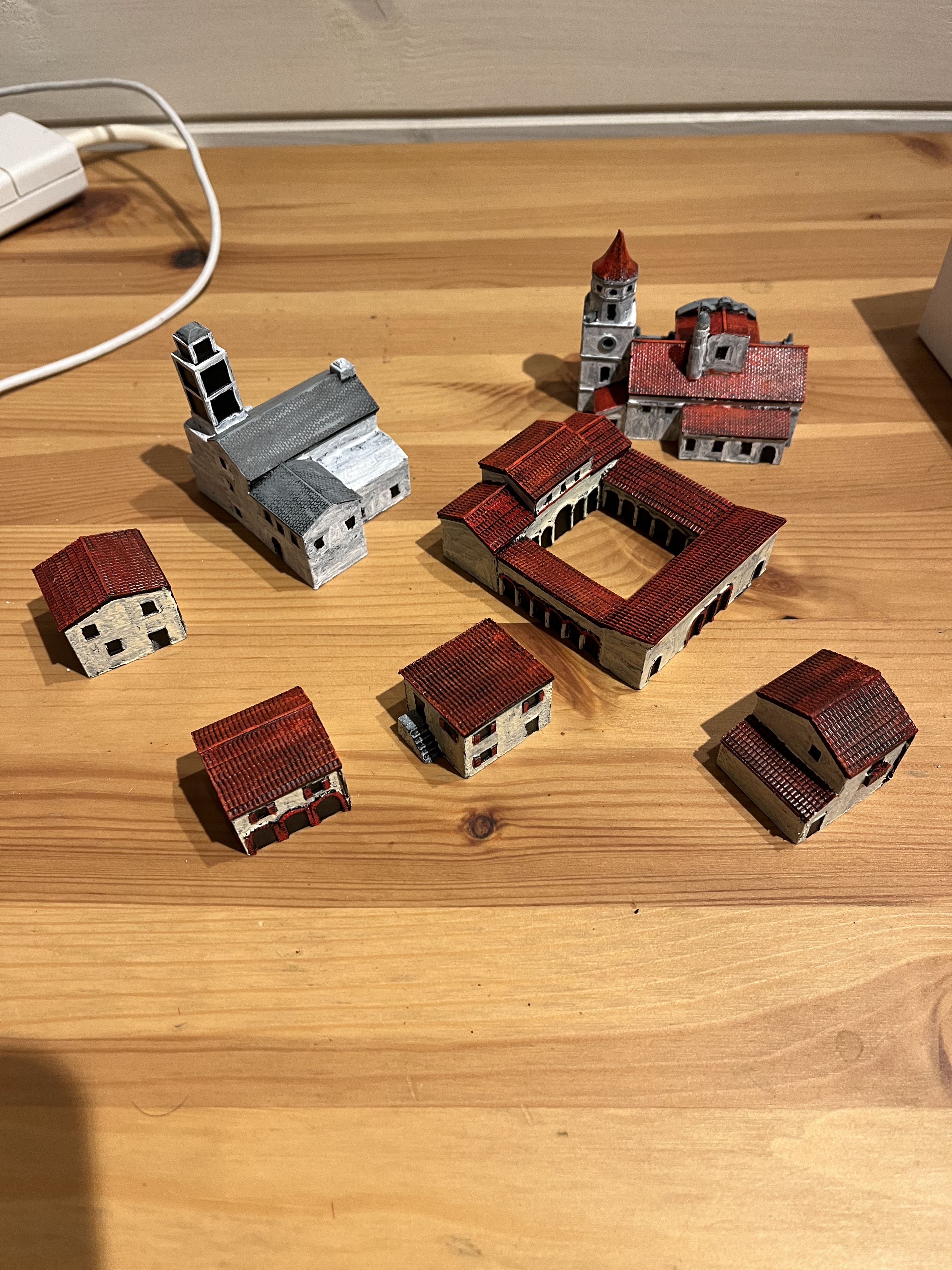
In terms of 'terrain' pieces I only painted up 7 buildings (AWI) and a couple of packs of brick walls. Less good, but I didn't need to do much. This is the great benefit of limiting the scale models used and having restricted geographical scope (Europe and NAM).
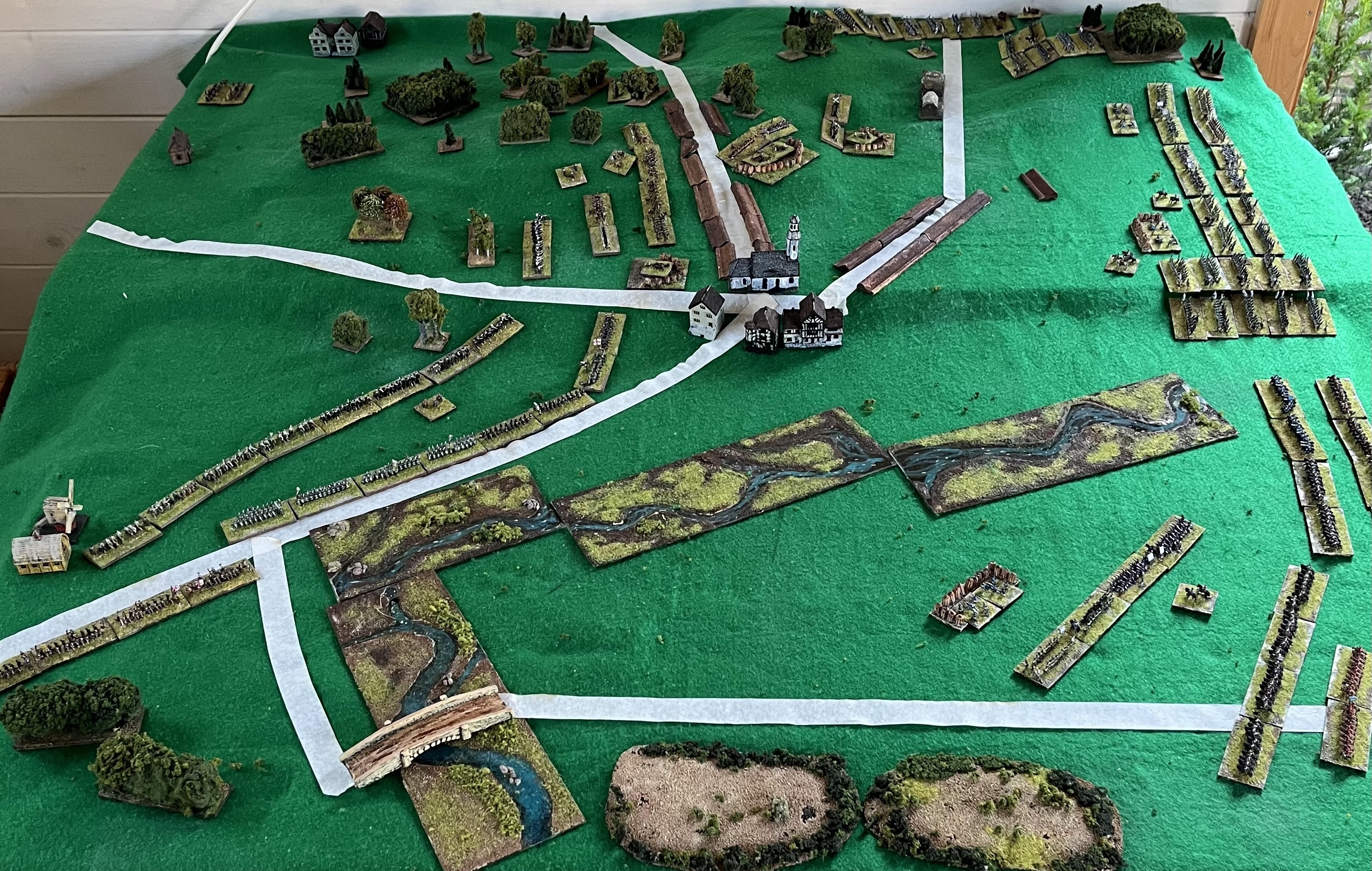
Hastenbeck in September


Games Played

OK, how do the actual games totals look? With 21 games played, a school teacher could mark my report "could do better. Splitting them by period we can see a pretty varied scope:

  • Ancients - 3 (1 Bronze Age, 2 Punic Wars)
  • AWI - 5
  • ECW - 2
  • WAS - 5
  • SYW - 1
  • ACW - 4
  • Spanish American War - 1

These were all one-off games except for 1 PBEM AWI and 1 solo WAS campaign.

Split by 'mode'

  • 3 games I hosted remotely; 
  • 12 remote games hosted by Jonathan Freitag*; 
  • 1 was PBEM; 
  • 5 were solo. 

No face-to-face games: how very 21st century. Or you could say "should get out more".

* and many plaudits go to Jonathan for his hosting, and scenario preparation, and rules revisions.

Broken down by rules used:

  • Jolly Broom Man's AWI campaign rules - 1
  • Homebrew WAS rules - 1
  • Jon's ECW rules - 2
  • Loose Files & American Scramble -3
  • Basic Impetus - 3
  • Twilight of the Soldier Kings - 4
  • Fields of Honor (with period variants) - 7
First off the blocks for 2024. 

Interestingly, I seem to be drifting more into the War of the Austrian Succession than SYW at the moment, looking at the numbers above.


Conclusions and Thoughts for 2024

In terms of games, I want to do more. The main thing that's held back the number of solo games is ....me. I've allowed things to drift. Partly this is motivation - but I want to do more and will get more out of it if I game more. A bit of it is connected to not having a permanent set-up. A part of it is also settin-up big games. Twilight of the Soldier Kings is great because it gives a good, historically plausible game in a few hours. I tend to spend too long on the set-up. If I can find a more efficient way of setting-up I can get more games in.

Painting levels are OK. I don't have a massive lead pile. I have some odds and sods that have been hanging around undercoated for a while, but these are 'ancillary pieces' (pack animals, villagers etc). Having initially said I will keep my Spanish and Piedmontese WAS collection down, I am very tempted to get more. (1) because I like doing them; (2) I am getting into the 'sub-period' the more I find out about it**; and (3) because I really 'need' more ;-). Actually I'll get some games in with what I've got first. If I do go ahead with it, I'll probably do c.1000 figures. The amounts of Spanish and Piedmontese in the total for 2023 was 965.  I know when I have them, I can churn them out.

** in fact, as well as the WAS, there are several battles in the War of the Polish Succession I fancy having a go at too. So don't be surprised to see Guastalla on the table.

I doubt I will be adding to my ECW collection (I managed to get through 2023 without touching them) or my AWI forces.

At some point I really need to think about my book collection. I have outgrown my cabinet and I have to question whether I will read them all again. So maybe some need to go out of the door before more come in?

I will be disposing of some figures soon. The Erbprinz said he wants to store his Napoleonic Prussians at his place when I suggested e-Bay. My Baccus Anglo-Spanish-Portuguese chaps could do with a new home. Some other unpainted figures will be going out of the door sooner than later.

None of this addresses what else I would like to do in the future. Ancients and Colonial have long-been kicked around as unfulfilled aspirations, but nothing solid has been done about it. Partly this is hesitation over acquiring a heap of new terrain and buildings, to say nothing of more books and 'research'. Another 'itch' to scratch is an 18th C Ottoman army. Campaigns figure large in my wish list too. I had ideas for an ECW mini-campaign nearly 3 years ago and have done sweet FA about it. And I keep saying, the Italian WAS campaign is imminent!

The shape of things to come?


Expect some more navel gazing. Oh that reminds me. I have been thinking about buying a handful of 18th C ships (scales down from 1/300th) for the Med aspects of my WAS campaigning and possibly for the Great Lakes/AWI. I can find ships for the Napoleonic era and for the Anglo-Dutch Wars/Pirates period, but nothing specifically for the mid-century. Any ideas will be gratefully received.


Monday, 22 March 2021

Mollwitz Again - this time with the rules

I had another run through of the Twilight of the Soldier Kings rules tonight. My first whilst actually in possession of the rules. If that sounds bizarre, if you are thinking "how did he manage without the rules", then I refer you to my previous post on the subject when I played a solo game on the strength of what I learned from the videos Hwicce (aka Nick Dorrell the author) posted on You Tube. See YouTube link also on the previous post on Mollwitz.

Reading the scenario for Mollwitz given in the back of the rules, I noticed that the space allowed was c 90cm by 90cm. Enough space for me to set-up the game on Sunday night and still have enough room on the dining room table to work comfortably today!

This time round I took on board some of the nuances of the rules which I hadn't picked up from the videos (although they were there!). Namely Improved Movement ("IM") for the Prussians and Rapid Fire ("RF") for the Prussians. IM allows for some advantages in formation changes and in making extra moves. RF permits the Prussian player to insist the opponent retake one of the D6 rolls if he thinks there is a chance of a worse result for the opponent. E.G. In the morale test when under fire, the unit taking the test rolls two D6. The pass score is 8. Various modifiers are applied. If say the testing unit rolls a 5 and a 3 the Prussians could make the defender retake the 5, given there's a good chance of it resulting in a lower score. These two mechanisms are excellent ways of representing the superiority of Prussian infantry without giving them the traditional overall higher troop rating.

* another innovation which I think represents the Prussian doctrine very well is the use in the rules of Bayonet Tactics or "BT". BT are used by the Prussian infantry in the latter part of the Silesian Wars and the army part of the SYW (roughly 1744-mid-1757). This rule represents Frederick's belief at the time that the moral force of lines of silent, Prussian infantry marching mechanically toward them would be enough to see off any opponent. Fritz was keen to avoid getting bogged down in fruitless firefights, and no doubt save some money on powder and lead at the same time. The rules means that Prussian infantry cannot voluntarily stop and fire until they have made a failed close combat attack. This is a fantastic innovation in my opinion, and stops the bluecoats from becoming invincible. 

When playing the Prussian side I made 'the Austrian' me re-roll several times and on only one occasion did it backfire. In this one case it meant the Austrians passed the test - I was gambling on them getting a score low enough that would make them rout rather than simply suffer a loss.

The other thing I applied in this game that I forgot last time was the Wing Morale Test, when a Wing loses fifty per cent of its units. Then when fifty percent of an army's wings go (in this game there were 3 each, left, right and centre), it has to take an army morale test. 

So how did the game play out? The Prussians advanced on the right and centre, whilst their left were slightly refused. The Austrian left wing charged in as soon as possible. Unlike in the real battle the Prussian cavalry proved stubborn. The opposing horse got bogged down for a long time, as first one side, then the other would pass morale tests. The Prussian left was also a stand off although the Austrians got the upper hand. They tried without success to turn their second line cavalry onto the Prussian infantry but with the lack of space the manoeuvre was too tricky. Meanwhile the bluecoats advanced to firing range, saw off one small unit of hussars then started to shred the whitecoated infantry opposite. Outnumbered and outshot, the Austrians lost three out of their five foot units and failed the subsequent Wing Morale Test. So that was two out of three wings gone**, and with both Neipperg and Römer out of the picture, the Queen of Hungary's army dissolved into the darkening April gloom.

**The Prussian right wing cavalry wing went at about the same time as the Austrian cavalry.

The only snap I took. End of the game shortly before the Prussian Right Wing failed its morale test and the Austrians failed their army morale. Round bases indicate 'morale failures'.


The game took me just over an hour to complete, so pretty much in line with the last attempt. Even allowing for the fact an opposed game would take longer, this is still a fast play game. I will work up to something more ambitious next time.

Thursday, 14 January 2021

War Without an Enemy - Converting Numbers

Notwithstanding Iain's astute comment that War Without an Enemy ('WWAE') looks a little too involved to just be a battle generator, I ploughed on to have a look at how many models might be needed.

First off I did a stock take of my models and came up with the following numbers.

13 Jan 2021

Horse

Foot

Dragoons

Staff and Train

Command stands

20

17

1


Trooper stands

94


8


Pike blocks


16


Musket/dism.dragoons/firelocks


35


Clubmen stands


3


Mounted officers/staff


26

Field guns


8

Ships/fortress guns


4

Limbers


4

Wagons


3

To put some context on this, each Horse stand is 3 figures, notionally representing a troop of about 60 men in my rules. A Foot stand is 10-12 figures representing a pike block or a shot wing of 200-240 men. In my tactical rules ('Jacob Astley's Prayer' see below*) the command stands are supernumerary and are to show what the unit is doing - e.g. in front of the unit means it's advancing; behind it is stationary. [Aside: looking at these numbers I'm short of a Foot command stand, but have plenty of spare command figures].

Then I totted up the Strength Points on the wooden blocks that come with WWAE, and came up with the following.


Royalist

Total Strength

Units

Horse

30

10

Foot

69

8

Guns

6

3

Clubmen

3

0


Parliamentarian

Total Strength

Units

Horse

27

9

Foot

87

10

Guns

8

4

Clubmen

3

1


Combined

Total Strength

Units

Horse

57

19

Foot

156

17

Guns

14

7

Clubmen

6

2


The Total Strength shows the theoretical maximum numbers. However, it is unlikely that it would get to the point when more than 1/3 of the total armies got into in a battle. The rule mechanisms encourage you to disperse your armies in order to take cities and territories, and to avoid attrition by having too many troops in one area.

The final column shows a notional number of units if say 1/3 of the totals came face-to-face. In this scheme each Horse Strength Point converts to 1 unit and each 3 Foot Strength Points convert to 1 unit. The relative ratios of Horse and Foot to SPs fits with the fact that my horse units are a dozen figures whilst my foot are 3 dozen. Gun SPs are halved to arrive at the required number of model guns. That all works out very conveniently close to my total collection. Strictly speaking I'm about 30 figures short of the horse total - 2 packs of Mr Pengilley's excellent little models.

So a little army under the command of Old Robin like this on the board.......

Strength Points: Horse 3; Foot 12, Guns 4. The little halberd icon on Essex's block shows it is foot as well as a Leader.

....would convert to something like this on the table.


To be honest though, if it ever got to a full on mash-up I would not use Jacob Astley's Prayer, which are more suited to medium sized battles. I would run such a large game with In Deo Veritas or Ramekin ECW C&C. In both of those two I can use the command stands as whatever is the opposite of supernumerary, so I can eke out more units.

Glad I've got that sorted. I can move on to the next challenge.

* "Lord, help me today to realize that thou wilt be speaking to me through the events of the day, through people, through things, and through all creation. Give me ears, eyes and heart to perceive thee, however veiled thy presence may be. Give me insight to see through the exterior of things to the interior truth. Give me thy Spirit of discernment. O Lord, Thou knowest how busy I must be this day. If I forget [the rules], do not Thou forget me. Amen.”


Thursday, 31 December 2020

This War Without an Enemy - First view


The game I ordered a few weeks back for my wife to give me for Christmas (the one of which she said, 'don't bother getting me a birthday present, you getting this for yourself will be my present' [head scratching emoji]) was dutifully held back until Christmas Day. Over the last few days I've been examining the contents of the box and reading through the rules, trying to understand how to play it and how to combine it with table top miniatures for playing out battles.

The map is on an A1 size thick board (c2mm thick) 

This is going to take some effort. By which I mean understanding the game, not this blog post. I hope. I don't play many board games, and the last one I bought (Maria) took some time and effort to understand but was well worth the effort*. So maybe my brain isn't trained up to modern board game standard. It might therefore be a little unfair to say, this isn't all easy to get my head around. There were some bits I read and re-read in the rules, and was still puzzled, before the penny dropped. But I'll defer proper judgement until I've had a trial run through.

* In fact I thought that Maria was a beautifully produced and very cleverly constructed game

I'll probably write a few posts on it, for my own benefit; as part of my learning process. If I can describe it, I must be able to understand it, is my theory. If a side-benefit is it gives you an appreciation of the game so much the better. So my plan is to work through an overview of the game, and then work through the game sequencing and finally have a look at how I can use it in conjunction with miniatures. In effect, how I can use it to generate battles with a strategic context.

First things first, the game is based on the First English Civil War, 1642-46, for two players. It has a number of different scenarios with the full game covering all four and a half years, with each full year having 6 turns and 1642 having only 2. The 6th turn of each full year being a Winter Turn. Each Turn has 5 phases, except the Winter Turn which also has a Year End Phase when things are re-set for the following year**. So already it's beginning to sound a long game. 4 years by 5 turns by 5 phases = 100 phases. Plus 4 Winter Turns times 6 phases = 24 phases. Plus 2 turns times 5 phases = a further 10 phases for 1642 (no Winter Turn). Total = 134 phases, if my maths is correct. Admittedly some do look very brief. One of the phases in each turn is the Tactical Phase when Battles and Siege Combats are resolved. Battles and Siege Combats (Sallies and Storms) themselves have more than one round each, so whilst action is abstracted it doesn't look like it's over with a simple modified die roll. It may be that once I get into it, it will become clearer and actually be simple to enact. Siege Resolution occurs not in the Tactical Phase but in the Supply Phase.

** The Phases in turn are:

  1. Initiative
  2. Operational
  3. Tactical
  4. Supply
  5. Victory
  6. Year End (Winter Turn only)

There is a Victory Point Track (Royalist at one end and Parliamentarian at the other end) on which a marker is moved according to the relative achievement of VPs through the game. If for example, the King has 2 VPs and then Parliament wins one, the marker is moved on the tracker one place towards the Roundhead end, thus reducing the King's VPs to 1. A further 2 VPs to Parliament would mean Parliament is now on 1VP on the tracker. When one side reaches 3 VPs it wins a major victory in the war. Otherwise the game runs to the end of 1646. If a side has VPs it wins a minor victory. If neither side has VPs, the King wins a minor victory.

Labels for the blocks. Not my favourite part of assembling games like this - I'm not the neatest when it comes to applying labels.

Blocks and part of a QRS

The game is played out using blocks which represent either Leaders, Horse, Foot or Artillery. Each block has an Effectiveness rating and a Strength, which can be reduced by attrition or built back-up again. Initiative and ability to move blocks is determined by card. Some cards also have various events which can influence play during the turn. The cards differ between the two sides so there is a slight difference in events which might help or hinder the respective causes. Obviously cities and areas held differ at the start of the game and this can also influence replenishment of the armies.

A sample of the cards. The number at the top represent the Action Points for that turn, the letter below is the Phase in which it is played. Some Events can only be played in certain years.
 
I haven't yet been able to properly assess whether the game is weighted in favour of Parliament. My initial impression is it looks fairly evenly balanced but I haven't really got into the detail yet, so that view may change.

One issue ahead of me is how to convert blocks to table top units. My initial thought is taking the Effectiveness rating as the quality (raw, trained, veteran etc) and Strength as the number of units. Strength could be a problem if it leads to armies too big for my table or more units than I possess. I need to do a bit more arithmetic here to see how it would pan out. I'm not sure yet whether I would want to play out sallies and storms as a figure game or just use the rules from the game - probably the latter. I certainly don't intend to game the sieges per se on the table top. Apart from not having suitable models for the fortifications, I haven't settled on a set of siege rules.

The quality of the materials is good and the graphics are nice reproductions of period images. As well as the rule book, the game comes with a Playbook which I haven't read yet. It may help make more sense of some of the text in the rules.


Touch of Barkerese


Clearly, a lot of thought has gone into these rules. They have lots of period flavour (though most of the mechanisms could work for other periods). My initial thought is that they are a bit on the complicated side, but that could say as much about me as the rules.

I'm looking forward to getting to grips with This War Without an Enemy and understanding it better over the next few days of my Christmas/New Year break. In fact I'd better get a move on. there's not much of it left!

All that remains is to wish you all a Happy New Year. Let's hope it turns out much better than 2020.

Hyvää uutta vuotta!

Monday, 21 December 2020

Influential Book 2/Shameless Nostalgiafest

Things have been quiet on the wargaming front. Since the last post I've not read any wargaming related books, but blogs have been keeping me going. Reading time has mostly found me with my nose stuck in the Return of the King. I seem to have acquired a lot of books this year and I was poised ready to order new titles a couple of times recently but something held me back. It's so easy to see something I want, click and order it. It's not that I'm worried about the expense - as pastimes go it's not expensive as long as I don't go mad, and I've saved a bit with Lockdown. What I'm worried about, I suppose, is that it's too easy and that diminishing returns will set in. I wonder am I missing something. Is it just another form of consumerism, or displacement activity. Yes and yes, probably, to the last two, but mostly it's the diminishing returns thing. 'Where will it stop?', I ask myself if I simply order a book that I want, read it, enjoy it, then order another.*

* Aside. Where does this thinking come from? Is there some underlying facet of my character that makes me feel guilty about satisfying my own wants? It's not like I'm taking bread from my children's mouths. I didn't grow up in a particularly religious household. The family weren't churchy. Not irreligious. Just not churchy. We weren't lapsed Catholics, or from some brand of ascetic Protestantism. I had a few years in the Boys Brigade, admittedly an avowedly Christian organisation, but it never made me into a self-denying martyr. Growing up we were never flush, so maybe that's got something to do with it. Up until my 30s I didn't have a lot of spare cash, but when I did I loosened the constraints and enjoyed myself for a few years. That didn't cause any feelings of guilt. I just found that it didn't make me happy. Later in my 40s I returned to living on a budget and I was (and have been) happier. But I don't think that satisfying my wants will necessarily make me unhappy.

So I picked up ROTK again as I had read the Fellowship of the Ring a couple of months ago when hit by a similar urge to delay gratification. And that was a good decision in that I've been enjoying it and seen a couple of things I'd not noticed before, including a passage where it struck me that Tolkien might be talking about his own thoughts on fighting through the voice of Faramir. That might not be news to some people. I'm a fan but not one steeped in Tolkien lore.


Anyway, this is all a digression within a digression again. I meant to post something sooner about book 2 on my list. For what it's worth. Before I discovered that there was school wargames club, I played solo with my own rules derived from the notes in the Appendix to the War Game. To be honest, these were a bit laborious, but in my mind this was serious stuff and so any dullness should be accepted. Maybe greater minds could come up with ways of combining all this "realism" with fast playability - perhaps computers could do all the work if only they could be made available to mere mortals. It was the mid-70s so way before even PCs. Finding the school club was a big relief. Here were a bunch of like-minded individuals and the 'house rules' followed the same principles as those suggested in the War Game. In fact the house rules were Arthur Taylor's Rules for Wargaming. Great stuff!

** It wasn't something massively publicised, but there wasn't a massive stigma attached to it. 

Now selling for silly prices on-line

In practice however, the rules, if followed fully, still took forever. There was lots of admin. Casualty rosters (each figure = 20 men). Written orders and simultaneous movement, and therefore scope for much lawyerly activity. Writing the orders with all the daft contingencies we made took longer than the turns. I'm not saying that we didn't have enjoyable games, but it was difficult to reach a conclusion in a couple of hours after school before we were kicked out. I did miss out on an epic D-Day game one weekend, and the boys who took part really enjoyed that, so maybe it was me.

Soon after I bought the newly published WRG rules for the horse and musket period (cannot remember where from though?). It took a bit of getting my head round the new turn phase sequence, but there it was. Simplicity! No written orders. No casualty rosters. Hurrah! (with a few 'huzzahs!' thrown in for good measure). They also came with a points system so we could each choose an army and have a nominally balanced game. 

What it's all about! (Not my copy, I had the '77 edition)

The fledgling Seven Years War interest, sparked by the Lobositz chapter of the War Game, was positively encouraged by the WRG rules. The rules had army lists in an appendix. Army lists only for Marlburians (WSS), SYW and the early Anglo-French conflicts in India. No Napoleonics. I'd been wavering between SYW and Marlburians, but as Martin already had SYW Austrians, SYW Prussians it was. 

I had a trial game on my own then persuaded Martin (the lad who had the Minifigs SYW Austrian collection) to have a game at the school club. This attracted a bit of attention from some of the other lads because one, we were using metal figures (ooh shiny - and they were just that because they were mostly unpainted), and two, it was not the green book. The game was a success in more ways than one. I had the advantage of knowing the rules better, so I won; it turned out to be a very playable game (helped no doubt by the fact that we had no more than a battalion, plus a squadron of cavalry each); and it was of wider interest to the group. 

The rules were a liberation from book-keeping and we could concentrate on being little Napoleons, not Berthier's. Other lads then joined in subsequent games and the arms race commenced! SYW began to butt in on the WWII and ACW table time. My mostly unpainted Airfix Napoleonics and Ancients conversions were consigned to the cupboard. Pocket-money and cash from jobs were funnelled into the fledgling armies. Month-by-month, as state resources allowed, new units were ordered from Minifigs via Toynes model shop in Grimsby. Units under these rules were economical too, when you consider that with the 1:50 ratio you only needed a dozen or so models instead of 30-40 figures. Points values of our respective armies increased, from 150 to 200, 300 and it didn't seem long before we were battling it out with 1,000 point armies. Megalomania had set in. 1,500 points became the norm.

The SYW group grew to five. So we ended up respectively with Austrian, Prussian, Russian, French and British. We started on historical re-fights. Sometimes 2 aside, sometimes 1-v-1. Action relocated from school to my mum's dining room or Tony's bedroom. 6 by 4 feet became 8 by 4 feet and eventually 8 by 6. Anything horse and musket period was adopted as a SYW battle. From Aughrim to Waterloo. All scaled down of course, so 1 battalion on the table represented 3 or 4. The length of the games stretched out from a couple of hours to whole weekend affairs. All day Saturday, right through the evening. Then again the next day until tea time ('dinner time' for southerners). Tony's parents were very tolerant!

Often games would be paused while we got side-tracked in various discussions. Military history. Or politics. Sometimes in intervals, whilst downstairs we'd chat to Tony's parents, or one one memorable occasions, one of the guys who worked for his dad. He had an interesting anecdote of interest to teenage boys. Let's leave it there.

Over time, some of the others dropped out. Martin discovered Lambrettas and sold his collection to Tony. Anthony, discovered I don't know what, and sold out to Tony. And I think the other Chris' collection was also procured by Tony. The height of the megalomania was some time in the early 80s. By then Tony had moved out from his parents house and was living in a flat above a pub on Cleethorpes promenade (what could possibly go wrong!). A couple of his other mates were interested in wargaming. Every SYW-looking model we possessed was put on the table. A simple scenario was devised. My outnumbered army (around 20-odd battalions with slightly more than proportionate cavalry, plus guns) defended a river against Tony's 40 battalions and God knows how many cavalry. Columns from one end of the table to the other. There wasn't space for deploying into lines. The 4 of us pulled an all-nighter, claiming to ourselves that our tiredness would reflect real generals' fatigue. To be honest, we did run out of steam a bit by the end. Not helped by the refuelling method. Well, our 18th century heroes couldn't drink the water could they. I think my side lost.

That was probably the last time I had a SYW game using those rules until I ran a solo version of Soor this time last year. A few years after that all-nighter I sold my stuff off to fund my Heroics and Ros armies.

So, the WRG 1685-1845 rules have a special place in my wargaming life. I had a LOT of fun with them. They helped steer me in the direction of the SYW (and all the subsequent satisfaction I've gained from that interest). The bibliography included a couple of books by a chap called Duffy. WRG 1685-1845 were almost ever-present in my longest spell as a social wargamer. And those games helped cement a friendship. You can't say better than that really for a ruleset.


Saturday, 12 December 2020

Influential books

Whilst surfing through my Blogger reading list earlier a thought came to me* that there were two or three books which have had a massive impact on my wargaming life. More than any others. All three were published, and acquired by me, in the 1970s, so they've been around me during the last 5 decades. Whilst others have come since and have had a big impact on my hobby time, most of these have sprung from one or more of these wellsprings. I mentioned a couple of these last year in a trawl through my own history as a wargamer.

* Two things probably brought this about. One, I made a throw-away remark to david in suffolk  about the 1970s. Two, I had been thinking about Jonathan's analyses of the Great Wargames Survey 2020 which discussed the associations between age and wargaming interests.

The three books in question are:

  1. The War Game, ed. Peter Young, London 1972
  2. Wargame Rules 1685-1845, The Wargames Research Group, 1977
  3. The Army of Frederick the Great, Christopher Duffy, Newton Abbot 1974

The Young and Duffy books were both presents from my sister and brother-in-law, known within the family for the great books they choose as presents. I think I was 13 when I got number 1, then I bought the WRG rules in early 1978. This in turn got me into the SYW and I was subsequently bought number 3.

The dust jacket alone got a young lad salivating. Incidentally this is the second copy of the book. The original I had got damaged when it was stored in a damp garage for several years.

I want to take each book in turn and give a sense of how and why it has influenced my wargaming path, naturally starting with The War Game. Wargamers of a slightly older vintage often cite Featherstone, Grant,  and Scruby as their formative wargaming influencers. Others in this truly 'Old School' era were Young & Lawford, and Wesencraft. Whilst many of the chapters were written by these luminaries, mentally I classify the War Game as 'NQOS' (Not Quite Old School). For a start it's in colour! And the terrain is diorama quality. Also, the chapters do not describe wargames or wargaming but historical battles. For Tail-end Baby Boomers like me (I snuck in under the wire) the 70s were probably our formative years. The 1980s were by contrast the least favourite of all my 6 decades. In fact I pity people for whom the 80s were their formative years (sorry Gen-Xers).

So, this book, edited by the pioneering Peter Young, was produced near the start of the best decade and I got given it somewhere in the middle. I'd not seen the real Old School stuff at that stage. I'd not seen any wargaming books or rules at all. So getting the War Game was truly one of those mind blowing moments. First of all, the photography and the models are stunning. Peter Gilder was a major influence on the look with his terrain and some of the models. The other chapter authors, plus other wargamers, also contributed models. And all were superbly photographed by Philip O Stearns, who looks to have had an interesting life. He was in the OSS during the War, and as well as photographing wargames and toy soldiers, he also photographed  er-hem, models in 1/1 scale. There's more about him here including some of his contributions to something called Mayfair. No me neither đŸ˜‰. 

I'm not sure whether I saw the book first, or a display by the Grimsby Wargaming Club in the Army Recruitment Office Window, but both were around the same period. This was a Proper grown-up Hobby. (I think the GWC was called the Horse & Musket Society in those days).  

Clearly a Proper Hobby. Apparently not all wargamers have such paraphernalia lying around the table.

So clearly presentationally the book was superb. Then there was an impressive list of authors, many with military experience themselves. The pen portraits of the authors gave it all added respectability in my eyes. Each chapter was well structured giving historical background to each of the battles, descriptions of the leaders, a summary of the forces engaged, an account of the battle and some very useful maps.

I'm going to throw in some gratuitous photos here, because the book is such a feast for the eyes. And it conveys something of the sheer mass of material that was in front of my young eyes 45 years ago. Here's something from every chapter. This showed me what a rich field of interest was opening up to me. I hope it conveys some of the excitement I felt first opening up the book and when I devoured every page. And if you haven't read this book, I hope it inspires you to get hold of a copy. 

From the chapter on Thermopylae. So this was the battle that inspired The 300 Spartans film! Not gamed it though. Yet.

Agincourt initial dispositions

Agincourt again. A lot of the English archers here are Airfix Sheriff of Nottingham and Robin Hood's Men conversions, as are some of the French dismounted men-at-arms. I ended up buying lots of these but for conversion to Ancients.

Dispositions for Edgehill. Now I hadn't heard of this battle at the time. It took me until 3 years ago to finally get this battle on the table. Over 40 years but I got there eventually!

Lovely opening shot from the Blenheim chapter. I had Airfix Napoleonic at the time but this set the slow match burning for the 18th century. Or was that down to songs like 'Soldier Soldier' and 'O'er the Hills' learnt at primary school?

Now this was a complete eye-opener for me! I'd not heard of Frederick the Great, or von Browne, let alone  Lobositz. I don't think I even knew that Austria and Prussia contended the SYW! That was all Britain and France in North America, India, plus a bit in Germany right? This shows the style of the pen portraits of the commanders as well as the maps. The figures are clearly Grant's Spencer Smiths - painted in his imagi-nations' armies' colours. Finally re-fought this one 35 years later.


From the Saratoga chapter. Another battle I'd not heard of. The Battle of Freeman's Farm. 2 battles in the one chapter here, the other being Bemis Heights. Re-fought with a lad from school using book 2 rules and Airfix AWI figures.

In the Grand Manner! Austerlitz - another new one on me (I don't recall it from the Ladybird book on Napoleon which was my one source on the Nap Wars outside the British area of involvement). Just look at that lot!

Another mouth-watering shot from Austerlitz. It took until about 2011 to get involved in a re-fight of this when I umpired a game using Marechal de l'Empire and Old School Tony's Baccus collection.

Pretty much all I would need to know to get Waterloo set-up. It took me a few years before I war-gamed it, and that was a refight as a SYW battle because that's what our school group did.

Gettysburg. Day One. Another new one on me. Again it took me a long time to get to this. And again with Old School Tony, using Altar of Freedom. A great battle to attempt. Lots of options.

Last, but not least. El Alamein. Shot of a German column. Whilst I was aware of the Desert War (how could I not be with Airfix DAK and 8th Army sets amongst the first figures I had) I wasn't familiar with El Alamein. I must have had a very cursory acquaintance with the campaign in the Western Desert! And still not made it to the table.

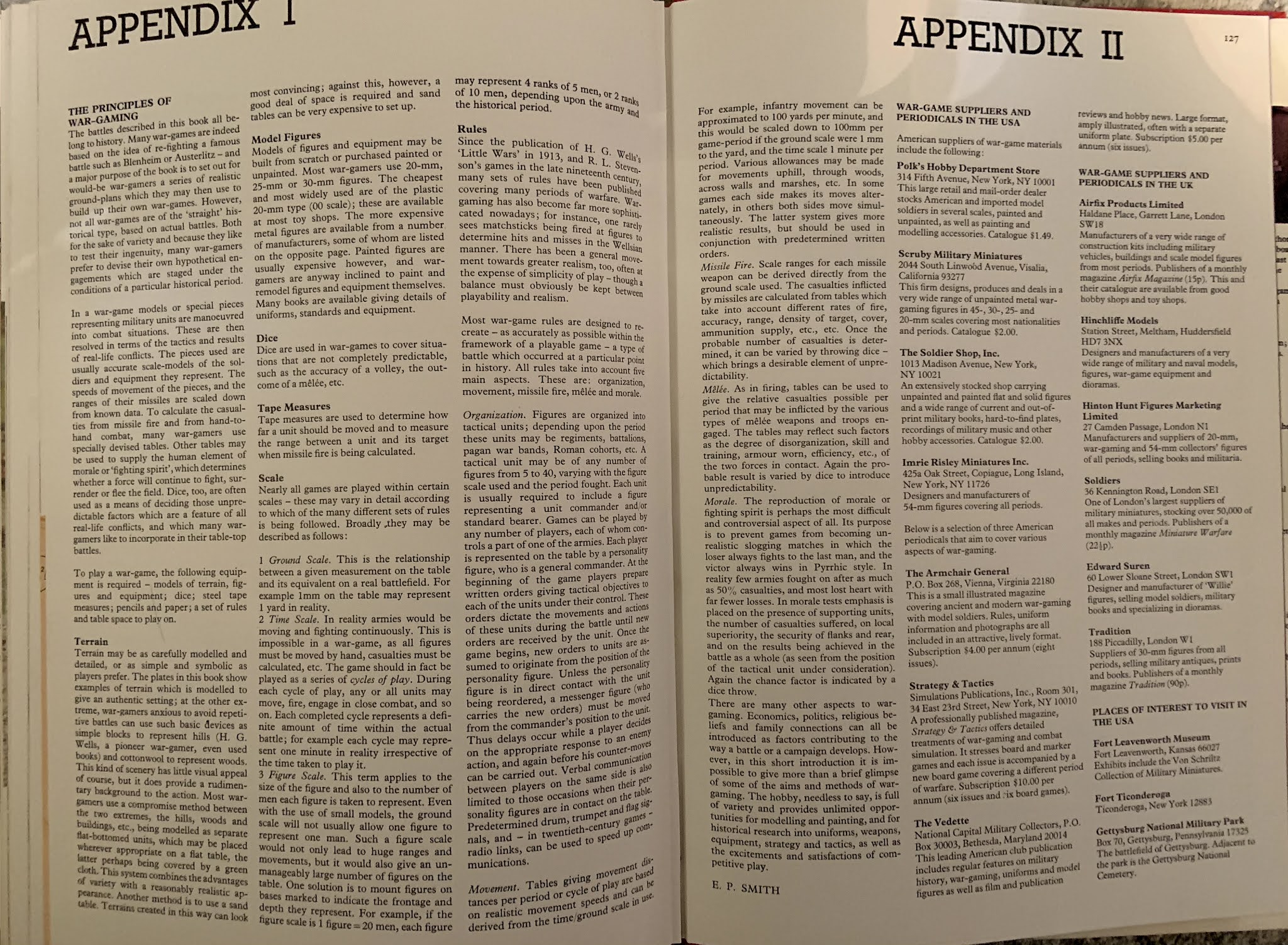
Lots of eye-candy then. And lots of historical background. Much new information. And all very well put together and excellent told. But what helped nudge me in the right direction was the appendix. This gave me the bare bones to get started with war-games rules. Most of this was a revelation. I had not seen a set of war-games rules at that point. I still hadn't after reading this book. But I could cobble together my own on the basis of what the appendix described. Before this I was struggling with 1:1 troop ratios - shooting ranges were enormous on the table!


In conclusion then, the War Game really set me on the path to 'proper' wargaming. It gave me inspiration, validation, information, and (importantly) a framework. More than that it, educated me in areas of military history that I knew nothing about and it nudged me more towards the 18th century from Napoleonics where my area of interest had been the Peninsular War. The Seven Years War in Central Europe became my abiding passion, but not straight away, though the slow match had been lit.

I almost forgot that it also encouraged me to get into Ancients. One of the lads at the school wargames club was also interested in Ancients. Through him I heard about the Wargames Research Group, and thence on to book 2 on the list.....

What would you say are the books most influenced your wargaming career?