As promised on Sunday, here is 'the war bit' from my recent sojourn on the Baltic. The second week of the hols was based in Helsinki, and much of the time was taken up with seeing friends and family of the Margravina. Lovely people, but by Friday I felt that I'd imposed enough on folks' willingness to talk in English, so rather than accompany the ladies of the Household on another familial visit, I elected selflessly to go to Suomenlinna.
Suomenlinna is a fortress on a small collection of four islands (not sure it warrants the appellation 'archipelago') that guards the approaches to Helsinki from the sea. For facts, take a look here:
https://en.wikipedia.org/wiki/Suomenlinna
For eye candy:
https://whc.unesco.org/en/list/583/
And for the official site:
https://www.suomenlinna.fi/en/
I pootled down to the city centre on the tram and walked down to the harbour by 'Kauppatori' (a waterfront market square, which is a pleasant trip in its own right). The buses are just as efficient but trams appeal to the little boy in me. Incidentally, if you're ever that way, download the HSL app (the metropolitan transport authority). Tickets cover all modes pop public transport in the greater Helsinki area, including trains, metro, trams, buses and water buses. Usefully, the location of the apartment and the Suomenlinna island were both covered by Zone A (€2.80 for the trip). At the fortress there are museums that have entry charges, but you can wander round the fortress for free. Which I did on my first trip years ago, and got mistaken by some American tourists as a tour guide with exceptional English!
I made a beeline for the Sotamuseo (War Museum) - third visit again (although 20 years ago it was on the mainland). It's not a big museum by any means. Forget the Imperial War Museum or the National Army Museum, but it is very interesting. It's predominantly about the 20th century, from WW1 to the Arctic War via the Civil War, Winter War and Continuation War. Unfortunately there are no displays of Hakkapeliitta or other warriors of the Swedish period. I understand there is a large archive somewhere that you can arrange to see, but I have no idea how or if you need to have 'credentials'.
After the War Museum I visited the Toy Museum (a private venture on the island). Again, a small museum but with many things of interest to the sort of people reading this blog. By the time I'd finished there the caffs on the island were closing up and I needed sustenance if I was to tramp around the fortress. Accordingly I took the ferry back to town and met the ladies of the house near the apartment with impeccable timing. I'll let the pictures tell the rest of the story.
Part the First - Approach - in which our traveller avoids shocking the readers' sensibilities
 |
| Looking back to the Kauppatori. The big white building at the back is the Lutheran cathedral. The yellowish one on the right is the Presidential Palace where the impressive Sauli Niinistö sits. |
 |
| The Orthodox cathedral dating from the period of Russian rule 1809-1917. |
 |
| One of the bastions on the approach to Suomenlinna 's ferry jetty |
 |
| One of a sequence of massive gun barrels by the garrison church (human a few meters behind for scale). I had to edit this pic because inadvertently the photo had captured a woman in a very short skirt, and this isn't that type of website. |
 |
| Garrison church |
 |
| I never knew this...the pic above shows the original form of the church (built in the Russian period) which was later trimmed down to suit the Lutheran design ethic, after independence. |
Part the Second - War Museum - early 20th Century
 |
| Regimental colour of the Prussian Jäger unit made up of Finnish nationalist emigres during WW1. The style is still very much like those of the Frederician period. Finnish lion shield in the centre. These Jägers went on to form the core of the White Army during the Civil War, and were regarded as the elite infantry of the WW2 period. |
 |
| I think this was a WW1 Russian cavalry officer. |
 |
| Uniforms of the White Army from the civil war (1918) |
 |
| The Reds (losers of the Civil War). I think more were killed by execution or in prison than in the actual fighting. One of my former tutors said that ill-feeling extended into the late 20th century in her home area of Tampere (a Red stronghold), although the Winter War did much to unite the country. |
 |
| Maxim gun on carriage wheels! |
 |
| Probably speaks for itself - these guys leant a hand to the Whites during the Civil War |
Part the Third - the Soviet Wars
 |
| Fabulous 1:100 scale model of an infantry position in the Winter War |
 |
| Cutaway from the above. Captions going from top left to right, then below: sleeping quarters for 20 men; observation cupola; machine-gun post; entrance; place for second machine-gun. |
 |
| Army uniform - not sure of the rank, I didn't note it at the time - and Civil Guard |
 |
| Lotta Svärd - the voluntary women's auxiliary organisation. The Lotta Svärd dates back to the 1920s and was originally for nice gels, but war time expansion led to a more 'democratic' membership. Lottas performed just about every non-frontline function. Some near the front were armed for self-protection. An incredibly important organisation. Banned after the War as a supposedly 'Fascist' organisation under the accords with the Soviets. More a cross between the WI and WRACS than Aufseherin. |
 |
| See explanatory text in next picture. |

Amongst Molotov's claims, was that the Soviets were coming to liberate Finnish workers and make sure they had enough to eat. It seems that amongst other things, the Soviets liberated the Finnish workers from their homes. So as well as Molotov cocktails, the Winter War gave us Molotov Breadbaskets. "Witty chap Johnny Finn!"
The war also gave us a number of jaunty ditties including the one this recent Ukrainian effort was based on:
The original:
https://www.youtube.com/watch?v=Jl2_0OCwNbg |
| Think this was a Swedish poster calling for volunteers |
 |
| Uniform and medals of Simo Häyä (Belya Smert or 'the White Death'). Evidently not a big man physically, but as a sniper Häyä was responsible for c.500 hits - in a war lasting only 100 days! Mostly over open sights, with an old Moisin-Nagant or a Suomi SMG. Danish volunteers' flag in the background. |
 |
| (1) Molotov Cocktail; (2) Finnish-made stick grenade; (3) Satchel Bomb; (4) Explosive from 2? |
 |
| Soviet AT gun with a chunk out of the shield! |
 |
| AA gun(s) |
 |
| Sled mounted LMG |
 |
| Another model. This time of a position by a lake. Sorry about the poor quality - it was difficult to capture without glare. The position included 4 Vickers tanks/T26 dug in as pill boxes. |
 |
| Ship mounted AA gun. This is massive > 2m long. |
 |
| One of a series of cartoons. My favourite of the bunch! |
 |
| I found this one very poignant. He looks not much older than my 16 year olds. There was a picture on a rolling display of Soviet troops, and one of those looked literally 14 years old. The rolling display on a large screen was one of my favourite exhibits. Lots of old (black and white) photos. |
 |
| German radar at Malmi airfield. Top is a Freya, bottom a 'Dora'. Malmi is still an active airport, just a few km from Helsinki's main airport at Vantaa. |
 |
| No prizes for guessing what this is. |
 |
| Mobile field kitchen. Whilst there were never enough of these, mobile field kitchens, along with saunas, are credited with keeping the Finnish troops going. The horse was covered in a white sheet for camouflage! |
 |
| Soviet invasion map |
 |
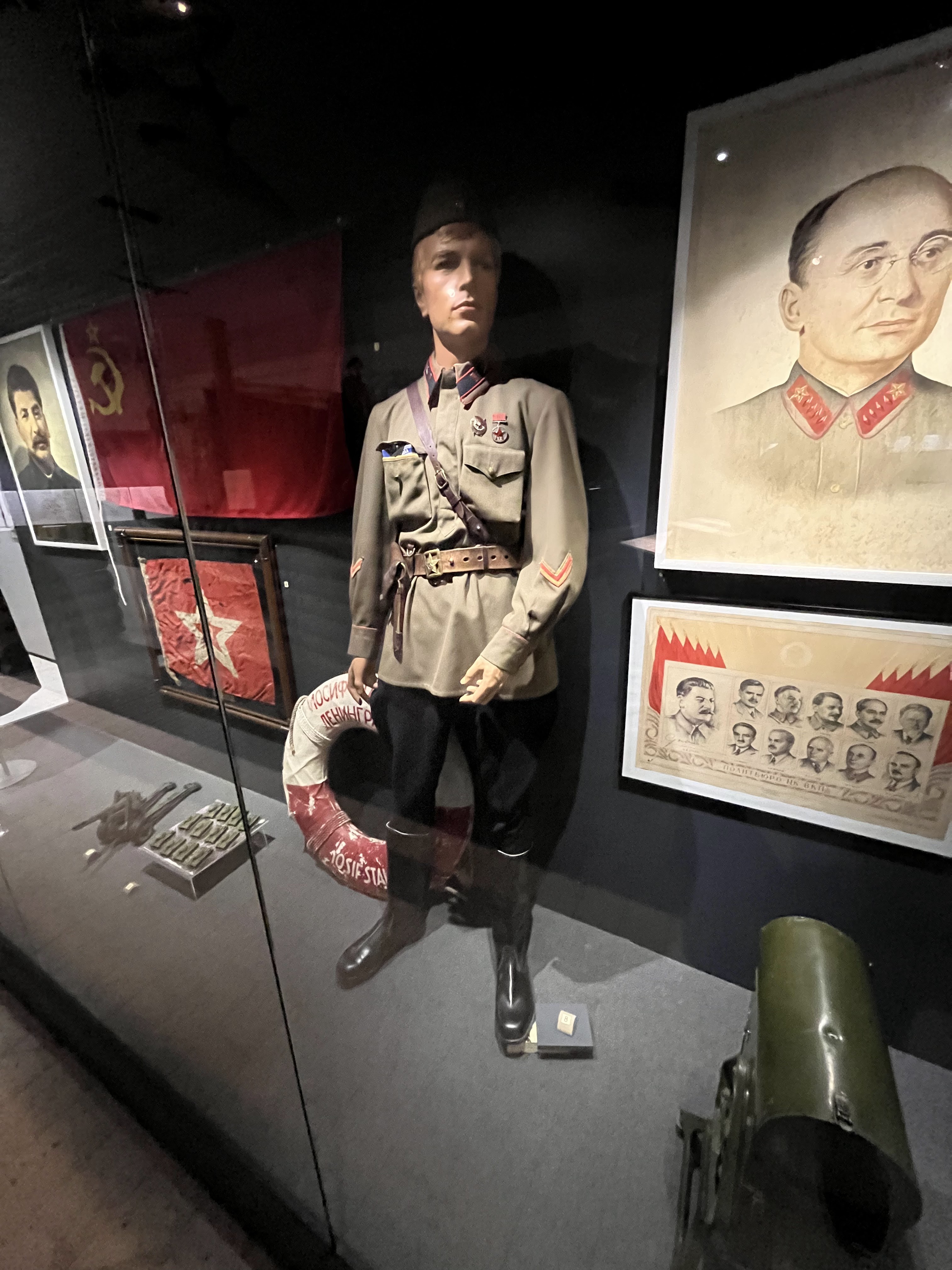
| Soviet junior officer |
 |
| I like this one. The colour came out pretty true to life. Cheap, but practical Soviet blouson. It was clear from the other displays that the Finnish uniforms were of a similar 'design ethic'. |
 |
| Finnish tanker, complete with throat mike |
 |
| Panzerfaust. Vital weapon in 1944 |
 |
| Panzerschreck. Ditto! |
 |
| For the uninitiated that swastika ('hakatristsi') is an ancient, pre-historic even, symbol. The Finnish military adopted it after being gifted an aircraft by a Swedish countess c 1919 - her family had the crooked-cross as a family symbol. |
 |
| Vickers Light Tank. Only about 6 tonnes. Bought by Finland in the 30s, they couldn't afford to buy them with the guns fitted, and they installed locally sourced weapons! They were already obsolete by the outbreak of the war in 1939, and were later used dug in as pill boxes. |
 |
| The Big Man's service uniform. Mannerheim was a tall guy! Must have been pushing on for 2 metres judging by this. A surprisingly plain outfit for a former (Russian Imperial) Guards Cavalry General. |
 |
| Uniform of Infantry General, Axel Erik Heinrichs, Chief of Staff to Mannerheim. Heinrichs succeeded Mannerheim as CiC of the FDF in 1945. |
 |
| Map case 'liberated' by Mauno Koivisto from a dead Soviet soldier. Koivisto was later Finland's first Social Democratic president, leading a very interesting life along the way. He was greatly mourned when he passed away in 2017, a few months short of the centenary of independance. During the war Koivisto served in Jäger Detachment Törni. Törni was something of a revelation as a leader in the war of raids. A dedicated anti-Communist, Törni joined the Wafer SS after Finland's surrender and became wanted by the Finnish government as a war criminal, before turning up in the US and becoming a leading light of the US Special Forces. Maj. Larry Thorne (as Törni became known in the US) was supposedly the inspiration behind John Wayne's character in the Green Berets, and died in a helicopter crash in Vietnam in 1965. I'm not sure about that - I vaguely remember another character in the film who was a trainer of the Green Berets, who seems the more likely candidate. |
 |
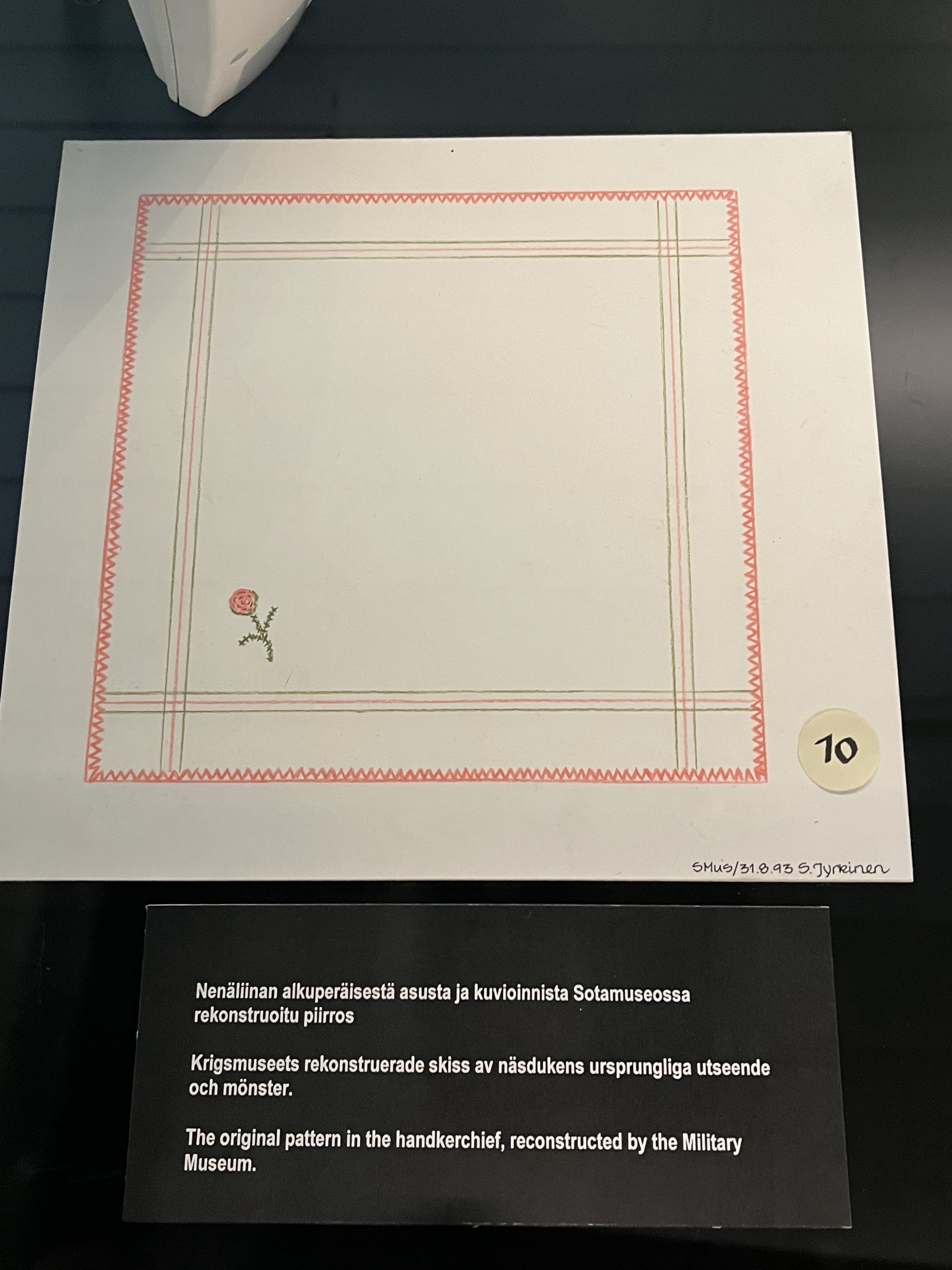
| Odd, but sad story this. In the map case were some embroidered handkerchiefs, maybe hand-stitched by some beloved family member of the Soviet officer. I'll leave it there. |
*********************************************
Let me know if you want to see some old toys next.