Tuesday, 1 August 2023

The Pattern - the 33rd Foot in the AWI


I mentioned a while back that I was gradually working through the collection of 18th century books from Helion that I bought in May. After finishing These Distinguished Corps (Don Hagist's work on the flank British battalions of the AWI), I took the Pattern as holiday reading. And very glad that I did. This is a fascinating book, and a good companion to the Hagist book. A great example of scholarship, and well written. Definitely recommendations for both books.

A bit of background. The 33rd was Cornwallis' regiment. In the years before the American War, he raised the regiment's standards of drill, deportment, dress and tactical flexibility to such a level it earned the nickname 'the Pattern'. An older nickname for the 33rd was the 'Havercake Lads', after the oak cakes of that name popular then in the White Rose county. In the immediate pre-war years the regiment was sent around Britain and Ireland to show other regiments how it was done. A key element of the regiment's evolution pre-war was the development of light infantry tactics. MacNiven makes the case that the regiment was able to perform so flexibly that it may have been used at times as light infantry as a whole, and not just the light company (which spent most of the war with one of the combined LI battalions). 


All you Napoleonic fans will know of Wellesley's colonelcy, and even later it was named after the Iron Duke. The West Yorkshire connection was already strong in Cornwallis' time. Now it's merged into the Royal Yorkshire Regiment, one of the multi-battalion infantry regiments created in the Noughties, and has the unimaginative nickname 'the Yorkshire Warriors'. I should imagine that British Army wit has come up with something much more colourful.

Postscript: without knowing it last night when I penned the above, today, as well as being Minden Day is Yorkshire Day, as my cousin’s husband reminded us on a family WhatsApp group.  So Happy Yorkshire Day. Eh up!

Frederician Podcast

I came across this podcast about, well, the Life and Times of Frederick the Great. The style isn't always to my taste as it seems very much read from a script - I prefer the more discursive style of podcast*. But it's a good way of covering the subject in a brief period of time and there's some interesting pieces in there that I hadn't thought about before**.

https://podcasts.apple.com/gb/podcast/the-life-and-times-of-frederick-the-great/id1566277737?i=1000520393905

I listened to a couple of the later episodes initially, but jumped back to the beginning on a flight back from holiday on Saturday, and learned lots of new stuff about Brandenburg-Prussia in the 17th century.

* I'm a big fan of We Have Ways of Making You Talk, which is hosted as a double-header and the hosts have enough heft to get lots of interesting guests on. And of course, one of them is a professional performer, so it's unfair to compare the podcasts. I've listened to a couple of episodes where the host (Alex Avdakov) has guests on, including one with Doctor Alexander Burns (Kabinettskriege blog), and these were very interesting. Alex Burns edited the Changing Face of Old Regime Warfare: Essays in Honour of Christopher Duffy.

** Such as the episode on why Frederick invaded Silesia, where it's suggested that if he didn't, then Saxon Elector (and Polish King) Augustus III might, pushing Prussia further down the pecking order.

Anyway, the Life and Times of Frederick the Great is well worth listening to. A good accompaniment to painting. Especially SYW figures.

Friday, 28 July 2023

Off track

I was supposed to be thinking about a post on the Bloody Big Battles blog, but I got sidetracked. Easily done these days. The distraction came about by looking at recently taken photos on my phone.

A couple of weeks back I was walking with the Margravina in Richmond Park, where there’s always something new to see. In the gardens of Pembroke Lodge I saw one of those benches which people sponsor on behalf of the departed. This one caught my eye particularly because of the dedication.

The name wasn’t familiar so I resolved to investigate later. Something I forgot about until now*. 

https://en.m.wikipedia.org/wiki/Sommerfeld_tracking

My WWII knowledge is patchy so this was news to me. Doubly intriguing because the chap was a German expat at the time and his invention was used against his former homeland. What was the backstory to his arrival in Britain?

What’s also noteworthy in my opinion, is that Britain supplied 44.5m yards (!) of the tracking to the US in reverse lend-lease. Reverse L-L was something I was aware of thanks to James Holland on his We Have Ways of Making You Talk blog. I think he said something like 30% of US war matériel in NW Europe was supplied by the UK.

* one of the things that distracted me at the time was this amazing flower which even the Margravina couldn’t identify. It’s about 40-50mm diameter to give you an idea of size.


Wednesday, 19 July 2023

Bat-oh!

Knocked up a mock up of a ‘bateau’ for the wars on the American Continent. This was a quick test to see if I could do something. The answer was ‘I can’ but there’s room for improvement.


Materials were an empty cereal packet, some cocktail sticks, paper and Blutak to hold stuff in place temporarily. And a sharp knife (after an abortive attempt with a blunt one).

The basic idea was to make something that can hold a base of my AWI chaps (2x3cm base). Functionality is more important than looks. At the back of my mind I had Dave Crook’s stylised ships for the late 29 18th century. What I’m basing the design on is a simple ‘bateau’ of the type used on the rivers and lakes of North America in the F&I wars, the AWI and War of 1812. Bateaux had pointy bits at both ends and were flat bottomed to aid portability across land. Some had sails as well as oars and varied greatly in size. They were used to move men, weapons and supplies. Some even seemed to have little ‘canon’.

The plan is to maybe make a fleet of 30ish for use in amphibious operations - prompted by my reading of ‘These Distinguished Corps’ by Don Hagist. The book is a history of flank battalion operations in the American Revolution. The Lights and Grenadiers seemed to do an awful lot of bobbing about in boats in the AWI, do I thought ‘why not?’

Now on to the critique:
The gunwales are too low for the figures. I need to up these from 5mm.
I need a good method of gluing the gunwales and pointy bits to each other. Not sure how.
Ditto the mast.
The oars and rudder handle could do with being thinner - maybe thick wire is the answer.
And maybe more of them.
And one or two ‘crew’.
Obviously it needs a paint job.
I might need bases for them (c 12x6cm) to protect them from handling.

But overall it looks workable!


Wednesday, 5 July 2023

18th Century Reading

There's not been much painting or modelling activity here at the Schloß Nundanket. Any wargaming has come courtesy of the Wells of Washington, Jonathon of the Palouse Wargaming Journal, who has been running on-line re-fights of the First Battle of the Bull Run. I had the pleasure during the games of the company of noted bloggers Messrs Broom (https://mudbloodandsteel.blogspot.com/2023/06/get-yer-tots-out-for-lads.html), 'In-Suffolk' (https://russetcoatcpt.blogspot.com/2023/06/fnurban-24-east-riding-military.html), Foy (http://prometheusinaspic.blogspot.com/2023/06/wss-eichenfeld-noch-einmal.html) and Napoleon Dave (https://stcyronwheels.blogspot.com) for the games. Won one lost one, since you ask.

My current excuse for not doing much in the way of wargaming activity is being involved in taking the young mistresses of the Schloß to university open days, and visiting the West Country branch of the family to raid their garden equipment before they do their flit to Lincolnshire where, ironically, they won't need anything beyond one of those misters and a jug.


I have been making slow, but steady progress through the batch of books I bought last month. So far I've read The Army of George II and More Furies Than Men, and I'm currently on the Hagist book on British flank battalions in the AWI. The book by Brown on the British army of George II is excellent - almost tempted to say it does for that army what Duffy did for the armies of Frederick and Maria-Theresa. I would recommend it for anyone interested in the period and especially if you want to model a British army. The central thesis of the book is that the army was more more professional than is normally portrayed, including its officers.

The book on the Irish brigade I found harder going. It is good on Franco-Irish relations (not as warm as you might think, both being enemies of England) and on the importance of patronage within the Irish regiments. I found my interest waning in the chapter on the way contemporaries portrayed the Irish brigade, especially when it seemed to disappear down the rabbit hole of what this or that poet said in response to some other poet. But I admit, this is a subjective view and it's a case of what floats your boat. As with the British army book, the author researched the subject thoroughly.

As I said above, I'm currently reading the Don Hagist book on British grenadiers and light troops of the AWI. I've been thinking about getting the book since I listened in on the Helion virtual book launch a couple of years ago. Again, this is thoroughly researched and great background for the period. You don't need to read this, or the other two, of course. You could happily wargame the period without it. For me, it adds to the interest though and gives some great insights.

I think next up will be the Pattern (another of the Helion virtual book launches I 'attended'). Going by the book launch, it will be packed with interesting research. Maybe it's time I got the table out.

Sunday, 2 July 2023

Le Tour de 1813

Sat down for a rest and switched the telly on. Noticed that  Stage Two of the Tour de France today covers some of Arthur Wellesley’s old stomping ground.

Very pleasant scenery.

https://www.letour.fr/en/stage-2

Wednesday, 21 June 2023

The Happy Wandler

Back in Spring 2021, Lincolnshire Tom and I walked a large part of the Wandle Trail. This is a walk along the river of that name that rises in near Croydon in South London and runs down through Wimbledon and thence to the Thames at Wandsworth.


Rivers from left to right are: Hogsmill; Beverley Brook and Wandle - all subject of river walks by yours truly. Central London is off the map, top right. Earlsfield is in the upper central part of the map.

On that trip LT and I met at Earlsfield Station and walked upstream to Carshalton where we called it a day and walked to catch the bus back home from Sutton. The full trail can be seen in the attached link.

https://www.merton.gov.uk/system/files?file=wandle_trail-4.pdf

The stretch downstream from Earlsfield looked like it would be mostly urban and uninteresting. But a couple of weeks ago the Margravina and I decided to give it a go on the spur of the moment one Sunday evening. It did prove to be pretty urban, but more interesting than expected, as these things often do. 

Most of the trail seemed to be away from the banks of the river, with the best views of it coming from the many pedestrian bridges. That said, much of the walk was through parks, so there was plenty of greenery. For part of the way, on the right bank (i.e. right as you head downstream) several houses backed onto the river and residents had built decks from where they could dine by the stream. As it was balmy weather, many residents were out, so taking pictures didn't seem the right thing. Once we got to Wandsworth Town, we were clearly in a much busier urban space, but ironically the river was more open to view, especially around the site of the former Young's Brewery.

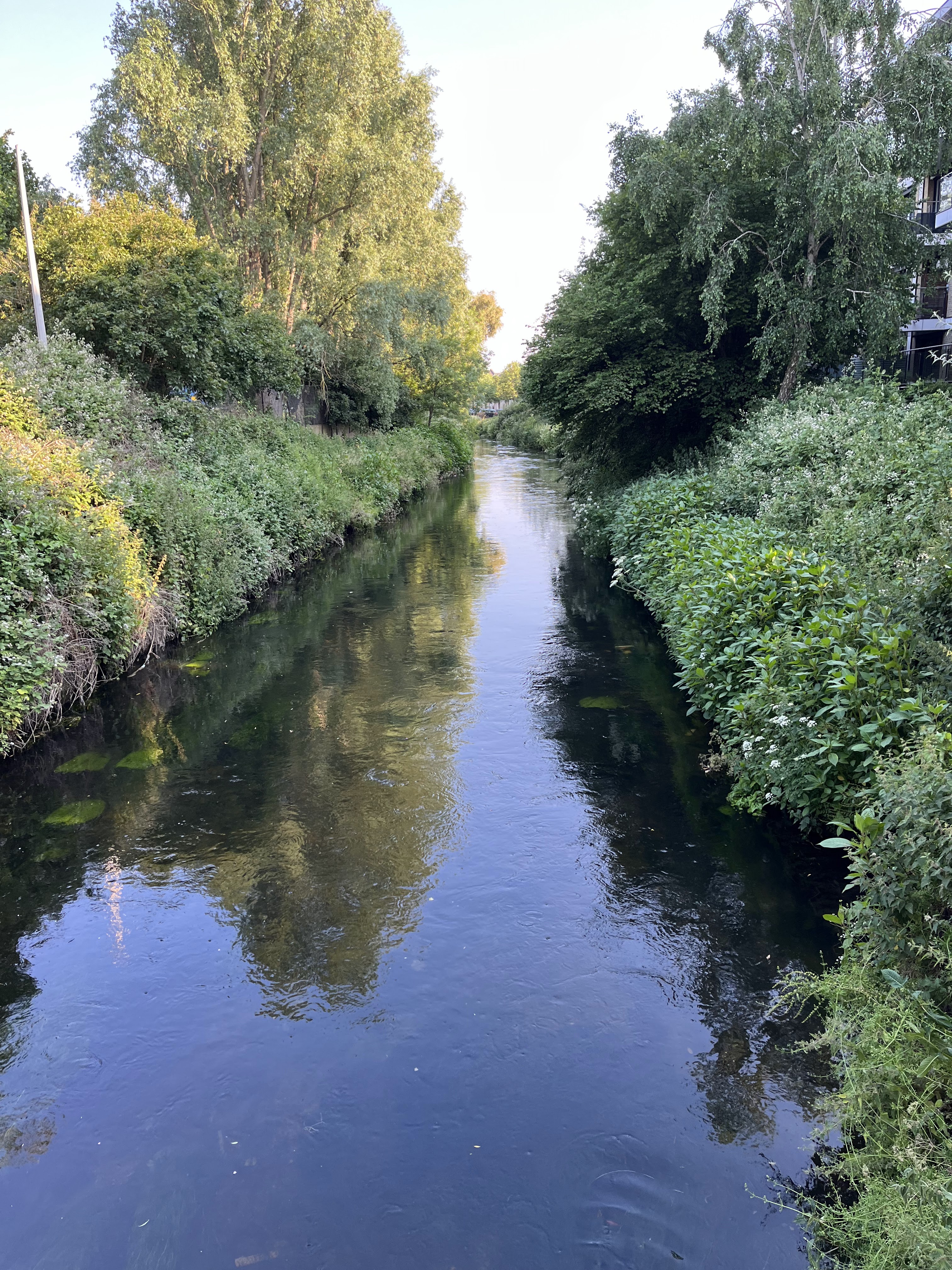
First siting after leaving the station. Some public spirited person clearly wanted to help encourage flora by creating a a 'dam' with an old bike wheel.

Ah, this is better. View from one of the many foot bridges.


This looks like apartments in an old 1930s factory. I could be wrong.


A fair stretch of the walk was through a park like this. Not a great view, but it is a growing city.


Information board in the park explaining its previous use as the site for pre-fabricated houses built after WWII as a quick response to the housing crisis. I remember houses like this still being occupied into the 1970s in Grimsby. They were very well thought of by residents as they came with 'all mod cons' that they often didn't have in their old homes.


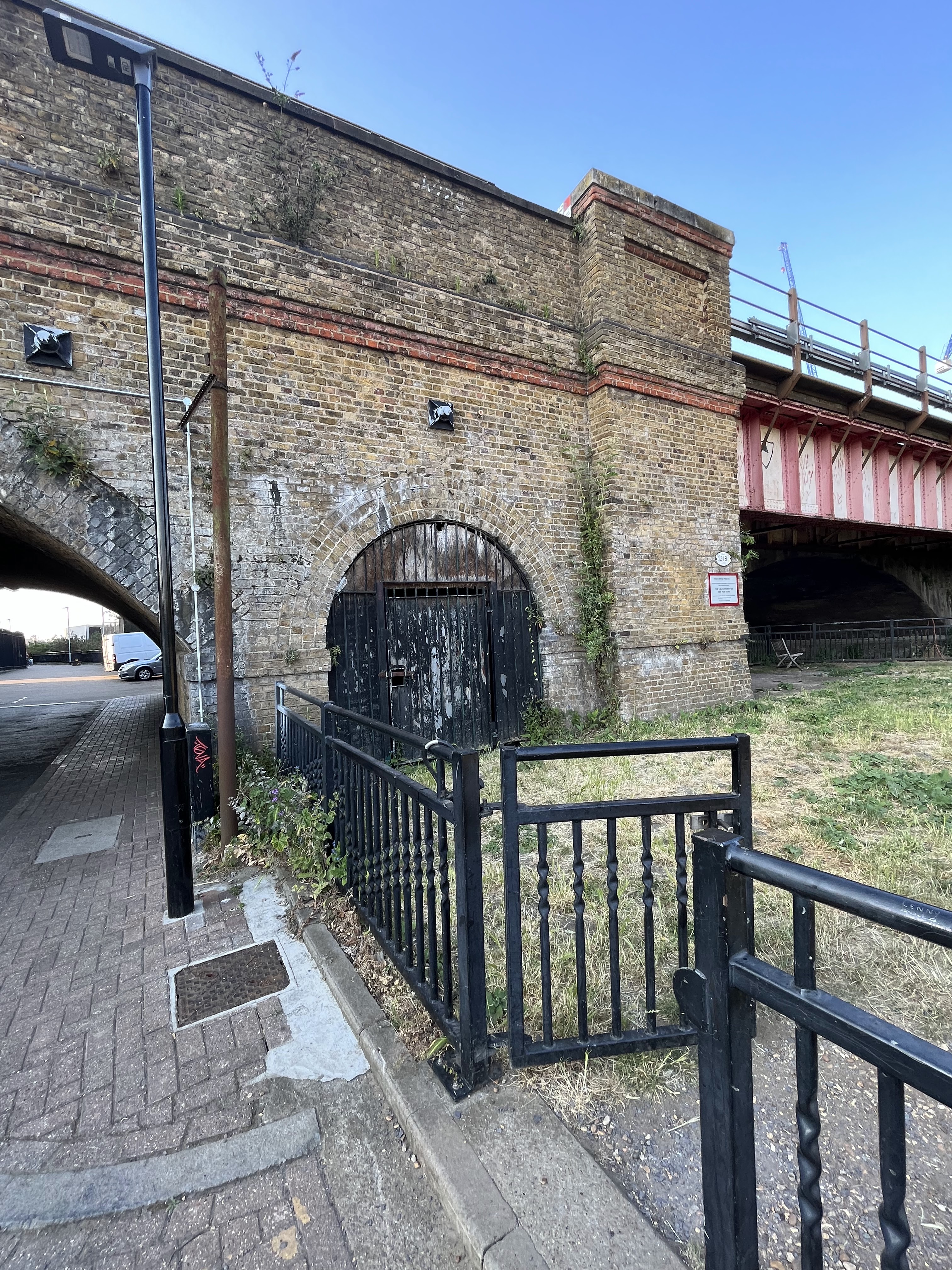
Think this must have been part of the old brewery.

Mixed use redevelopment of the brewery site. Bars, restaurants and retail below residential flats.


Back on a main road, a rare example of housing from c.1900(?) surrounded by more modern development.

View from next to the above houses, showing the on-going development of the south bank of the Thames. 


A more run down industrial stretch of the Wandle


A 'pool' by the above stretch. I can this this becoming a waterspouts area at some point.


This sort of scene wouldn't be out of place in the Sweeney.

Waste recycling centre?

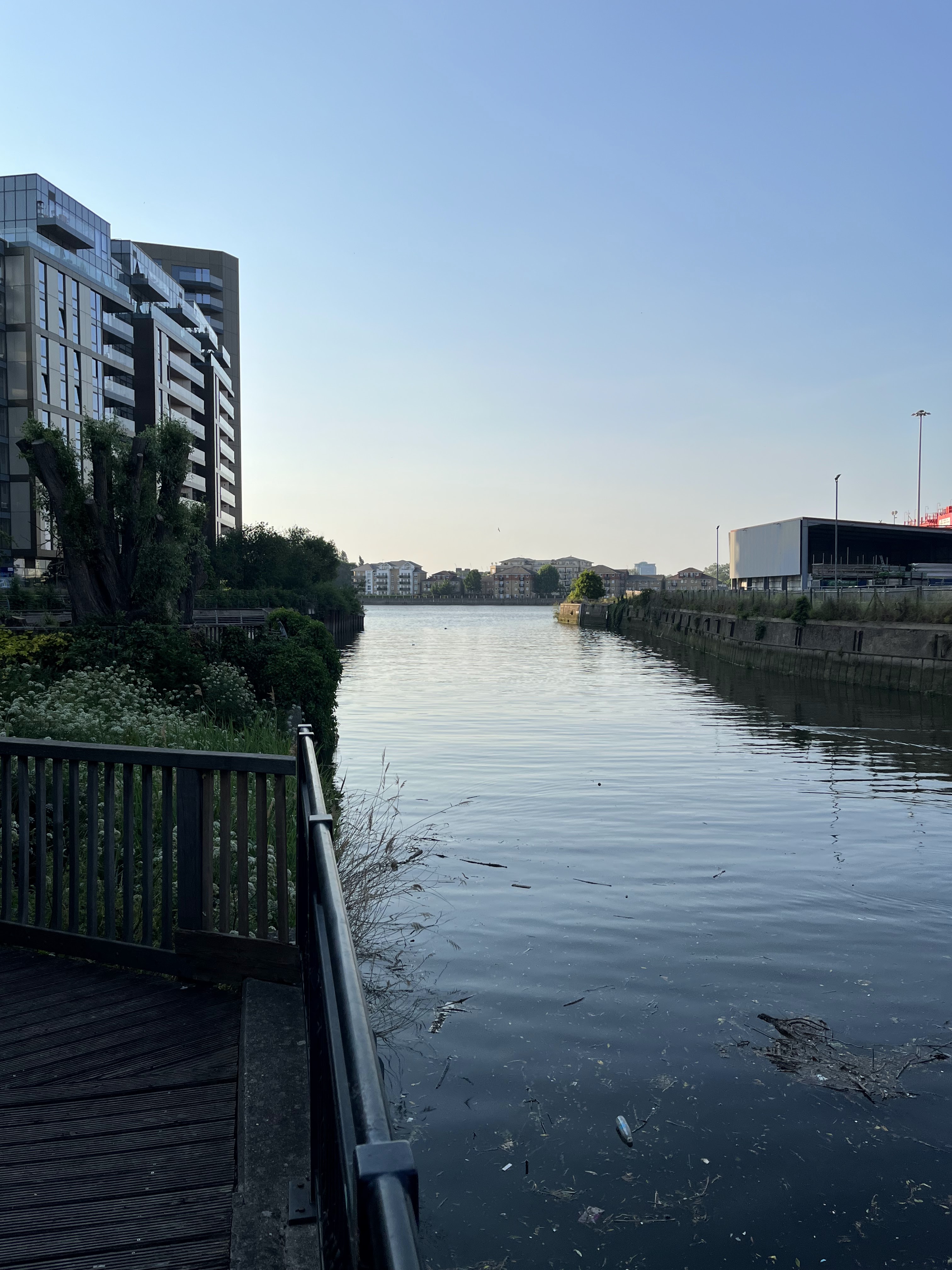
At last a sighting of Old Father Thames!


Looking towards Chelsea

Lots of new blocks of flats by the Thames

House boats?

Ah-ha! An island of Georgian architecture. I wonder what it was.

Ah, so the Prince Regent's knocking shop. Or am I being too liberal in my interpretation of the word 'frequented'?  

Wandsworth Park, resplendent with London Plane Trees

From the mouth of the Wandle we turned left to walk up the Thames to Putney to catch a bus back home. The Thames Path took us inland slightly, to skirt around some properties which fronted directly onto the river bank. The architecture became more varied as we approached Putney, with many fine Victorian and Edwardian buildings. Close to the end we spotted this curious shield.


All in all, a pleasant evening's stroll, after the heat of the day. It's filled in more of the gaps for me and has got me around 3 sides of a circuit involving the Wandle, the Thames and the Beverley Brook (see map above) since I've done the walk to Putney Bridge from both the Beverley and the Wandle. I'd like, at some point, to find a route which links up the two tributaries upstream, 'across the watershed' as it were, that doesn't involve too much walking along pavements. We'll see.