Tuesday, 19 November 2019

Lincolnshire Campaign III - the Leaguer of Grimsby

The matches are lit. Prayers are being said. Firearms primed. A Roundhead deserter (probably a former Royalist soldier who had been offered the choice of 'freedom' shouldering a musket in a rebel regiment or labouring in a saltpetre workshop) had made his way into the old port of Grimsby the night before bearing news of the intended assault on the morrow. The Royalist regiments stand to. Battered in the great battle of Clee Fields five weeks before, astounded to have been thrown back by the Roundheads, they are now rested and ready to give a good account of themselves.


Map of the town from 1620s. This map covers much of the western part of the battlefield, with the Parliamentarians occupying the area of the old abbey and to the west of Bargate (the road heading roughly south to north)

Taken from a map c 1820. The area of action concerns the Old Town, the old haven to its right and Holme Hill further to the east, and the area south of the West Marsh. The location of the Battle of Clee Fields can be seen to the east of the map.

18th century plan of the town. Not much has changed since the 17th century.

God looks down on the old town. 'Will it burn, this home of the old pagan Grim', he asks himself as he surveys the eastern marshes and the approaching columns. He rather hopes not because of its association with fish, the symbol of the early followers of his son.
The two sides at the start of the fateful day. Bargate runs directly north on the west side of town coming from the site of the nunnery north of Sartho. The Abbey Rd branches off Bargat immediately at the south of the picture and enters the town on its eastern corner. Brighowgate branches off further up Bargate. The old high street (now Victoria St) cuts across the town east west. Parts of the East and West Marshes can be seen at the top of the picture. The old haven is immediately to the east of the town - its silting up from the 15th century led to a decline in the towns fortunes, but it still retained its two MPs from its days as a major medieval borough - one, Gervase Holles fought for the King in this campaign, the other (Christopher Wray was with Manchester's main army.
The eastern approaches. The East Marsh top left. Parliamentarian columns march up from the south, guns behind the wall of gabions. On the small eminence known as Holme Hill the Royalists have built a redoubt to command the eastern approaches and haven.

The commander of the Royalist battery on Holme Hill salutes his Roundhead adversary and invites him to shoot first. The cavalier battery is armed with heavy guns landed from a Dutch ship. More of the same form the arsenal of the town itself. A fortunate gift from the sea as the King's men had lost all their guns at the Battle of Clee Fields. Some of those guns are now turned on their former owners.
View from the grounds of the old papist abbey looking north towards Grimsby. Here the Royalists have site one of the large cannon from the grounded Dutch ship.

West of Bargate, the Parliamentarians eye the Cavalier guns guarding the defences on Brighowgate. More guns sit to the west towards Cartergate, by the church of St James.
The Parliamentarian guns commence bombardment of the redoubt on Holme Hill and the barricaded gateways to the south of the town with no effect despite some accurate gun laying. This is owing to miscalculations on the part of their commander who didn’t allow properly for the effectiveness of the defences - he really should have laid guns and the lines at closer range!

Nevertheless, on the right flank a cavalry regiment and the Red Regiment advance on the flanks of the redoubt. The plan was for the horse to drive off any supporting troops and for the foot to storm the earthworks, but on arriving to the north of the redoubt Lt Col Dickerage Lane saw there were no support troops and promptly ordered his troopers to dismount and to storm the redoubt from the rear. The startled gunners waited not upon their honour and climbed over the palisade and ran down the hill hoping to escape into the East Marsh.


The Blue and Tawny Regiments form column ready to assault the eastern approach to Grimsby


Meanwhile the defenders’ attention is drawn to the small unit advancing along the abbey road. Hidden behind the small column of foot is a wagon full of gunpowder barrels to blast an entrance into the town.
Further West the Yellow Regt has climbed over the Countervallation and makes ready to advance on the south western corner of GY. In the far west a cavalry regiment comes up against the West Marsh and its colonel is trying to get it to turn east to escort a second powder wagon, which has somehow been able to follow its orders, but is in danger of leaving its escort behind.


Meanwhile the Royalist White Regiment in reserve is being rushed to the eastern perimeter to meet the assault there.
The redoubt successfully taken the Parliamentarian foot and guns follow orders to turn to the town. It takes longer to rally the dismounted horse who are pillaging the abandoned redoubt for anything worth having - apart from the guns and ammunition, there are slim pickings so after a while they too return to order and remount.


The Light Blue Regiment has successfully driven off the gunners at the southeastern gate and maintain good order ready to be turned against the defending infantry.

The Tawny Regiment forms in line by the eastern earthworks ready to go over. The Royalist reserves arrive and form up just in time. Frantic shouts to redirect the eastern powder wagon are ignored or are not heard and it continues along the Abbey Rd. Literally a powder keg that might hoist the Roundheads with their own petard!

The western powder wagon has managed to get through despite fire from the Royalist dragoons at that gate. The charge is ignited and…..it explodes!! Unfortunately the defenders fire has put the engineers off and they weren’t able to place the wagon properly and the explosion has little effect bar scattering wood and horse flesh across a wide area and blowing some hats off the supporting Yellow Regiment. The Yellows now advance within close range ready to release their first volley in the teeth of the defenders. Simultaneously the Roundhead batteries have shown rare drive and bravery and moved aside their gabions and are manhandling their guns to get close range shots at the defenders. Their Godly zeal must burn bright, Praise be to the Almighty!

The crisis approaches. The opposing foot have been engaged in a hitherto ineffective firefight. The Royalist shooting had been particularly bad - it must be due to the damp conditions in the town. The Tawny Regt was bloodily repulsed from the parapet by the White Regt and some of the Roundheads had to retreat into the marshy Haven. Nevertheless their General urged them on and they took up the firefight again. But all along the line the Roundheads are now beginning to drop. The only unit engaged that has not been battered is the Light Blue Regiment, having driven off the artillery and repulsed the Grey Regiment.


Can they break the Greys? Can the Parliamentarian right wing arrive in time to tip the balance?


The crisis is not over but the Roundheads are returning to the fray.

The right wing infantry have engaged the defenders on the eastern rampart and the artillery has pounded the earthworks reducing their defensive power.

The Light Blue Regiment has seen off two units of Royalist foot and have just repulsed a cavalry charge, the musketeers having entered buildings while the pike hold forth in the street.

Only the dismounted dragoons, one small battery and the horse remain intact from the early morning. It must be close to decision time. Break off and escape west towards Barton across little known tracks through the West Marsh, or try to hold on?

End Game: The Roundheads are pouring into the town from all southern and eastern entrances and are pushing back the Royalists through the streets. Only a counter-charge by the Blue Horse has seen off the Roundhead cavalry preventing defeat being turned into a disaster. The Dragoons unbowed again but fail to drive off the Light Blue Pikemen, those veritable Alexanders!, who capture the remaining guns before they are towed away. Remnants of 3 battered infantry units, the dragoons and all the horse escape over the bridge and across the West Marsh.


They will only pause to pillage Immingham, that nest of Puritans, once they realise the Roundheads are too exhausted to launch a full pursuit.


Tuesday, 12 November 2019

The Winter War - Talvisota (movie)

Tell battalion that the next people in the bunker will be archaeologists

In August I mentioned that my lovely wife had bought me a couple of DVDs when she was over visiting her mother. Towards the bottom of here

I watched the first set, Tuntematon Sotilas, soon after and thoroughly enjoyed it. So with naff all on the box last night I intended to watch the first hour or so of Talvisota. At 191 minutes long I thought I would space it out over 3 evenings. The fact that the 'or so' part of 'first hour or so' extended to 'the whole three hours plus' tells you a lot about my feelings on the film. And this was my second viewing (I'd seen it a couple of years ago on line).

According to Wiki there were 3 main versions released. The international cinematic version (127 minutes), the one I saw (the original Finnish cinema version) and the extended TV series at a whopping 275 minutes.

The basic plot concerns a small sub-unit (don't they all?) of soldiers called-up in October 1939 ('for manouvres') and what happens to them over the succeding five months. Naturally, the bulk of it is the 100 days of the Winter War. As with all films of this genre, the sub-unit gets whittled down and you begin to wonder whether the main character Martti Hakala will cop a 'Bäumer'.  I'm no WWII specialist so I don't know how realistic the action scenes are (if anyone has seen it and has a view I'd love to hear it). It seemed plausible to me (even if the Soviet tactics shown were mostly suicidal, which I understand they largely were).

One facet of this film that I appreciated were the little insights into what life was like then in Finland - still a mostly agrarian country. As with Tuntematon Sotilas, I found some of the 'homefront' scenes touching. We see a society where most people didn't have much, didn't expect much, but nevertheless felt that they had enough worth protecting - though that wasn't necessarily material. It seems almost as if there was a collective expression of "look our ancestors came to the most inhospitable part of Europe, hacked out a modest living out of unpromising material, kept ourselves to ourselves, and you lot still want to bother us and ask for more".  Maybe that's just me with my biases.

We also see a society where Christianity still had a big influence culturally and socially. In one scene the singing of a Christmas Carol becomes an act of resistance. Probably like my grandparents generation here, they all knew the words.

Also much appreciated by this blogger is the deadpan Finnish humour, that goes with the no-nonsense approach to troubles. If you get the typical British wartime humour, you will like this. The sort of thing where a quip is made out of the corner of the mouth, with a fag* in the other side. The Russians are nearly always 'naapurit' ('the neighbours' - e.g. 'the neighbours are trying to move the garden fence again') when not 'Ryssät' (which I understand is a more perjorative than 'Russkies').

The special effects are pretty good on the whole, especially when the film was made in 1989 - it coincided with the 50th anniversary of the war. We're now approaching the 80th and that generation is nearly all gone. Although the Finns ended up on the 'other side' in 1941, I can only honour and admire their sacrifices in defending their homeland and freedoms**. Just as I would honour the poor bloody sods who were sent to take them away and suffered unimaginably in a frozen forest a long way from the steppe or from the warm valleys of the Caucasus.

I'll raise the mood a little now by reference to a song (or rather tune to a song) that got played a couple of times by one of the characters in the section. This was originally a hit in the 20s (I read somewhere it was the first 'pop' sensation in Finland) and there are many clips (from several countries) out there in the interweb of different versions (sometimes simply called "Emma" or "Oi muistatkos Emma?","Emma's Waltz", "Emma's Valssi", or "Finsk Vals" or variations of that - yeah I am obsessive.). All lovely because it's such a great melody. It's been a while since I inflicted any 'obscure Nordic music' on you, so here you go. And I'm sure many of you will appreciate singing along in your French farmhouses, so this one has helpfully got lyrics on screen. Or just take the missus for a waltz around the kitchen table.

 https://www.youtube.com/watch?v=9dpcVRW8DfI


* for clarity, this is British-English for 'cigarette' (and in such cases it nearly always is a 'fag' not a 'cigarette').
** For anyone so inclined to point it out, no I'm not ignoring the unacceptable things that happened in the Continnuation War....but to coin Basil Fawlty in 'the Germans' "Yes you did, you invaded [Finland]".


Monday, 11 November 2019

Cheriton II

Eight weeks since the last attempt at Cheriton, I got around to having another go. That was played 'traditional' style without a grid, using my own ruleset (pretentiously named 'Jacob Astley's Prayer'). Since then I'd fiddled around with different hex grid sizes on paper and then finally plumped on 13 cm 'across the flats'. This is just a tad wider than three foot stands or 4 horse stands in my basing convention (4cm wide for foot, 3cm for horse). I went slightly larger because 13cm can accommodate the largest of my building models and having a gap between neighbouring units looks better.

High ground was created as usual by DVD cases, then my now gridded, green baize cloth was thrown over the top. The table at 3 feet deep could fit 7 full hexes and two partial hexes (I would count units in these as being completely on the table if needed). I made a slight change in the layout compared to the previous outing. I added buildings representing the village of Hynton Ampner - I omitted it last time but a re-reading of Adair showed it figured a lot in the actual battle ......according to Adair. I placed a hedge row in the hexes in front of it representing the hedges along the road. As before, the Royalist horse had to suffer a scenario specific rule making them advance on to the field initialy via the hedge-lined Broad Lane and Alresford Lane before they could attempt to deploy in the meadow.

Initial set-up. Cavaliers to the left, Roundheads to the right. The lanes marked by the hedges in the left centre and top left.

Two Parliamentarian battalia defend the hedges in front of Hynton Ampner. Four companies of dragoons behind to their left

Ralph himself, on the forward slope of what Adair terms the South Ridge. Confusingly on the north side of the battlefield.
Now the rules. I have been intending to try the esteemed M. Foy's ECW_CnC variant but haven't got around to printing the cards yet, and as a last minute decision I decided to wing it. I haven't yet created a gridded version of Jacob Astley's Prayer. Here is what I decided on (turns are UGOIGO in the folowing sequence):

Victory Points
  • Victory would be acheived with 8 VPs
  • VPs scored for each unit eliminated and each general eliminated
To put this in perspective, the Royalists had 5 units of horse, 6 of foot and 1 of guns. Parliament had 7, 7 and 1 (although most horse and the artillery unit were stronger than the Royalists).

Shooting
  • Muskets - max two hexes (long range)
  • Guns - short 1 hex; medium up to 3; long 6 hexes
  • Pistols - now ranged combat, assumed part of melee. 
  • Muskets 3 dice per base, two at long range. Hit on 4,5,6.
  • Guns 3 at short range, two at medium. Hit on 4,5,6. Long range 2 dice, hit on 5 or 6.
  • Minus 1 die per hit marker
  • Minus 1 from dice if disordered
  • Saving throws: 6 horse, 5 or 6 for guns or cuirassiers 
  • Roll 1D6 for each unit each turn - foot start firing at long range on a 1 or 2.
  • 3 hits removes a base
Melee
  • Horse & pike 2 dice per base
  • Muskets - 1 dice per base
  • Minus 1 die per hit marker 
  • Minus 1 per dice if disordered
  • Hit on 4,5,6.
  • Saving throws 6 horse, 5 or 6 for cuirassiers
  • 3 hits removes a base
Movement
  • Foot one hex per turn, horse (of whatever type) two, and staff figures three hexes.
  • Minus 1 hex for crossing hedge and are disordered (one turn stationary to become ordered).
  • 1 hex if on road/trackway/in march column
  • Changing formation costs one move
  • No movement if the unit fired that turn
Orders
  • To commence moving, or to halt, or change formation (or any other change) a unit has to score 4,5,6 on a D6.
  • Plus 1 for general with, and plus 1 for each messenger figure.
  • Movement in first turn was 'free', but any unit that didn't move in the first turn had to test to see if it followed orders when it did want to commence moving.
  • Messengers move at 3 hexes in the movement phase.
  • Dice at each turn to determine how many messengers the Commanding General can deploy each turn (they start with the General).
A morale test would be needed if a unit lost a base through firing, or lost more bases in melee than the opponent, or if you want to stop a unit pursuing. Pass on adjusted score of 7 or more from 2D6.

Simple! Anything else I would decide on the spot. Decisions on the hoof included: could attempt to rally from rout if not pursued; general eliminated on a score of double 6 if with a unit that has suffered losses; pursuers occupy the same hex as routers.

The Royalists (top) have decided to attack all along the line rather than allowing isolated units be defeated piecmeal. 1 horse regiment is left in reserve. The Parliamentarians counter, with their cavalry swiftly advancing down the hill to meet the Royalists as they reach the meadow. You can see here how I messed up the drawing of the grid - what was I thinking?


Roundhead foot bravely (foolishly?) cross the hedge row to confront the advancing Royalist tercio.

The first Cavalier regiment has been crushed by a brigade of Roundheads, and the remnants sent back up Broad Lane. The second Royalist unit forms up to face the victorious, but disciplined Roundheads.

I did try inserting a video clip at this point but it won't play. 'Video!?' you exclaim. Yes, I 'cunningly' recorded the firework display in the school at the back of my house last night, downloaded it from my phone onto my laptop and then played it back whilst moving my camera around the table and recording it again. Well it beats making the bangs myself. The school concerned considerately always sets the firework launch point directly behind my house so I have a prime viewing point. In the dark I can imagine some bombardier with his lintstock firing mortars into some poor beleagured fortress like in the Last of the Mohicans movie. Each year the display is held on the Saturday the week following everyone else's presumably because, as a RC school, it doesn't want to be joining in with what was used as an excuse to oppress their forebears.

Alas for the King, the second Royalist regiment is seen off by the Rounhead horse (one regiment hitting it in front, the second, Heselrige's Lobsters, hitting them in the flank). Heselerige's regiment rallies whilst the other horse pursue.


At the eastern end of the field, the Roundheads defeat one regiment of Cavaliers, whilst the second decides that rather than charge headlong into the maelstrom, they would burst through the hedge and reform in the meadow where there was more space to deploy. The blue unit centre left is a Roundhead unit pursuing the defeated Cavalier regiment.
Meanwhile a brigade of foot from each side had clashed in a firefight, but seizing an opportunity to charge a Parliamentarian cavalry regiment pounces on a Royalist battalia and routs it.
In the centre the Royalists have had much better fortune. They have dispersed a brigade of Roundhead foot - see the gap where the two isolated staff figures are - this is the Night Owl himself with the now brigadeless 'brigadier'. The Royalist guns top left began whittling away at the enemy foot before being gradually ground down by the Parliamentarian guns opposite.


On the western flank (bottom) the Roundhead foot who climbed over the hedge in front of Hynton Ampner were cleared from the field but the Royalist foot have in turn been seen off by Parliament's cavalry. This was effectively game over for the Royalists, losing by 6 VPs to 8.

Post match analysis: horse attacking foot proved lethal. Too lethal probably. Horse units had 6-8 bases, foot only 3. Therefore without losses horse roll 12-16 dice and foot units only 4 (2 for pike). In the ungridded game this was less important as horse units tended to be smaller. This needs some adjustment. Maybe only 1 D6 per base for horse v foot, but keep the 2 D6 for pike v horse. Still an advantage for horse but foot can have a shot first and the odds are not so heavily weighted.

The game took about two and a half hours actual playing time, so pretty 'efficient'.  It might have been a bit longer if horse hadn't been so effective against foot - Parliament had plenty of spare units after seeing off most of the Royalist horse who could only attack piecemeal as in the real battle.

So after two attempts, the Royalists have lost both. The odds are really against them: (1) they are outnumbered; (2) the scenario rule makes their horse attack piecemeal. Maybe removing that scenario rule (which will make it less like Cheriton) will even up things sufficiently.

Mid-week match analysis: muskets at long range is too effective relative to short-range. Short-range remember uses 3 D6 and needs a score of 4,5, and 6. Long-range uses 2 D6 and also only needs a 4,5, or 6.  So by my maths, long-range is 2/3 as effective. If I reduce the number of dice to 1 then, if there  is 1 hit marker on the firing base it would reduce to 0D6 so impossible to hit anything. There are three other options here. (a) require a higher number on the dice roll. (b) Reduce the number of dice to 2. (c) A combination of the two.  The table below shows the average number of hits to be expected with the different options.
Number of Dice
Dice roll required

4,5,6
5,6
6
3
1.50
1.00
0.50
2
1.00
0.67
0.33
1
0.50
0.33
0.17

1 dice is ruled out for the reason mentioned above. Two likely candidates stand out for me: reduce to 2D6 and require a 5 or 6; and 3D6 requiring a score of a 6.  Just whether or not I think the odds of hits at long range should be 33% of the odds of a hit at short range or 44%. Who knows?

Wednesday, 6 November 2019

More wooden buildings and some linguistical drivel


Following on from yesterday's post, here are a few more shots of buildings transported to Seurassaari from different parts of Finland. Some I have descriptions of, others unfortunately I didn't note at the time. Not all would necessarily be found in the areas contested with Russia/the Soviet Union in the East, but large parts of the country were overrun anyway in the GNW, so I'm sure models of all the following types could be fitted into tabletop action under some guise or other.

Mylly/kvarn/mill. A linguistically odd case (case as in 'example' not grammatical). For once the Finnish word seems closer to English (and especially German 'mühle') than the Swedish does. Obviously this is a tuulimylly (which sounds even more delightful than it looks - check it out on Google Translate's audio button). They had a couple of examples of vesimyllyt/vesimyllyjä* one of which has the water wheel laying flat (i.e. 90 degrees to what we normally expect) - maybe because it's simpler to construct that way?  * There are confusingly different ways of expressing the plural in Finnish and I have never got to grips with which one to use when, but the gambler's choice is the second one (the 'partitive case')              


Sadly I've no idea about this one.

Or this.

Explanation for the picture below (Pertinotsa)
Pertinotsa house

Unfortunately I messed up with this and the next two as to recording where they were from. They are basically for grain storage, built off the ground to avoid mice. In the Summer, farm workers would sleep on the upper deck.


This sign relaes to the following two pics. Torppa/Torp is clearly one of those words common to both languages and translated here as 'tenant farm', and seemingly cognate with English 'thorpe' (Cleethorpes), Dutch 'dorp' and German 'dorf'.


The fencing here is similar to zig-zap split rail fences in the US.


Finally to matters spiritual...
....both Christian...


...and pagan? This pole is used in a similar way to English Maypoles with coloured ribbons and dancing, only at Midsummer's Festival ('Juhannes')
The church tower is a separate building from the main 'chapel', being some 30 yards away. There are other similar examples of this style in Ilomantsi and Taipalsaari in Finnish Karelia.  There are some much better pictures of Seurassari and Tamminiemi (see previous post) on the official website of the National Museum of Finland

And that I'm afraid, is it. I'll be back soon with another thrilling episode of the 1643 campaign in northeastern Lincolnshire. Will it be another Grim day for Lord Beddington Lane and his Royalists?

Autumn in the Baltic

We arrived back in the UK this evening to a balmy 12 degrees Celsius after an Autumn break visiting my in-laws. The temperature when we set off from eastern Helsinki was zero, but it felt like minus 10 with a northerly wind. Up in Lapland it has been as low as minus 26. Ouch!

Whilst there, as well as visiting the new library 'Oodi' (see last post), my other half and I had a couple of very enjoyable walks. Obviously chilly weather doesn't encourage people to go outside (especially during the working week) but I am still surprised by how quiet the city can be both on the roads and on the pavements. It's very pleasant to be in a city without crowds. Especially in a city where public transport is punctual, clean and very reasonably priced.

We saw a few things that might be of interest to wargamers and military history buffs (despite not going to Suomenlinna this time).  On Friday we took a stroll from the university district, through the 'Kauppatori', which in Summer is a bustling market place next to one of the harbours*, then past the swanky area around Esplanadi and up to Observatory Park. * In the Autumn it's, surprise surprise, still by the harbour, but not bustling. On the way to the park I spotted this memorial to German soldiers who helped fight for Finnish independence in 1917-18:

The memorial has a tribute in German, Swedish and Finnish. I can't remember what was on the forth side. The shadow on the left is of me taking a photograph, not saluting by the way.
The Imperial German Army had a significant influence on Finnish independence. They recruited a battalion of Finnish jägers to fight the Russians - technically they were traitors to the Russian Empire, which Finland was then a part of. The Jägers became the cadre of the militant Finnish nationalist movement - armed, trained and organised along German lines (ranks are still known by German style titles - and the Jäger Movement went on to form the backbone of the Whites during the Finnish Civil War. Since then the Jägers built up a reputation as the elite troops during the struggle with the Soviet Union.

Once past the observatory we walked down through the Kaivopuisto district to the water's edge where you can see the western end of the Suomenlinna complex.

Heading back into the city centre I noticed we were on Kasarmikatu (Swedish:Kasernen Gatan) which rang a bell and I found myself humming 'Liisa Pien' a.k.a Lili Marleen (Finnish version here: https://www.youtube.com/watch?v=Bq6ostfO6MI and lyrics in many languages here so you can sing along :-)  http://ingeb.org/Lieder/lilimarl.html#dutch ). A hospital building further along the street looked distinctly like a neo-classical style barracks to me. There were no lasses standing underneath the street lamps though.

A bit further along the road opens up into a square (Kasarmitori) where the ministry of defence is located and where a new monument to the Winter War stands.

Winter War monument with MOD building n the background
I'm not sure I like this monument. In fact I probably don't. The best bit for me is the collection of photos which you can see inside the sphere through the windows. My wife reminded me that her father was born into a family of refugees from the part of Karelia that was taken by the Soviet Union after the Winter War.

We warmed ourselves up with an excellent, good value meal in a small, friendly veggie restautrant in Fabiankatu (Zucchini, if you're ever in that part of 'Stadi') - the style of the place is more works canteen than anything the name, or indeed location, might suggest. Choice is pretty well non-existent, but that means the quality is high and price is low for Helsinki.

On Sunday (when the Sun never really pierced the mist) we caught the bus over to the west side of town where one of the presidential residences is located. https://en.wikipedia.org/wiki/Tamminiemi The place now is mostly associated with Urho Kekkonen ('UKK") who was president for from 1956-1981 and continued to live there until his death in 1986. Whilst the house was built around the turn of the twentieth century, the style internally is mostly late 20th century, UKK being found of modern art and design. Finland occupied a unique position during the Cold War and the house at Tamminiemi was where he often entertained visiting dignatories from East and West, including (famously) Krushchev in the sauna. I like to think the temperature was turned up very high, and Nikita could not lose face by being the first to leave, so was grateful and ready to make concessions when led out and offered a drink ;-)

What becomes clear is that UKK was an 'action man' and with an acute eye for a media opportunity. He was frequently photographed out on hunting, skiing and fishing trips, and regularly took runs well into his 70s. It struck me he could have been Putin's role model (perhaps he impressed the young KGB officer?) - though only in respect of Putin's style and not his nationalist, anti-liberal policies!

Here is the man himself on his daily constitutional.


A short walk from the house is a bridge across to Seurassari, one of the many islands off Helsinki. What we didn't know before, was that Seurassari is a gold mine of old wooden buildings. We were just out there for a stroll round the woods. We found that the island has become an open air museum with old wooden buildings brought from across the country. Here are a few examples.

This had me intrigued

It housed this verrry long rowing boat

Which turned out to be a 'Church Boat'. With the population being thinly spread, going to church often involved a trip accross a lake. These boats were the transport used on these occasions.

I think this one could hold 90 people!

After the service, parishoners would race each other back across the lake. You can imagine the excitement this could cause on otherwise austere, Lutheran Sundays. I wonder whether these boats have been used in the black powder era wars between Sweden and Russia.

External view of the construction for keen modellers out there.

Not a church boat this time, but a tar boat as the sign below explains.


Miko over at On Wargames and Such told an interesting story about the Royal Navy's blockade of Russia in the Baltic in the Crimean War whereby the Brits burnt supplies of tar, despite locals explaining that the British government had already paid for it and was theirs to take!

When I get a little more time, I have some more pictures of rural buildings to post. These may be of interest to anyone who wargames any of the Finnish wars of the last couple of centuries.

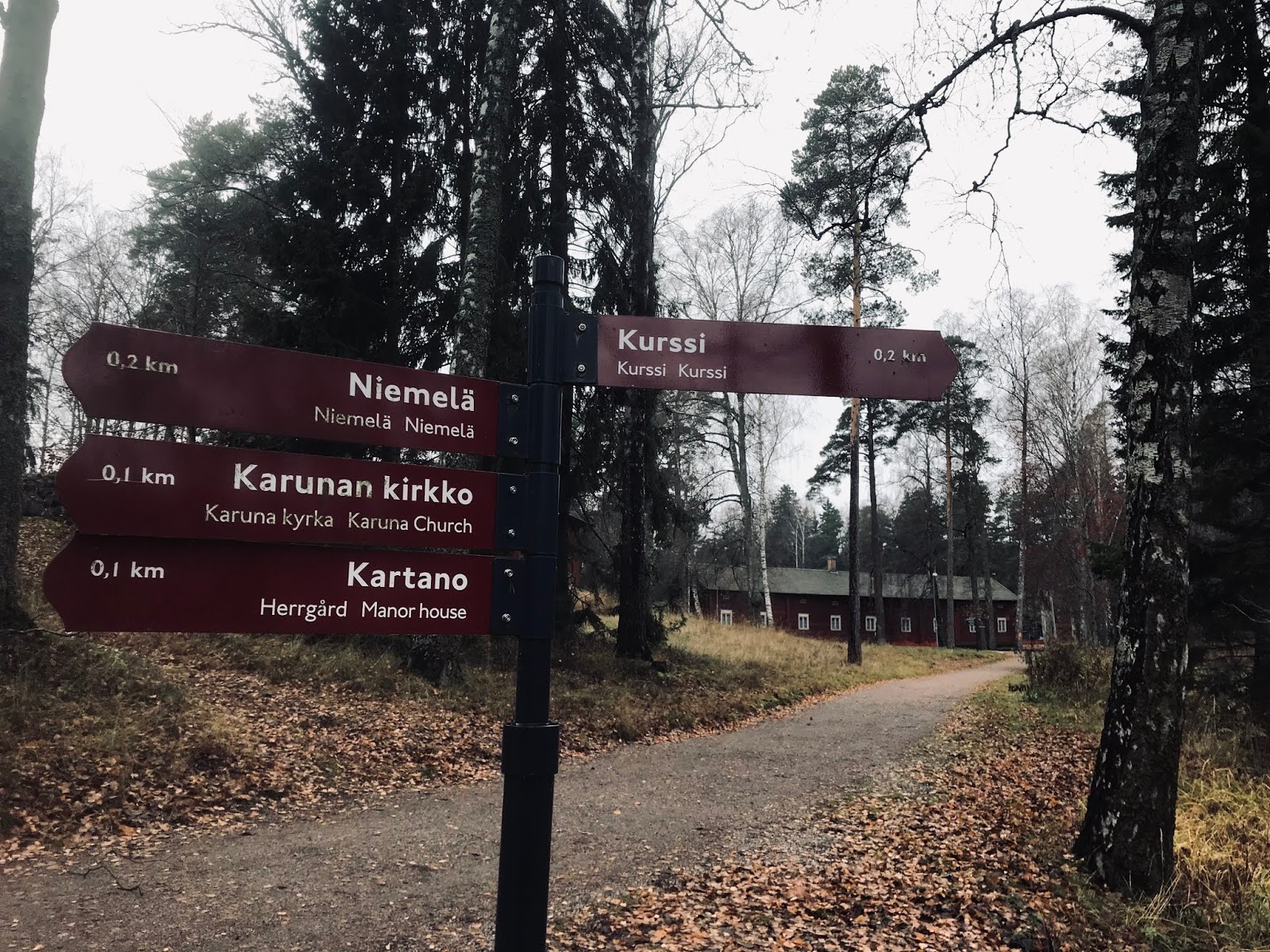
Before I sign off I'll leave you with one more picture. But first a little background. Finland is famously a bilingual country. Equal status is given in law to Finnish (the majority language) and Swedish (at risk of losing its status as the second most widely spoken language in the country). Street signs, public buildings, instructions etc are all printed with both languages on them. Usually Finnish is first, but driving through the country you might notice the order changes to Swedish first where native Swedish speakers are in the majority. All seems right and proper. Place names often look different - they might be translated from one to another literally with the words being very different in each language (karhu and bjørn for 'bear' for example). Even when one language uses the 'same' word they look different because of the way they are said by native speakers and are then written down (e.g. Swedish 'gate', street, becomes Finnish 'katu'). Instructions can be even more different - the grammar is TOTALLY different. So it makes sense to have things in both languages. In those cases. Since I first started going, English has become much more visible, and signs can often be in all 3 languages. The Finnish civil service is to be greatly admired for its dedication, efficiency and even-handedness, and it will not be diverted from its mission. It is therefore capable of producing masterpieces like this: