Ever get the feeling you’ve been out-geeked?
http://www.alternativefinland.com/kuivasaari-coastal-artillery-fortress/
Ever get the feeling you’ve been out-geeked?
http://www.alternativefinland.com/kuivasaari-coastal-artillery-fortress/
First Half
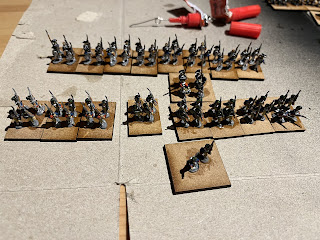
I finished the latest batch of AWI figures. Ahead of schedule too. The Germans and Rebels have now been painted, based, flocked, flagged* and magnetised, and they are now sitting in their Ferrero Rocher boxes.
* Not the Germans. I don't have any flags for them but I have a plan.
Pics below are all pre-flag and magnet.
 |
| Jägers |
 |
| Americans |
 |
| German line and grenadiers |
The collection now musters the following:
4 Continental regiments
3 Militia regiments
1 Rifle regiment
3 6-pounders (can be either side)
1 British Light battalion
2 British Line regiments
1 German Grenadier battalion (small)
1 German Musketeer battalion
1 Jäger battalion
15 light dragoons await paint.
Half Time (Digression)
As I'd run out of superglue and didn't want to put off finishing the basing, I glued the last couple of units to their bases with PVA. I don't think all are very secure in position. I expect one or two might prove to be 18th century ancestors of my brother's famous Subbuteo player from the early 1970s, Sir Stanley Dropbottom. The figure of Sir Stanley slotted into his plastic base, but unlike his teammates at Portable Rovers, he wasn't glued firmly in place. As a result, when flicked, he was wont to fly off in one direction, his base in another and the ball in yet a third, and entirely unpredictable direction. This made him no longer suited to an attacking roll, and Stan saw out the final years of his long and distinguished career in front of the defence. Sadly no photos of Sir Stanley exist now, but I was able to find the picture of his Scottish cousin below.
 |
| Sir Stan played in 'Everton-style' blue back in the early 70s. Cousin Jimmy McDroperse is seen here in Celtic colours. |
When the club chairman/manager/striker/fanbase lost interest in what today would be called 'the project', the hallowed turf of Portable Road was torn up and was used as a battle mat by the chairman's younger brother. But legends never die. Years later at Blundell Park, a cry of 'Sir Stanley Dropbottoooom!' would go up if a ball went at right angles to the kicker's intended direction.
Second Half
Earlier this evening I listened in on the Helion 'virtual book launch' for Don Hagist's These Distinguished Corps, and very interesting it was too. The subject of the book are the British light and grenadier battalions of the War of Independence, with the author taking a ground-up, very granular approach. He explained he likes to find out about the individual soldiers and their experiences. One very useful type of document he cites are the records of soldiers' pension petitions, as these set out the men's career paths, origins, trade, and injuries. The book also explains the method of fighting adopted by the light and grenadier battalions. I'm very tempted to get this.
https://www.helion.co.uk/book-launches.php?sid=67feff39f211d876fc9c4d0c5c07a251
The author also runs a blog specifically about the British ORs, which I have jumped into yet:
Inspired by Steve’s Hubbardton posts on Sound Officers Call, I ordered some German infantry (grenadiers, musketeers and jägers). Naturally being a very balanced sort of person (‘a chip on both shoulders’ I hear someone say) I evened things up by ordering more Continentals (cocked hats and caps) and militia.
 |
| The hated mercenaries. Booo! |
 |
| The King’s ungrateful rebellious subjects. Where’s Christopher Walken when you need him? |
The painting stage is over. Most have been based. Not all, because I ran out of superglue, most of it ending up everywhere but where it was needed. I managed to glue my fingers to the glue tube, and figures to my fingers, but could I get all the little blighters stuck to the bases, upright, where I wanted them? Eventually yes. Eventually. I don’t have any finger prints at the moment though.
The Germans are in close order, 5 or 6 to a base, and the Continentals, like the British, in loose files at 4 to a base. Each base here representing a company sized formation. I’m deliberately using the term ‘German’ because at this scale, with my painting, they could be either Hessians or Brunswickers. No candy-striped pants. The models are actually Brunswickers from the Pendraken range, though I cannot discern any difference in the catalogue.
Rather conveniently, the Pendraken pack size (30 figures), padded out with NCOs from the command packs, is enough for a battalion. To that I add a command group on square bases.
Awaiting basing are the Jägers and militia. I experimented with grey acrylic spray primer for the Americans. Not sure I like it, though it did give better coverage than the black.

So on to the game. Played this afternoon and evening in two parts with a break for dinner and Around the World in Eighty Days. The account is given below in photos.
 |
| Prussians to the right, main Austrian position to the bottom left, Saxons and more Austrians to the top left. I decided to start with the Prussians across the Striegauerwasser, and with the Allies already out of their camps. |
 |
| The Saxons. The village of Pilgramshain to the right and the area of boggy land known as the Gule in the rear. |
 |
| The min Austrian infantry with the low ridge and Thomaswaldau in the foreground. |
 |
| The Austrian right wing seen from across the Striegauerwasser. Thomaswaldau on the ridge in the background. |
 |
| Prussian cavalry of the left wing form up having crossed the stream. |
 |
| Having driven off the Allies left wing of cavalry the Prussians (above the blue line) are beginning to feed troops to the flanks. They are particularly needed to re-inforce their left (right of the picture) where the Austrians have the stronger cavalry force. |
 |
| The Prussians have gained an overwhelming advantage on their right, with just a sole Austrian cuirassier brigade left (centre of picture). |
 |
| Austrian infantry advance onto the low ridge. |
 |
| The cavalry action between Thomaswaldau and Halbendorf. Ebb and flo was the order of the day. The Prussian wing would eventually be the first to break, taking Ziethen with it. The Prussians needed the Bayreuth dragoons on this wing (they are fighting Austrian cuirassiers upper left) so no heroic charge against the infantry this time. |
 |
| A more general view round about the same time. Prussian cavalry squeeze the last of the Saxon cavalry (the Uhlans) from two directions whilst infantry pin the Saxon grenadiers in Pilgramshain. Meanwhile Frederick's bluecoats march slowly in the centre. |
 |
| As above but from behind the Prussian positions. |
 |
| The first wing has broken! And it's the Allies left. The one unit left here are Austrian hussars sent from the centre to try to slow up the Prussians. |
 |
| Back to the Austrian right flank. Having seen off the Bayreuth Dragoons (and a cuirassiers brigade before that) the Austrian cuirassiers have turned to tackle a Prussian cuirassier brigade. By the village at the top several lines of Prussian cavalry remain. But each has suffered losses already..... |
 |
| Heavy going for the Prussians in the centre. |
 |
| And there we have it! The Prussian left wing cavalry has had enough and beatled back across the bridges whence they came........ |
 |
| But a moment later the morale of the Austrian cavalry on this wing has also collapsed. They decide that they have done enough for the Empress-Queen today. |
 |
| Prussian horse and foot stream to the south to crush the Austrian centre. With no cavalry left, bar one brigade of hussars, for Charles of Lorraine the day is lost. Frederick has shown that once he has his hands on Silesia, it is going to take a lot to wrest it back off him. |
 |
| The Reckoning |
Once again, Twilight of the Soldier Kings proves that it fairly trips along. This was by far the largest battle I have gamed with these rules (twice the number of units as Kesselsdorf) and yet it only took 3 1/2 hours. Even with a slow start re-reading sections of the rules. It was a convincing win for the Prussians, as it was historically, although the Austrian right wing was engaged before the Saxons were beaten. Also the Austrians did better on their right than they did historically. Without holding off until more help arrives, the Prussian cavalry on that wing need a lot of luck to win in this game. On the other flank a clear advantage in cavalry for the Prussians was telling. It was probably a mistake on my part (acting as Frederick) not to send more cavalry to the Prussian left right from the start. It was so close and the Prussians were perhaps a little bit lucky not to fold sooner on their left.
This is a very challenging battle for the Austro-Saxons. The numbers of units that I came up with show a much more balanced number of troops than traditional accounts, and the Prussians have the edge in quality of infantry having many more grenadiers. To add to the Allies woe, the Saxon foot is rather poor. At the last minute I reduced the number of Prussian artillery brigades from 3 to 2, with one being large, to reduce the overall advantage. It's hard to see how the Allies can win this.
Before the big battle here is some context.
 |
| As the Allies leave the safety of the border hills, Frederick marches at speed to intercept them. Prior to this he had fined weakness to tempt Charles of Lorraine to make his move. A strategem that inspired Napoleon in the Austerlitz campaign. |
 |
| The German General Staff map. Prussians in blue, naturally. |
 |
| The battlefield today. Apart from the growth of Stzegom (Striegau), the settlement pattern looks unchanged from the General Staff map. Note the long, strung-out villages. |
 |
| The approximate positions of the armies superimposed on the preceding map. Names of the villages and the river added in German. The black ovals indicate higher ground. They permit guns sited on them to fire over the heads of intervening troops but otherwise only act to block line of sight. |
Right, since my last post on the matter I've managed to scrutinise the German General Staff map* and having obtained a copy of Duffy's the Army of Frederick the Great, I've cobbled together an order of battle based on the maps; and converted that to 'brigades' for Twilight of the Soldier Kings ('TOSK'). And I'm actually content with it. Finally.
The German General Staff map names all the regiments (of all three armies). I was able to cross-reference these against the army lists in the Army of Frederick the Great and the Army of Maria Theresa, to confirm which cavalry units were which type (cuirassier, dragoon, chevauxleger, hussar). The infantry was more straightforward to determine which were combined grenadier battalions/guard and which were ordinary musketeer/fusiliers.
 |
| The southern half of the battlefield. These maps really are beautiful. |
If you want to cut to the chase and avoid the waffle you can jump straight to the table below.
* admittedly this is a secondary source, produced 140 years after the event.
A note on names/language.
The town of Striegau (top right in the above map) was the point around which the Prussians orbited on their way to confront the enemy. The Saxons referred to the battle as Striegau and not Hohenfriedberg, which is off to the south west on the map below.
The region this was in, Silesia**, is now mostly in Poland. At the time it was a newly-acquired part of the Prussian state, passing via the German Empire into Polish control after WWI, and then again after WWII. Consequently Hohenfriedberg became Dobromierz and Striegau, Strzecom.
** Schlesien in German; Śląsk in Polish; Schläsing in Lower Silesian; Ślōnsk in Silesian.
Before becoming Prussian, it was part of the Habsburg realm. Before that it was part of the Kingdom of Poland. It seems like it's gone full circle.
Throughout I've used the German names, simply because they're the ones I'm more familiar with, and easier for me to say. Or rather, I probably pronounce them less incorrectly than I would the Polish names. Whilst in this period large numbers of inhabitants of Silesia spoke Lower Silesian (a German dialect), many spoke Silesian (a west Slavic language). What they called the towns and villages, I have no idea - NOT necessarily the same as the modern Polish names.
First some caveats.
(1) The number of Prussian squadrons.
I've assumed all cuirassier and dragoon regiments were at their complement of 5 squadrons apiece. Except the Garde du Corps (CR13) which I believe had only 1 squadron at this point, and it certainly looks that way on the map.
The hussars are not so straightforward. The size of the blocks on the map are the same size as the heavy cavalry. I've therefore assumed 5 squadrons apiece, except for Ziethen's regiment (HR2) which looks like it had the full complement of 10.
(2) The number of Austrian squadrons.
I've assumed all dragoons and cuirassiers were at 6 squadrons each. Hussars are not shown on any map. They don't appear to have been expected to take part in the main cavalry action in that period. Duffy says there were about 2,500 hussars and 'Croats' (i.e. Grenzers/light infantry) so I've assumed a 50:50 split. This equates to one 'brigade' of hussars in TOSK.
(3) 'Croats'
I've assumed 1/2 of the above mentioned light troops were 2 or 3 battalions, and converted this into 1 'brigade'. They'll sit somewhere in the centre, at the back with the Austrian hussars.
(4) Saxons
I can make out most of the names of the cavalry regiments and cross-reference these against Pagan apart from 3 names in the main line and two 'blocks' off to the left of the line. Pagan states that there were 4 squadrons of Karabiniersgarde, 12 of cuirassiers, 4 of chevauxlegers, 4 of dragoons and 22 companies of uhlans.
Apart from the Karabiniere most heavies were on a strength of 2 squadrons. The units I couldn't make out could therefore be 1 regiment of cuirassiers and 2 of dragoons. The second line of the detached block looks like it could be '5 pulks uhlans', a pulk being a Polish*** for a regiment. On the basis of this I've allocated the Saxons 2 brigades of cuirassiers, 1 of dragoons****, and 1 of uhlans.
For the infantry I've allocated 4 line brigades for the 18 battalions (with 1 being large), and 1 for the 18 companies of grenadiers.
*** the Elector of Saxony at the time of Hohenfriedberg was also King of Poland. This put him on the same level as the other Elector-King, Fredrick II, which probably irked Old Fritz no end.
**** The Chevauxlégers don't seem to have worn the cuirass and the troopers were referred to as 'dragoons', so I've assumed they're the same tactically.
General notes (not notes for Generals).
For the Prussians and Austrians I've allocated 1 brigade per 2 regiments of cavalry/10 or 12 squadrons, or 4 battalions of infantry. It doesn't always work out neatly in terms of which wing they were in so there's a certain amount of fudging. TOSK allows for normal, large and small brigades in any case.
Where there are different types of horse or foot interlaced (e.g. a dragoon unit between cuirassiers) I've moved them around to 'neaten' things up. In TOSK you can have mixed quality units, where you dice on first contact to determine which prevails, but I like to keep it simple for solo play. I've been more generous with the Saxons giving them a brigade for every 8 squadrons of heavies.
The General Staff map clearly marks each of the infantry unit blocks (is there a special term for these?) with those little sticks, one for each battalion. Thus it is easy to see which of the Austrian regiments has 2 and which has 3 battalions. For the Prussians incidentally only the regiment of Alt-Anhalt (IR3) had 3 battalions at Hohenfriedberg, and the Grenadier Garde (IR6, or Potsdam Grenadiers) had just the one. The Garde (IR15) are shown as having 2 of the 3 battalions present. All the rest of the Prussian infantry were on an establishment of 2 battalions.
Brigades for Twilight of the Soldier Kings.
Surprisingly the opponents were evenly matched in terms of numbers of men and units. 136 squadrons Prussians (more than Duffy but not as many as Chandler) versus 125 Austro-Saxons (counting an Uhlan company as 1/2 a squadron). The infantry faces off at 69 Prussian battalions against 71 Austro-Saxon battalions.
The Prussians have a slight edge in cavalry numbers, but the Allies have more cuirassiers. The Prussians have a distinct qualitative edge in infantry, and more heavy guns. Light pieces are not classed as game pieces in TOSK.
Total Brigades | ||
Prussians | Austro-Saxons | |
Cuirassiers | 5 | 7 |
Dragoons | 5 | 3 |
Hussars | 3 | 1 |
Uhlans | 0 | 1 |
Garde/Grenadiers | 5 | 2 |
Musketeers | 12 | 15 |
Croats | 0 | 1 |
Heavy Guns | 3 | 2 |
33 | 32 | |
In terms of the overall numbers of men engaged, this seems bout right. The Prussians had more cavalry and the Allies had more infantry. Fuller detail is shown below, including the split between the different wings.
I need to allocate subordinate commanders to each army.
Next Step
Next on the agenda is to work out a way of creating a game that reflects the semi-encounter nature of the battle. The whole field can be contained within an area of 3 miles by 4, or about 108 x 132 centimetres, if I use the German General Staff map.
 |
| Maybe I should just go with this layout |
The full OOBs.
The regimental designations were only given much later after the war, and contemporaries used the Inhaber's name (i.e. the Colonel-Proprietor). 'Bde' refers to Twilight of the Soldier Kings game units.
Desig | Sq | Bn | Cav. Bde | Inf Bde | Artillery Bde | Remarks | |
Prussian OOB | |||||||
Right Wing | |||||||
Natzmer | HR4 | 5 | 1 | Large | |||
Reusch | HR5 | 5 | |||||
Suldan | HR6 | 5 | |||||
Garde du Corps | CR13 | 1 | 1 | 1 small elite | |||
Gensd’armes | CR10 | 5 | |||||
Buddenbrock | CR1 | 5 | 1 | ||||
Prinz v.Preussen | CR2 | 5 | |||||
Leib-Karabinier | CR11 | 5 | 1 | ||||
Kyau | CR12 | 5 | |||||
Möllendorf | DR6 | 10 | 1 | ||||
Possadowsky | DR1 | 5 | 1 | ||||
Wurttemburg | DR2 | 5 | |||||
Grenadiers | 12 | 3 | |||||
Holstein-Beck | 11 | 2 | 1 | ||||
La Motte | 17 | 2 | |||||
Alt-Anhalt | 3 | 3 | 1 | ||||
Prinz Moritz | 22 | 2 | 1 | ||||
Hesse-Darmstadt | 12 | 2 | |||||
Hautcharmoy | 28 | 2 | 1 | ||||
Polenz | 4? | 2 | |||||
Kalckstein | 25 | 2 | 1 | ||||
Lehwald | 14 | 2 | |||||
Artillery | 2 | ||||||
Centre | |||||||
Alt-Wurttemburg | DR11 | 5 | 1 | ||||
Nassau | DR12 | 5 | |||||
Bronikowski | HR1 | 5 | 1 | ||||
Hallasz | HR7 | 5 | |||||
Truchess | 13 | 2 | 1 | ||||
Markgraf Karl | 19 | 2 | |||||
Garde | 15 | 2 | 1 | Small | |||
Grenadier Garde | 6 | 1 | |||||
Hacke | 1 | 2 | 1 | ||||
Blanckensee | 23 | 2 | |||||
Bevern | 7 | 2 | 1 | ||||
Schlichting | 2 | 2 | |||||
Dohna | 4? | 2 | 1 | ||||
Alt-Schwerin | 24 | 2 | |||||
Du Moulin | 37 | 2 | Fusilier | ||||
Borcke | 29 | 2 | 1 | ||||
Jeetze | 30 | 2 | |||||
Bredow | 21 | 2 | 1 | ||||
Hertzberg | 20 | 2 | |||||
Bonin | 5 | 2 | 1 | ||||
Anhalt-Zerbst | 8 | 2 | |||||
Grenadiers | 5 | 1 | |||||
Artillery | 1 | ||||||
Left Wing | |||||||
DR5 | DR5 | 10 | 1 | Bayreuth | |||
CR8 | CR8 | 5 | 1 | ||||
CR9 | CR9 | 5 | |||||
CR4 | CR4 | 5 | 1 | Large | |||
CR5 | CR5 | 5 | |||||
CR7 | CR7 | 5 | |||||
DR3 | DR3 | 5 | 1 | ||||
DR4 | DR4 | 5 | |||||
HR2 | HR2 | 10 | 1 | ||||
Prussian Totals | 136 | 69 | 13 | 17 | 3 | ||
Austrian OOB | |||||||
Right Wing | |||||||
Hohenembs | CR4 | 6 | 1 | ||||
K.St Ignon | CR22 | 6 | |||||
J.Pálffy | C27 | 6 | 1 | ||||
Diemar | C33 | 6 | |||||
Bernes | C21 | 6 | 1 | ||||
F.St.Ignon | C12 | 6 | |||||
Liechtenstein | D6 | 6 | 1 | ||||
Preysing | Dii | 6 | |||||
Wurttemburg | D38 | 6 | 1 | Large | |||
Philipert | D37 | 6 | |||||
Althann | D1 | 6 | |||||
Centre | |||||||
1st line | |||||||
Franz Lothringen | IR1 | 3 | 5 | ||||
Alt-Königsegg | IR54 | 3 | |||||
Hessen-Kassel | IR37 | 3 | |||||
Thüngen | IR57 | 3 | |||||
Grünne | IR26 | 3 | |||||
Maschall | IR18 | 2 | |||||
Baden-Baden | IR23 | 3 | |||||
2nd line | |||||||
Karl Lotharingen | IR3 | 3 | 3 | 1 large | |||
Harrach | IR47 | 2 | |||||
Neipperg | IR7 | 2 | |||||
Leopold Daun | IR59 | 3 | |||||
Kollowrat | IR17 | 3 | |||||
Hussars | HR24 | 1 | |||||
Croats | ? | 3 | 1 | ||||
Artillery | 2 | ||||||
Left Wing | |||||||
Grenadiers | N/A | 4 | 1 | 16 companies | |||
1st line | |||||||
Vettes | IR34 | 3 | 3 | ||||
Botta | IR12 | 3 | |||||
2nd line | |||||||
Gyulai | IR51 | 4 | |||||
Browne | IR36 | 2 | |||||
Cavalry | |||||||
Birkenfeld | CR23 | 6 | 1 | ||||
Czernin | CRiii | 6 | |||||
Lucchesi | CRii | 6 | 1 | ||||
K.Pálffy | CR8 | 6 | |||||
Saxon OOB | |||||||
Infantry | 18 | 4 | Inferior, 1 large | ||||
Grenadiers | 1 | 1 | 18 companies. Standard/trained | ||||
Cavalry | |||||||
Königlicher Prinz | CR2 | 2 | 2 | ||||
Maffei | CR3 | 2 | |||||
Garde Karabinier | GC | 4 | |||||
O’Bryan | CR5 | 2 | |||||
Gersdorff | CR8 | 2 | |||||
Haudring | CR4 | 2 | |||||
? | CR? | 2 | |||||
? | DR | 4 | 1 | ||||
? | CLR | 4 | |||||
Uhlans | 11 | 1 | 22 companies (Fahnen) | ||||
Allied Totals | 125 | 71 | 12 | 18 | 2 |
