Sunday, 27 July 2025

Wargaming Rabbit Holes

Your friend and mine, The Jolly Broom Man recently wrote about wargaming rabbit holes after he disappeared down the warren that is the Hundred Years War. I was listening to Cavalier Cast (a podcast about the Wars of the Three Kingdoms) and came across an episode about Powick Bridge. The guest, John Spiller, had done research on the battle which overturned the standard narrative promoted by Clarendon.

John, a native of Worcester, said his research into this particular encounter started as an offshoot of a lockdown project to create a wargame of Powick Bridge. At the end of the podcast, the pod presenter, Mark Turnbull asked John what happened to the original war-game project. In true wargamer style, that didn't get off the ground due to said rabbit hole.

Tuesday, 15 July 2025

Summer in SW London

As mentioned in the last post, things have been pretty quiet on the wargaming front at the Schloß in recent months. Partly this was due to trips and fluctuations in the population of the Schloß. Most of the time the household consisted of just 3 of us since #4 was at uni.

In May the eldest decided his sojourn in Liverpool was over and he agreed with his boss that he could work remotely from London pending a possible transfer to another office. The most obvious option for his temporary accommodation was ruled out for reasons I'll pass over, so the second most obvious option was chosen. Yours truly dutifully drove to Liverpool to bring #1 and his stuff back down south. As #4 was still away at uni he was able to use her room for a few weeks. So population increased to 4. A period extended by #3 and #4 joining us in Spain once uni was over. Once we returned the population was up to 5 for a few weeks.

Then when #1 had secured a room in a shared house, we were down to 4. Until the BF of #4 turned up from darkest Yarkshire. Population briefly back up to 5. Then when they tootled back up north to move their gear into their respective new digs (digses?) we were back to 3 for a few days. Now back to 4 since she returned.

Phew!

Now I've been doing a bit of pootling about during this time, with the odd park walk, lunchtime strolls whilst on office days and a trip to the local museum. Not forgetting wasting time in the garden. And last but not least, a sporting excursion that I've not got around to doing in my previous plenty-two years.


Entrance to an old canal by Chelsea Waterworks. I believe the canal once went up to where Victoria station is. But in my mind's eye this looks like Early Modern artillery fortification.

Slightly further upstream it distinctly looks like a bastion has sprouted on Chelsea Embankment.

Nearer to home I went to the Kingston Museum for the first time. 31 years after moving to the area. I wasn't expecting much beyond a collection of buttons or some such things, and hoped for some old photographs so I could get an idea of what the specific area I live in looked like before being built up in the early 20th century. It was much better than I expected. And free to enter.


'Wasting time' in the garden one evening after eating outdoors I started looking closely at some plants which were covered in a wide variety of insects. These ones were tiny as the flowers in question are on mint. It's been a great year for pollinators. The Margravina has made a conscious effort to attract them, showing her concern for the betterment of agriculture and the lot of the peasantry. 

Lots of time spent photographing the lavender. And failing to get good close-up video footage of the bees.


Stained glass windows at the museum


Thames Watermen uniforms

Model of Kingston town c 1820 I think

Another model, similar period, with town centre pubs shown. More than there are today with a much bigger population!

A section on the aero-engineering industry that was formerly in the town. Sopwith and then Hawker being the main names. 


Not sure how much this had to do with the military preparations of both sides in the run-up to civil war, but it looks like it could be part of developments which led to Parliament trying to exert control over the Trained Bands.

There was a section on Eadweard Muybridge, local chap who developed some of the first moving pictures technology. I'm sure he took these pictures of a nudey lady purely in the interests of science.

Upstairs had an exhibition on the Interwar period when much of the suburban development occurred 


Slightly later: Noel Coward waxing lyrical about the Kingston Bypass1

The 'motoring culture' referred to included a piece about John Cooper (another local lad, motor racer and car designer) of Mini Cooper fame.


And my little sporting trip was to watch cricket for the first time (not counting village games).  The T20 match at the Oval for the game between Surrey and Glamorgan.

The famous gasometer is off to the left. I didn't get a good shot of it.

As the floodlights came on it was possible to see that they were designed to look like the Prince of Wales feathers. (The ground was built on land owned by the PoW).

An exciting game that started off very badly for Surrey. Glamorgan batted first and ran up a decent score, and then when Surrey came in they quickly lost 3 wickets with, more importantly, a very low run rate. But they managed to stabilise things and with needing 5 runs off the last over, they got a 6 with the first ball.

I must say, I didn't enjoy the very random selection of music clips played by the 'DJ' whenever there was a boundary or wicket or halt in play. But we had a good time. I might look into going to a 'proper' county game sometime.


Monday, 14 July 2025

3 Civil Wars

It's been pretty quiet on the wargaming front recently, apart from participating in one of Jonathan Freitag's Mortimers Cross games. You've probably already seen the AAR on Jon's blog, but if not I recommend having a read.

Screenshot of one of the early turns. Lancastrians in the foreground.

End of the road for the Yorkists


Anyway, back to Spain. My son reawakened a dormant interest of mine a few week back when he gave me the book below for Father's Day. I started reading it about a week ago (it's a big book). I'm currently 18 chapters in out of 52. I don't know how it stacks up in historiographical terms, but I'm enjoying reading it. It certainly doesn't pull any punches.

Early on fellow Grimbarian Tom Wintringham popped up (we're a Bolshie lot). Interesting bloke, being an early advocate for setting up the Home Guard (as in 1938 earl). https://en.wikipedia.org/wiki/Tom_Wintringham

Wintringham is in the middle, looking a bit like Mr Lah-di-dah Gunner Graham with his 'Huniversity Heducation'. "It Ain't Half Hot Mum" reference.

Oh, and the third civil war is the one we had over here in the 17th century. Ralphus of the Wars of Louis XIV blog has flagged up another worthy listen. Cavalier Cast. Here's the Podbean website for an episode they did on wargaming the Civil War. https://www.podbean.com/media/share/dir-nbkgv-1802ea54 And while I'm on the Pike and Shot theme, here's an excellent episode of Citizen to Soldier podcast https://www.podchaser.com/podcasts/the-citizens-to-soldiers-podca-5889375/episodes/episode-8-patrick-wyman-on-rai-230406209 They mostly cover contemporary military matters but now and again they delve into history.

Wednesday, 11 June 2025

Soldier of Spain

Inspired by a post a few weeks back on the Wars of Louis Quatorze blog, I sourced the first 3 books in the Captain Alatriste series by Arturo Pérez-Reverte as holiday reading. I only took 2 of the 3 and wish I’d taken them all.

I’d seen the film with Viggo Mortensen and the books certainly didn’t let the side down.

The stories are in the mould of the Musketeer stories of Dumas (though I haven’t read any of the latter), but certainly compared to the films are darker and more ‘adult’. They mix fictional and historical characters and episodes like McDonald Fraser’s Flashman (but without the comedy and footnotes). The cover art on the two volumes I read remind me adventure novels published in the last century and are not good representations of the contents IMO.


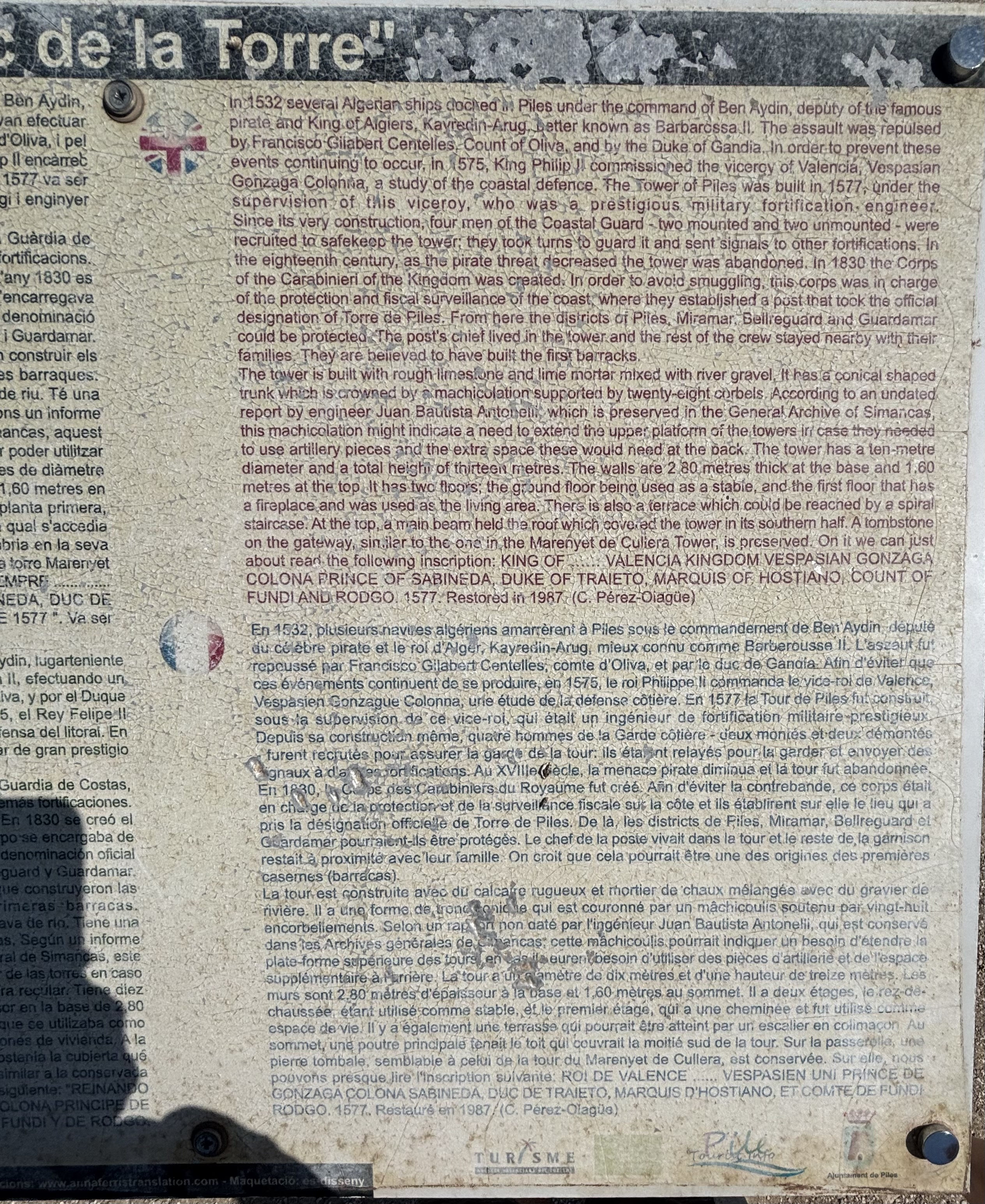
Sort of contemporary to the novels. 16th C built coastal watchtower near the town of Piles in Valencia province.

Information board for the tower in Valencian, Spanish, and English & French below.


Not high literature but not trashy either.

Right, I’m off to think about using my ECW armies for the battle of Rocroi. 😁

https://en.wikipedia.org/wiki/Captain_Alatriste

Saturday, 7 June 2025

Only mad dogs…and inspirations

Jonathan Freitag’s recent post got me thinking about sources of inspiration for me as a wargamer. One of my top sources is printed matter. I actually commented to Jon’s post that I didn’t really count magazines these days amongst my sources. Gone are the days of MW and WI in what for me was their heyday in the 80s and early 90s. But then I looked at this photo I took of a history magazine in a supermarket in an obscure Spanish town.


The article is about a book on Spanish soldiers in the British Army in WWII. The author gave a talk at the National Army Museum a few months ago (which I attended with David-in-Suffolk). The picture of the volunteers on the truck is similar to ones that got me interested in the SCW 45 years ago. But that is not a wargaming itch that I have scratched yet.

The same magazine also had an article on the Battle of the River Ter (or Torroella) in 1694. I passed on buying the magazine but I’m thinking that was a mistake, even though my Spanish is fledgling to say the least. 

As with the previous article, it’s the imagery that captures my imagination. At least at first. What about you? Is it words, pictures (still or moving) or sounds that spark your urge to wargame a conflict?

As for the mad dogs reference: the Margravina (who is most definitely not an Englishman) persuaded me to take a walk in to said town when most sensible locals were indoors behind closed shutters. The supermarket provided a welcome respite from the heat).


!Adiós!

Friday, 23 May 2025

Another podcast. And it's a goodie!

Thanks to Ralph's over at Wars of Louis Quatorze blog I've been enjoying a newish podcast these past few days. Prime and Load also here https://www.youtube.com/playlist?list=PLZnTpOagexNqE0wyla1BZwak37perxC0O

It concentrates on 18th century warfare in Europe and North America and is presented by familiar names: Doctors Alex Burns and Andrew Bamford, with Lee Gagino. Since launching in March 1/2 a dozen episodes have 'dropped' (as the young cool cats say). The ones I've listened to have been very good. Including the excellent episode released for the 250th anniversary of Lexington and Concord. It really deepened my sketchy knowledge of that encounter.

The reg'lars are comin.


"Hey Nathaniel. Ain't it strange how wherever we go these rocks and bushes seem to go too."
"Jus' quit your yacking Zeke and fill them lobsterbacks full o' lead".

That episode left me with the feeling that modern NATO soldiers on COIN operations must have a good insight into how the Redcoats felt on that fateful day. And of course, it set the mind racing on how it could be gamed. (I think Matt Crump and Jonathan Freitag did this a few years ago).

There are many podcasts claiming my attention these days (too many to keep up with), but Prime and Load has pushed its way tot he front of the queue.

No kings, no tyrants!

"You cannot be excused duty soldier. I don't care if your pop owns an inn on Long Island. What on God's green Earth are bones spurs anyway?!"


Tuesday, 20 May 2025

The Battle of Königgrätz, 1757

As mentioned in a previous post, Henry arrived outside Königgrätz where he discovered Serbelloni had arrived ahead of him. Circling the city around the north, having crossed the upper Elbe, he found that the Austrians were camped on the plateau immediately to his south.*

* This was all rather convenient because I found a map of the 1866 battle. In game terms it mattered not, but at least it was a map of the general area. And it gave the smaller Prussian force an opportunity to keep out of sight of the Austrian heavy artillery which had caused them problems in the battle at Jaromiersch.

Rather than decline battle, and risk some losses as he retreated back the way he came, Henry decided to stand his ground. He positioned his force behind the westernmost of the small hills. His infantry (1 brigade of fusiliers and 1 small brigade of musketeers) were behind the crest. A brigade hussars were on the infantry's right to threaten any Austrian attack that tried to come through the gap between the wood and the stream. A brigade of dragoons was on the low ground to the infantry's left to threaten any Austrians that tried to approach along that waterway that flows into the Elbe (bottom right). Two battalions of Freikorps infantry were available to move to either flank of the infantry should it be necessary.

Plan of the approximate positions and the advance of the Austrian army.

The Austrian army having got word of Henry's force, waited north of their camp. After cavalry vedettes reported no further site of the Prussians since they went behind the hills, Serbelloni ordered his army forward to deploy along the northern edge of the plateau.

The respective orders of battle were as follows.

Prussians (Prince Henry)

  • Infantry: 2 brigades (1 weakened by the recent action)
  • Cavalry: 2 brigades (1 dragoons, 1 hussars)
  • Freikorps: 2 battalions

Austrians (Count Serbelloni)

  • Cavalry: 4 brigades (2 cuirassiers, 1 dragoon, 1 hussar)
  • Infantry: 7 brigades (1 grenadier, 6 musketeer)
  • Artillery: 2 brigades of heavy guns

You can see why Henry chose to dispose his force in a Wellingtonian manner!

Serbelloni ordered his left wing of cavalry (1 cuirassier, 1 hussar) around the west of the wood. The infantry (2 lines of musketeers and a reserve of grenadiers) and the guns advanced in the centre whilst the right wing of cavalry (1 cuirassier, 1 dragoon) peeled off to the right.

As the infantry came down the slope they split into two wings - one heading towards the hill behind which were the Prussians, the other forming column diverged wide to the right, behind the cavalry. This all took some time for everything to get in position. When they did the Prussian dragoons caught the right wing cuirassiers before they could charge! The Austrians were pushed back and had to rally behind their own dragoons. The Prussian success was short-lived as the fresh Austrian dragoons got the better of the disordered Prussians. Following that, the cuirassiers were able to return to the fray whereupon they routed the Prussians!

On the left things did not go better for the Prussians. The Austrian heavies soon chased the Prussian hussars off. The Austrians now were threatening both flanks of Henry's infantry, and had their own infantry approaching the hill from the south. Returning to ease the pressure on their comrades, the Prussian hussars tried their luck again. They failed miserably.

In the course of seeing off the Prussian hussars, the Austrian left wing cavalry got too close to the Prussian Freikorps and took some casualties. But the end was approaching. The Austrian infantry on the hill was getting close, as was one brigade of guns. The infantry wing that had swept round the left flank of the Prussians were forming up on line. Both Austrian cavalry wings threatened the Prussian flanks. Henry tried a fighting withdrawal but it was to no avail. The Freikorps were routed by the Austrian left wing cavalry, and the Austrian right wing crushed the Prussian line from the other flank. Henry went down with his fusiliers. His small force ceased to exist.

The moth, drawn to the candle, got lucky once. But not twice. Once the Prussian cavalry wings were defeated the writing was on the wall. Serbelloni had his victory!

In a way, Henry was the victim of his own success. Down to 50% of his force, an Army morale test was taken, and passed. Twice. This meant the remaining units were cut down where they stood. Apologies, but I had no pictures from this game as I got caught up in the action.

The loss of so many men and the loss of his brother would come as a blow to the King after his victory outside Prague. Henry had fulfilled the brief set out for him tying up Serbelloni for so long, but would the cost be too great?